
Peking University's DyQ-VLA Cuts Robot AI Memory to 30% Without Losing Performance
DyQ-VLA uses real-time robot motion signals to dynamically switch precision, cutting memory to 31% while keeping 99.5% task performance
 Pro
Takeaways
- DyQ-VLA dynamically switches a VLA model's numerical precision step-by-step during robot execution, using the robot's own joint motion as a signal.
- It cuts peak memory to 30.9% of the original (15.2 GB down to 4.7 GB) while retaining 99.5% of full-precision task performance.
- Achieves 1.49x simulation speedup and up to 1.43x real-world speedup over the full-precision baseline.
- Two kinematic proxies -- Motion Fineness (r=0.90) and Angular Jerk (r=0.87) -- correlate strongly with quantization sensitivity, enabling real-time bit-width decisions.
- Weights are frozen at 4-bit; only activations switch dynamically between 2/4/8-bit and BF16 fallback, keeping memory bandwidth overhead minimal.
- No public code release yet; evaluated on OpenVLA + LIBERO benchmark and a physical 6-DoF robot arm.
Getting a robot to pick up a banana and drop it in a bowl sounds simple. But the VLA model controlling that arm is running billions of parameters, and every millisecond of inference delay is a potential failure. A new paper from Peking University and collaborators introduces DyQ-VLA, a dynamic quantization framework that watches the robot's own joint movements in real time and adjusts the model's numerical precision on the fly -- slashing memory use to just 30.9% of the original while preserving 99.5% of task performance.
The wall between lab robots and real robots
Vision-Language-Action models -- which take camera images and text instructions as input and output motor commands -- have become the dominant paradigm for general-purpose robot control. The problem is that these models are massive. State-of-the-art VLAs are typically evaluated on desktop-grade GPUs like the NVIDIA RTX 4090, which is not something you strap to a robot arm. A robot that takes two seconds to react is dangerous -- VLA inference must run at 30-100 Hz on hardware that fits inside or beside the robot, with bounded latency.
Quantization -- the process of representing model weights and activations with fewer bits (e.g., 4-bit integers instead of 16-bit floats) -- is the standard tool for shrinking models onto edge hardware. INT8 and INT4 quantization, weight pruning, and knowledge distillation let production policies run on Jetson Thor, Qualcomm RB6, and custom in-house silicon at single-digit watts. But for robots, static quantization has a fundamental flaw that nobody had properly solved.
Why "set it and forget it" precision fails robots
When you quantize an LLM for text generation, the sensitivity to numerical error is roughly uniform across tokens. Robots are different. A robotic arm sweeping across open space can tolerate sloppy math. The same arm inserting a peg into a hole cannot. The paper formalizes this as temporal-dynamic quantization sensitivity: the same quantization noise that is harmless during a coarse transit becomes catastrophic during fine manipulation.
The consequence for static quantization is brutal: you have to set your precision for the worst case -- the most delicate moment in the entire task -- and hold it there the whole time. DyQ-VLA is a dynamic quantization framework for real-time VLA edge deployment that leverages a sensitivity-aware switching strategy based on kinematic metrics to monitor temporal-dynamic quantization sensitivity. The key insight is that the robot already knows when it is doing something delicate: its own joint velocity and rotation data tell you.

Reading the robot's own body language
The team ran a careful profiling study on OpenVLA across the LIBERO benchmark. They injected 4-bit quantized actions one step at a time into otherwise full-precision trajectories and measured how much each injection hurt the final task outcome. The result confirmed the intuition: sensitivity spikes sharply during fine manipulation and stays flat during free-space movement.
The harder problem was finding a real-time proxy for that sensitivity -- something the system could read without waiting for the task to finish. The answer turned out to be two kinematic signals computed directly from the robot's joint state:
- Motion Fineness -- inversely proportional to translational speed. Slow, careful movements score high; fast sweeps score low. Tracks the macro-trend of sensitivity with a correlation coefficient of r=0.90.
- Angular Jerk -- measures sudden changes in rotational velocity between consecutive steps. Catches short-term sensitivity spikes with r=0.87 correlation.
Neither signal is sufficient alone. Motion Fineness is smooth but misses sudden spikes. Angular Jerk catches spikes but is too noisy on its own. DyQ-VLA fuses them with asymmetric time windows -- a wider macro-window for Motion Fineness and a tighter micro-window for Angular Jerk -- into a single unified sensitivity score S_t.

How the switching actually works
DyQ-VLA freezes model weights at 4-bit (INT4) permanently -- swapping weights dynamically would create memory bandwidth bottlenecks. What changes step-by-step is the activation precision, which toggles between 2-bit, 4-bit, 8-bit, and full BF16 depending on S_t. This is the W4AX paradigm (fixed 4-bit weights, dynamic X-bit activations).
The switching logic has two layers:
- Sensitivity threshold check: If
S_texceeds a critical thresholdθ_fp, the system immediately falls back to full BF16 precision for that step -- no questions asked. - Bit allocation module: If
S_tis below the threshold, an offline-calibrated lookup table maps the sensitivity score to the lowest bit-width that still keeps action error within a task-specific accuracy bound. The lookup is constant-time -- essentially free at runtime.
A hysteresis mechanism prevents rapid oscillation between precision levels. Upgrades (going to higher precision) happen immediately; downgrades require a stable confirmation window. This asymmetry protects against catastrophic failures from transient noise while still capturing efficiency gains during stable phases.
The entire dispatch runs asynchronously on the CPU while the GPU handles the visual prefill phase. The kinematic arithmetic takes under 0.5 ms and the memory overhead of the history buffers is under 64 KB -- effectively zero cost.
The numbers
Experiments ran on OpenVLA across four LIBERO task suites (40 tasks, 200 trials each) in simulation, and on a physical 6-DoF arm across three real-world task categories. Here is how DyQ-VLA compares to the full-precision baseline and the best static quantization competitor (QVLA):
| Method | Avg. Success Rate | Speedup | Peak Memory |
|---|---|---|---|
| FP Model (BF16) | 76.5% | 1.00x | 15.2 GB |
| SmoothQuant (W4A4) | 63.2% | 1.52x | 4.7 GB |
| QVLA (W4A4) | 76.0% | 1.47x | 4.3 GB |
| DyQ-VLA (W4AX) | 76.1% | 1.49x | 4.7 GB |
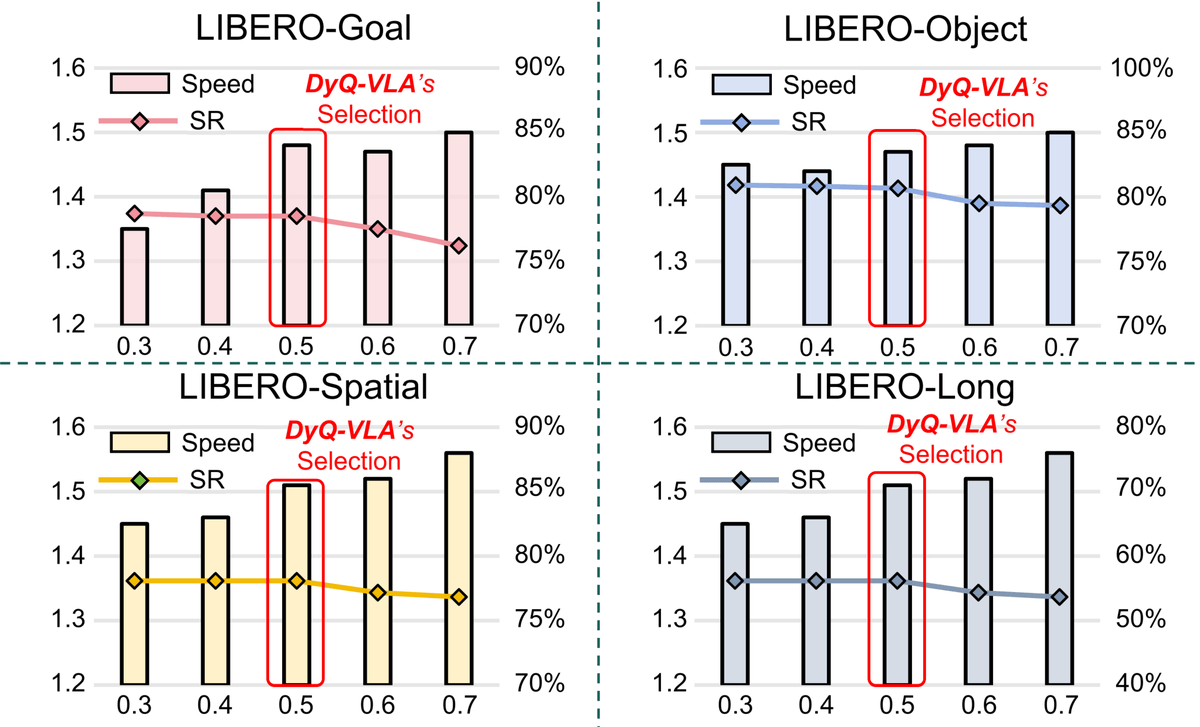
DyQ-VLA achieves speedups of 1.49x in simulation and up to 1.43x in the real world, requiring only 30.9% of the memory footprint while maintaining 99.5% performance. In real-world atomic grasping tasks, performance degradation was literally 0.0% compared to the unquantized model.
What makes this genuinely new
Prior VLA quantization work like QVLA allocated bit-widths at the channel level -- a one-time decision made before deployment. DyQ-VLA is the first framework to treat quantization as a closed-loop control problem, where the robot's physical state continuously informs the model's own computational precision. The kinematic signals are already being computed for robot control anyway, so there is no new sensing infrastructure required.
The design is also explicitly plug-and-play. It sits on top of existing static quantization methods rather than replacing them, and the authors validated it on a real physical robot with fine-tuning via QLoRA (Quantized Low-Rank Adaptation) to bridge the sim-to-real gap.
Limitations and what to watch
The current evaluation uses a single base model (OpenVLA) and a single benchmark (LIBERO). Whether the kinematic-sensitivity correlation holds across architecturally different VLAs -- particularly dual-system models that separate high-level reasoning from low-level control -- remains untested. The framework also requires an offline calibration step on representative trajectories to set the bit-width thresholds, which adds a deployment step for new tasks or environments.
No code or model weights have been publicly released alongside the paper. Given the system's plug-and-play framing and the active pace of VLA efficiency research -- with related work like KERV (kinematic-rectified speculative decoding) from the same group -- a release seems likely as the work matures. For teams building robot deployments today on constrained hardware, DyQ-VLA represents a concrete path to running 7B-class VLA models on commodity edge GPUs without the accuracy cliff that static quantization typically brings.