
Peking University's ColliderAgent Runs Full Particle Physics Studies Without Writing Code
ColliderAgent turns natural-language prompts into full high-energy physics workflows, wiring FeynRules, MadGraph, Pythia, Delphes, and MadAnalysis behind a hierarchy of Claude-powered sub-agents.
 Pro
Takeaways
- ColliderAgent is the first end-to-end language-driven agent for collider phenomenology, from Lagrangian to exclusion limits (paper).
- Five specialized sub-agents (orchestrator, model-generator, simulator, analyzer, pheno-analyzer) wrap FeynRules, MadGraph, Pythia, Delphes, MadAnalysis.
- Reasoning is decoupled from execution via Magnus, a containerized backend with SLURM support for HPC clusters.
- A validate-and-repair loop catches Hermiticity violations and UFO syntax errors before any expensive simulation runs.
- Reproduced literature results for leptoquarks, ALPs, Z' scans, and U1 mono-tau searches with detector-level ATLAS and CMS analyses.
- Code and skills open source at HET-AGI/ColliderAgent, portable to Claude Code, Cursor, and Codex.
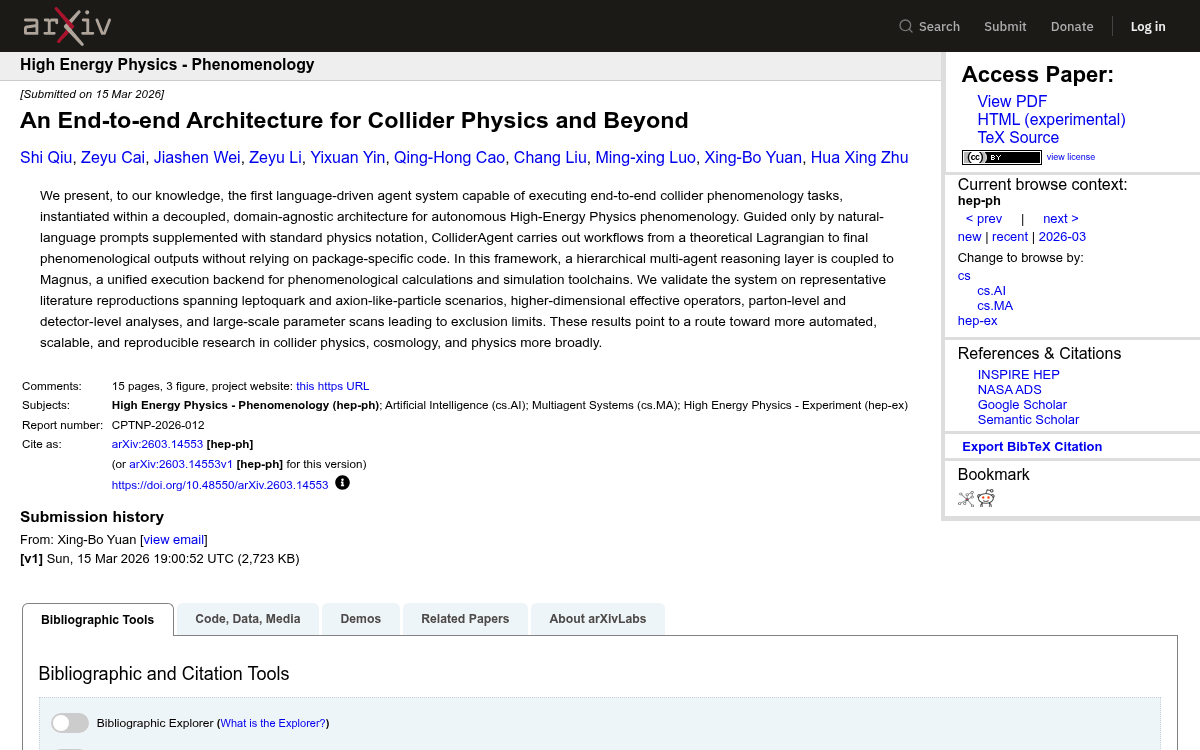
A team from Peking University and collaborating institutions has built what they claim is the first language-driven agent system that can execute an entire collider-physics study from a theoretical Lagrangian all the way to exclusion contours, without asking the user to write any package-specific code. ColliderAgent takes a natural-language prompt sprinkled with standard physics notation and orchestrates the messy heterogeneous toolchain that particle phenomenologists normally wrangle by hand.
If you have never touched high-energy physics (HEP) software, the pain point is easy to miss. A typical beyond-Standard-Model study means writing a Lagrangian in FeynRules, exporting it to a UFO model file, feeding that into MadGraph to compute cross sections, showering the events in Pythia, running detector simulation in Delphes, and finally reconstructing observables in MadAnalysis. Each of these tools has its own syntax, its own configuration files, and its own dependency mess. The manual orchestration of heterogeneous toolchains has long been a major bottleneck in the field.
Why previous automation attempts fell short
Existing automation frameworks tend to streamline only selected stages of these workflows, and recent agent-based studies have addressed parts of HEP pipelines but not the full chain from a theoretical Lagrangian to final phenomenological outputs. ColliderAgent is the first attempt at closing that loop end-to-end, and it does so with a deliberately decoupled design that separates reasoning from execution.
The architecture: reasoning on top, execution underneath
The system splits into two layers. On top sits a hierarchical multi-agent reasoning engine that reads the user's prompt and dispatches work. Underneath sits Magnus, a unified execution backend that actually runs the physics packages inside containers. Magnus is organized around three layers: an execution layer that runs containerized jobs with filesystem isolation and image caching; a sedimentation layer where Blueprints and Skills form a directed knowledge graph; and a collaboration layer for shared governance.
The reasoning layer is implemented on top of Claude Code, built on the Claude Agent SDK, and organized around five specialized sub-agents:
- orchestrator: decomposes the user request into subtasks
- model-generator: turns a LaTeX Lagrangian into a validated FeynRules
.frfile, then exports it to UFO format - collider-simulator: writes MadGraph scripts and cards, runs parton-level generation, showering with Pythia, and detector simulation with Delphes
- event-analyzer: performs cuts, cutflows, and histograms in MadAnalysis
- pheno-analyzer: handles downstream inference like profile-likelihood fits, exclusion limits, parameter scans, and plotting
Each sub-agent is powered by an Agent Skill, a lightweight directory containing a machine-readable SKILL.md file together with reference documents and templates that specify trigger conditions, expected inputs and outputs, workflow guidance, and example invocations. That skill abstraction matters because it makes the whole system portable. The same skills can be used directly by other coding agents including Cursor and Codex.
The self-correction loop that makes it usable
The most practically important piece is not the agent hierarchy but the validation loop wired around model generation. Building a FeynRules model by hand is error-prone, and a broken model file causes silent failures deep in the pipeline. Before any expensive simulation runs, the model-generator sub-agent invokes a dedicated validator that performs syntax checks, runs FeynRules built-in consistency tests such as Hermiticity, and test-loads the exported UFO model in MadGraph. If a check fails, for example because of a missing Hermitian conjugate or a UFO syntax error, the model-generator parses the diagnostic output, revises the model, and repeats the validation step.
What it actually reproduced
The authors validated ColliderAgent on a spread of literature results that cover most of what a working phenomenologist does. Every benchmark was specified only through a natural-language prompt with conventional physics notation, no code:
- Scalar leptoquark at the LHC: resonant single production through lepton-quark fusion. This one is genuinely tricky because it requires the LUXlep PDF set for leptons inside the proton, and Pythia cannot shower incoming leptonic partons. The prompt specified that initial-state leptons in the LHE events had to be replaced by photons before showering, and the agent handled these technical subtleties and reproduced the characteristic resonance peak.
- Axion-like particle EFT: two bosonic dimension-5 operators with a Wilson coefficient relation that zeroes out the diphoton coupling. The agent reproduced the missing-transverse-energy tail for a three-body final state with invisible kinematics.
- U(1)' Z' extension: a full 2D parameter-space scan yielding 95% CL exclusion contours in the coupling plane for three different Z' masses. This example compresses weeks of manual scripting, job orchestration, and data aggregation into an autonomous workflow completed within hours.
- U1 vector leptoquark mono-tau search: the hardest benchmark, requiring full detector-level simulation with both ATLAS and CMS Delphes cards, experiment-specific selections, and a profile-likelihood fit against published LHC data to extract the 2 sigma exclusion contour.
Supplemental benchmarks pushed the system further, including heavy Majorana neutrinos, a general Z' scan, KK gravitons in the Randall-Sundrum model at a lepton collider, and U1 leptoquark reach projections at a 3 and 14 TeV muon collider.
The honest caveats
The paper is refreshingly candid about limits. Runs used Claude Opus 4.6, and across three independent runs for each benchmark, ColliderAgent often produced outputs consistent with the target results, although occasional failed reproductions were also observed. The event-analyzer sub-agent is currently optimized for MadAnalysis normal mode rather than the more flexible expert mode, though the authors report that expert-mode tasks can often be handled by the LLM directly reading LHE, LHCO, or ROOT files via Scikit-HEP tools like uproot and awkward. And prompts used in the paper are detailed on purpose to maximize success rate; sparser prompts should work in practice but with less guarantee.
How to try it
The code is open source on GitHub at HET-AGI/ColliderAgent. Getting the pipeline running locally needs Docker, Python 3.10 or newer, and a coding agent (Claude Code for the full multi-agent setup, Cursor or Codex for skills-only mode). Magnus pulls two prebuilt container images on demand: collider with MadGraph, Pythia, Delphes, and MadAnalysis, and mma-het with Mathematica and FeynRules. For custom BSM models you also need a free Wolfram Engine license, activated inside the container.
A minimal smoke test looks like this:
git clone https://github.com/HET-AGI/ColliderAgent.git
cd ColliderAgent
pip install -e .
magnus local start
cp -r src/skills ~/.claude/skills
cp -r src/agents ~/.claude/agents
claude -p "Plot the dilepton invariant mass distribution for parton-level pp -> l+l- process at the 14 TeV LHC in the SM."
Why this matters beyond collider physics
The architectural bet here is more interesting than any single benchmark. The authors deliberately separated cognitive reasoning from analytical and numerical computation, and they designed the framework to be domain-agnostic. Collider phenomenology is just the first instantiation. Any scientific field with a heterogeneous, script-driven toolchain (lattice QCD, cosmology, computational chemistry, bioinformatics) fits the same pattern: portable skills describing tool-specific conventions, sub-agents that read those skills at runtime, a validation loop that catches syntactic and semantic errors before compute is burned, and a container-based execution backend that keeps environments reproducible.
The paper suggests this approach could scale to future collider programs like CEPC, FCC, and a Muon Collider. The more general implication is that scientific software, long treated as a graveyard of one-off scripts and Docker containers with mysterious dependencies, may finally have a natural interface layer.