
Peking University's CDRRM Fixes AI Reward Hacking With Evidence-Grounded Rubrics
CDRRM uses contrastive analysis to generate precise evaluation rubrics, beating fully fine-tuned reward models with just 3,000 training samples
 Pro
Takeaways
- CDRRM generates evaluation rubrics by contrasting chosen vs. rejected responses, then uses those rubrics to guide preference judgments.
- The system beats fully fine-tuned reward models using only 3,000 training samples for each of its two components.
- CDRRM-14B (SFT) scores 88.3 average across three benchmarks, a 5.7% gain over the best rubric-based baseline (RM-R1-32B).
- On RMBench Hard (bias resistance), CDRRM-14B scores 83.4 vs. 71.9 for the next-best rubric-based model.
- A frozen base model prompted only with CDRRM rubrics outperforms fully fine-tuned competitors, no judge retraining needed.
- Code is open-source; training dataset to be released publicly.
Training a language model to behave well requires a reward model that can reliably judge which of two responses is better. That sounds simple, but in practice it is one of the hardest open problems in alignment. The dominant approach, scalar reward models, outputs a single number with no explanation, making them prone to reward hacking and brittle to subtle errors. A new paper from researchers at Peking University, USTC, and Meituan proposes CDRRM (Contrast-Driven Rubric Reward Model), a framework that generates precise, evidence-grounded evaluation rubrics automatically, and then uses those rubrics to guide preference judgments.
Why Reward Models Keep Failing
The core problem is that reward models are asked to capture human preferences, but human preferences are nuanced and context-dependent. Traditional scalar reward models suffer from two critical limitations: their inherent opacity leads to a "black box" evaluation process with no explicit rationale for preference decisions, exposing such models to the risk of reward hacking, and training robust scalar models relies heavily on large-scale high-quality expert annotations, which imposes severe scalability and domain adaptability bottlenecks.
The field has been moving toward Generative Reward Models (GenRMs), which produce natural language reasoning before making a judgment. Within that space, rubric-based methods have attracted particular attention. A rubric, in this context, is a structured checklist of evaluation criteria tailored to a specific prompt. Rubric-based reward modeling improves open-ended evaluation by replacing holistic judgments with structured criteria or checklists. But generating good rubrics is its own hard problem.
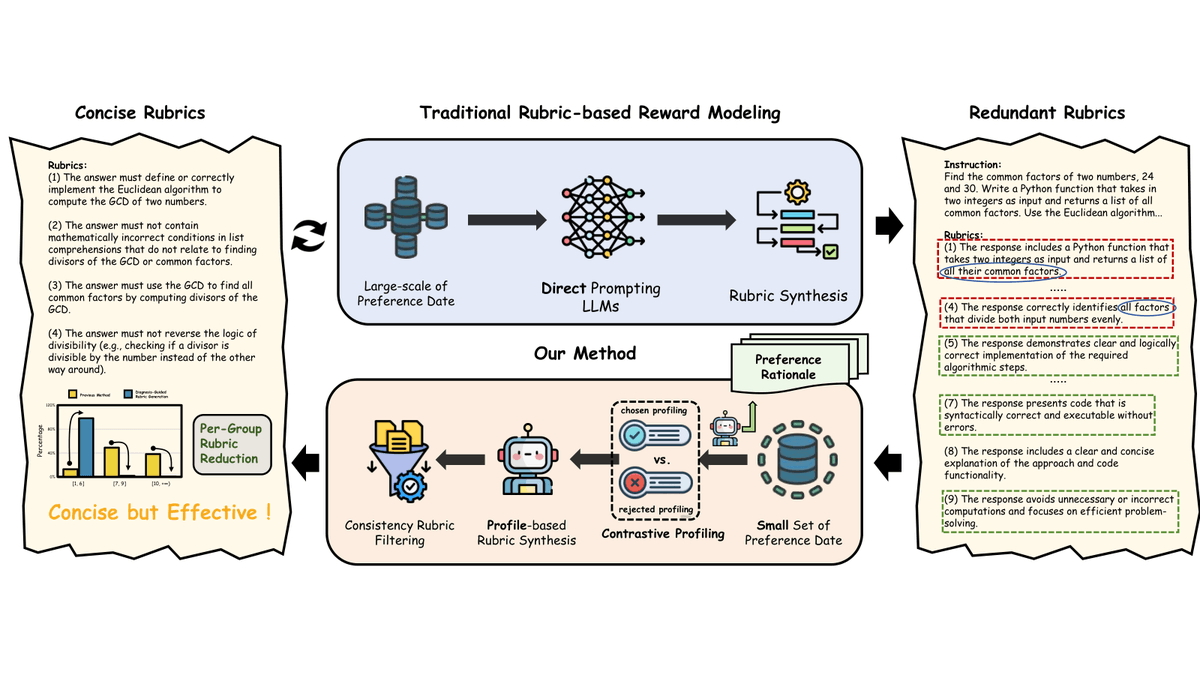
Current approaches largely rely on either labor-intensive manual annotation or direct prompting of LLMs, both of which have notable shortcomings: manual curation is not scalable, while direct prompting often yields noisy, redundant rubrics weakly related to actual discriminative factors. The team quantified this redundancy directly: when they randomly removed one to three rubrics from existing rubric datasets and retrained, performance dropped by at most 0.42%, confirming that most of the generated criteria were noise, not signal.
The Contrast-then-Synthesis Paradigm
CDRRM's central insight is that good rubrics should be derived by directly comparing the two responses being judged, not generated in isolation from the prompt alone. The framework has two tightly coupled stages.

Stage 1: Contrastive Profiling. Given a preference pair (a chosen response and a rejected one), an LLM-as-a-Judge analyzes both responses across a dynamic set of evaluation dimensions, such as instruction following, logical consistency, factual accuracy, and format compliance. Critically, the system does not just produce abstract assessments. It enforces an Evidence-Anchored Constraint: every finding must be grounded in specific text spans from the original responses. For example, if the instruction says "no Python code" and the response contains a Python block, the analysis must cite both the constraint and the offending span explicitly.
Stage 2: Rubric Synthesis. The differential insights from Stage 1 are fed to a teacher LLM (Qwen3-235B in experiments), which synthesizes them into a compact set of hard rules and principles. A Preference-Consistency Filter then validates each rubric set: if the generated rubric, when applied, does not correctly predict the ground-truth preference label, the sample is discarded. Only rubrics that pass this check are kept for training.
The result is a two-model system:
- Rubric Generator: A fine-tuned model (Qwen3-8B or 14B) that, given any new preference pair, automatically produces context-aware evaluation criteria.
- Judge Model: A model fine-tuned to reason over those rubrics and output a preference decision with an explicit justification.
Exceptional Data Efficiency
The most striking result is how little data CDRRM needs. Training the Rubric Generator on only 3k high-quality samples empowers a frozen pre-trained judge model to outperform fully fine-tuned baselines. The scaling analysis makes this even more concrete: performance saturates at around 1,000 training samples for the Rubric Generator, and at 3,000 for the Judge Model. Beyond those thresholds, adding more data yields negligible gains.
The authors attribute this to the quality of the rubrics themselves. Because each rubric is grounded in concrete evidence from the specific response pair, the Judge Model's learning objective becomes much simpler: it only needs to learn to apply explicit rules, not to infer implicit human preferences from scratch.
Benchmark Results
CDRRM-14B (SFT) achieves the highest average score of 88.3, a 5.7% improvement over the top-performing rubric-based baseline (RM-R1-Qwen-Instruct-32B) and a 3.6% gain over the best generative RM (BR-RM-Qwen-8B). The comparison is evaluated across three benchmarks:
- RewardBench: Covers chat, reasoning, and safety tasks using prompt-chosen-rejected trios.
- RMBench: Specifically tests bias resistance, including verbosity bias (preferring longer answers) and position bias (preferring whichever response appears first).
- RMB: A large-scale benchmark covering 49 real-world scenarios for helpfulness and harmlessness, with over 25,000 instances.
The bias resistance results on RMBench Hard are particularly notable. Traditional baselines show limited performance on the RM-Bench Hard subcategory: Scalar RMs peak at 54.3, GenRMs at 76.1, and rubric-based RMs at 71.9. In contrast, CDRRM models achieve significantly higher accuracy: 81.1 for CDRRM-8B (Base) and 83.4 for CDRRM-14B (SFT).
The Verbosity Trap, Solved
A concrete case study from the paper illustrates why this matters in practice. Given a prompt asking for an executive summary, a direct judge model incorrectly preferred a long, formatted response over a short, complete one, even though the long response was truncated mid-sentence. The direct judge praised the longer response as "comprehensive and well-structured" without noticing the critical truncation error.
CDRRM's Rubric Generator, by contrast, produced two hard rules from its contrastive analysis: the answer must be complete without mid-sentence truncation, and it must not include unrequested structural elements like headers and bullet points. Guided by those rules, the Judge Model correctly identified the truncation as a disqualifying flaw. This is the core mechanism by which explicit rubrics prevent the model from falling into superficial heuristics.
Where It Falls Short
A few limitations are worth noting for practitioners:
- The Contrastive Profiling step requires a powerful teacher LLM (the paper uses Qwen3-235B) to generate the initial high-quality profiles. This is a one-time cost for dataset construction, but it is not trivial.
- The framework is designed for pairwise preference evaluation. It does not directly extend to pointwise scoring or best-of-N selection without adaptation.
- The ablation shows that the one-step rubric baseline (skipping contrastive profiling) still underperforms CDRRM significantly, meaning the two-stage pipeline is load-bearing and cannot be simplified without a performance cost.
- The Judge Model's performance plateau at 3k samples also means the system is sensitive to the quality of those 3k samples. Noisy or low-quality seed data would likely degrade results more than it would for larger-data baselines.
What This Unlocks
CDRRM-8B (Base), which requires no fine-tuning of the Judge Model, only prompting with rubrics from the Rubric Generator, outperforms fully fine-tuned BR-RM-Qwen-8B (85.2) and RM-R1-Qwen-Instruct-32B (83.5). This is a meaningful result for teams building alignment pipelines: you can potentially improve your reward model's performance significantly just by plugging in a better rubric generator, without retraining the judge at all.
The practical use cases are broad. Any team using RLHF or preference optimization (DPO, PPO, GRPO) needs a reward model. CDRRM is especially relevant when:
- You are working in a specialized domain (medicine, law, code) where generic reward models underperform and expert annotation is expensive.
- You need interpretable reward signals, for example to audit why a model was penalized for a specific output.
- You want to reduce verbosity bias in your alignment pipeline, a common failure mode where models learn to produce longer outputs rather than better ones.
- You are building an LLM-as-a-Judge evaluation system and want to make it more robust to position and style biases.
Code is available on GitHub. The authors also plan to release the two-stage training dataset publicly. Future work targets integrating rubric-derived signals directly into policy alignment, closing the loop between preference discrimination and generation quality.