
Paris-Saclay's Adversarial AI Transfers Cancer Knowledge Across Mismatched RNA Datasets
Researchers from University Paris-Saclay's IBSC Lab propose an adversarial deep learning framework that bridges incompatible RNA-seq datasets for better cancer classification with less data.
 Pro
Takeaways
- The problem: Deep learning models for RNA-seq phenotype prediction overfit on small datasets, and naive cross-dataset transfer fails due to batch effects.
- The solution: An adversarial domain adaptation (DANN-based) framework that learns to ignore which dataset a sample came from while still classifying cancer/tissue type correctly.
- Key mechanism: A gradient reversal layer forces the feature extractor to produce domain-invariant representations, jointly trained with the classification objective.
- Benchmarks: Evaluated on TCGA (9,349 samples, 19 cancer types), ARCHS4, and GTEx -- outperforms ComBat, limma, and non-adaptive baselines, especially in low-data regimes.
- Both supervised and unsupervised modes work: The framework gains even with zero labeled target samples, making it viable when annotation is expensive.
- Code is open-source: Available at github.com/kdradjat/da_rnaseq; paper preprint at arXiv 2603.08062.
A recurring frustration in computational biology is that RNA sequencing datasets are rarely plug-and-play. Each lab, hospital, or consortium processes samples differently -- different sequencing platforms, normalization pipelines, and gene annotation versions -- and those technical differences can swamp the biological signal a model is actually trying to learn. Kevin Dradjat, Massinissa Hamidi, and Blaise Hanczar from the IBSC Laboratory at the University Paris-Saclay have now published a paper tackling this head-on, proposing an adversarial domain adaptation framework that lets a deep learning model trained on a large, general RNA-seq corpus transfer its knowledge to a much smaller, task-specific dataset.
The data wall in transcriptomics
Accurate phenotype prediction from RNA sequencing data is essential for diagnosis, biomarker discovery, and personalized medicine. The problem is that deep learning models have demonstrated strong potential to outperform classical machine learning approaches, but their performance relies on large, well-annotated datasets -- and in transcriptomics, such datasets are frequently limited, leading to overfitting and poor generalization.
The naive fix is to borrow data from a bigger, publicly available cohort. But transferring information across RNA-seq datasets remains challenging due to heterogeneous preprocessing pipelines and differences in target phenotypes. This is the batch effect problem: technical variations introduced by different sequencing centers, library preparation protocols, and processing batches can overwhelm biological signals and prevent robust cross-cohort validation. Classical correction tools like ComBat and limma can reduce these shifts statistically, but they are linear methods applied before training -- they don't learn to ignore irrelevant variation jointly with the classification task.
Domain adaptation as the fix
Domain adaptation is the ML subfield that deals with training on one data distribution (the source domain) and deploying on a different but related one (the target domain). The core idea is that knowledge transfer from one domain to another must be based on learning features that do not allow discriminating between the two domains -- DANN learns a classification model from features that do not encode information about the domain of the sample, thus generalizing knowledge from a labeled source domain to an unlabeled target domain.
The authors build their framework around the Domain-Adversarial Neural Network (DANN) architecture. A key innovation in DANN is the gradient reversal layer (GRL) placed between the feature extractor and domain classifier. During backpropagation, the GRL multiplies the gradient by -λ, effectively reversing the direction of optimization for the feature extractor with respect to the domain classification task -- this adversarial setup encourages the feature extractor to learn representations that are discriminative for the main task but invariant to the domain shift. In plain terms: the network is simultaneously trained to classify cancer types correctly and to be unable to tell which dataset a sample came from.

The method learns a domain-invariant latent space by jointly optimizing classification and domain alignment objectives, and to ensure stable training and robustness in data-scarce scenarios, the framework is trained with an adversarial approach with appropriate regularization. The authors also explore two operating modes:
- Supervised variant: some labeled samples from the target dataset are available at training time.
- Unsupervised variant: only unlabeled target samples are used -- the model must align the domains without knowing the target labels.
Three massive datasets, one tough test
The framework is evaluated on three large-scale transcriptomic datasets -- TCGA, ARCHS4, and GTEx -- to assess its ability to transfer knowledge across cohorts. These are among the largest public RNA-seq resources available:
- TCGA (The Cancer Genome Atlas): a pan-cancer RNA-seq dataset containing 9,349 samples and 56,902 input genes from 19 different types of cancer.
- ARCHS4: a pan-tissue dataset originating from experiments in the Sequence Read Archive (SRA) and Gene Expression Omnibus (GEO).
- GTEx: a large healthy-tissue gene expression reference dataset covering dozens of tissue types.
The experimental design specifically probes the low-data regime -- the scenario most relevant to real clinical research -- by varying how many labeled target samples the model sees during training.

What the numbers show
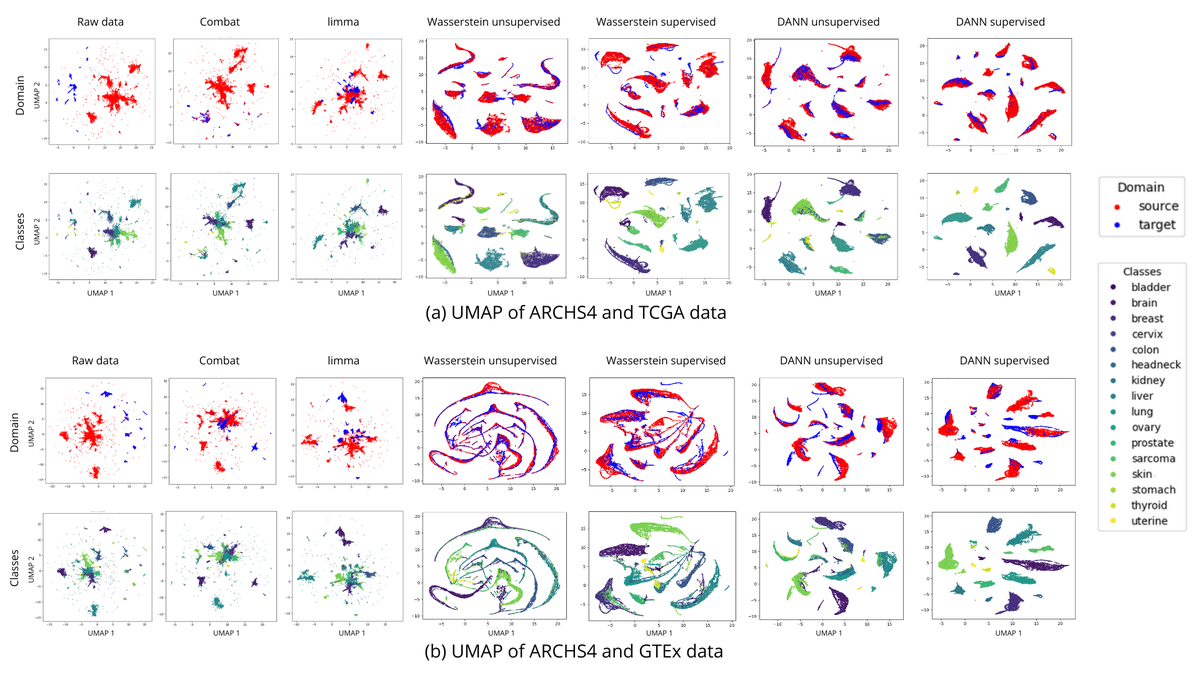
Experimental results demonstrate consistent improvements in cancer and tissue type classification accuracy compared to non-adaptive baselines, particularly in low-data scenarios. The adversarial approach outperforms both the statistical batch-correction baselines (ComBat, limma) and the naive "train on source, test on target" approach across both TCGA and GTEx transfer tasks. The gains are most pronounced when labeled target samples are scarce -- exactly the regime that matters most in practice.
The unsupervised variant -- which uses zero target labels -- also shows meaningful gains over non-adaptive baselines, which is significant: it means the framework can be deployed in settings where annotating target samples is expensive or impossible.
Where it falls short
The framework has real limitations worth noting:
- The paper focuses on classification tasks (cancer type, tissue type). Regression targets like survival time or drug response are not evaluated.
- Domain adaptation assumes the source and target share at least some overlapping biology. When the phenotype spaces are very different, alignment can hurt rather than help.
- Practical implementations require careful hyperparameter tuning and extensions like label-shift correction to address challenges in diverse domain adaptation scenarios.
- The method is evaluated on bulk RNA-seq. Single-cell RNA-seq, which has very different sparsity and noise characteristics, is out of scope.
The real unlock
The practical implication is straightforward: a research group with a small, disease-specific RNA-seq cohort (say, 200 samples of a rare cancer subtype) can now leverage tens of thousands of samples from ARCHS4 or GTEx without needing to manually harmonize the datasets or retrain from scratch. The adversarial alignment happens end-to-end during training.
This work highlights domain adaptation as a powerful strategy for data-efficient knowledge transfer in transcriptomics, enabling robust phenotype prediction under constrained data conditions. For teams building clinical classifiers on small institutional cohorts, this is a directly applicable technique -- not a theoretical curiosity.
The code and results are available at github.com/kdradjat/da_rnaseq. The paper is submitted to Bioinformatics and is currently available as a preprint on arXiv.