
Paracosm Draws Your Mental Image to Beat Every Zero-Shot Search Method
A training-free retrieval method generates the image a user is picturing, then matches it against a synthetic mirror of the database.
 Pro
Takeaways
- Paracosm generates a synthetic "mental image" for each query instead of a text description.
- To close the synthetic-to-real gap, it also generates synthetic twins for every database image.
- Beats prior zero-shot CIR by ~9 mAP@5 on CIRCO with ViT-G/14, reaching 39.82.
- Fully training-free, using off-the-shelf Qwen2.5-VL, Qwen-Image-Edit, and CLIP encoders.
- Costs 12.9 hours offline database prep on 16 A100s; 14 seconds per query at inference.
- Code and demo notebook on GitHub.
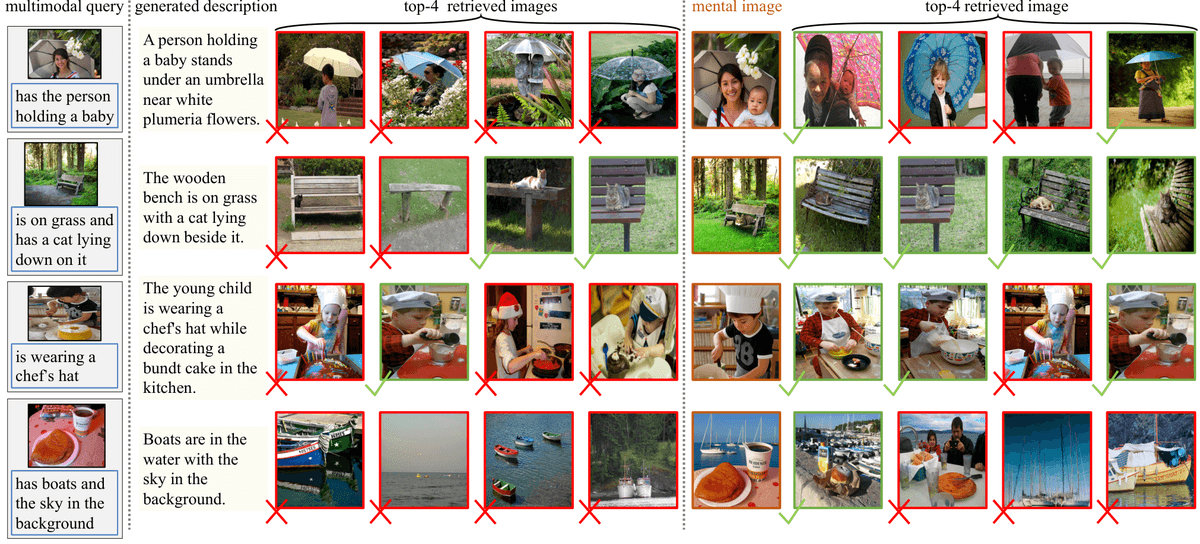
Composed image retrieval sounds simple: hand a system a photo plus a text instruction like make the dog a puppy and put it on grass, and get back the picture you had in mind. The catch is that the task retrieves a target image from a database using a multimodal query consisting of a reference image and a modification text, and the fundamental challenge is that this "mental image" is not physically available and is only implicitly defined by the query. A new paper called Paracosm takes that phrase literally: it asks a large multimodal model to actually draw the mental image, then searches for a real photo that matches.
The result is a training-free zero-shot method that beats every prior zero-shot approach on the standard benchmarks, and in some cases rivals fully supervised systems. Code and a demo notebook are on GitHub.
Why text descriptions were leaving performance on the table
Recent zero-shot CIR systems like CIReVL, LDRE, and OSrCIR all follow the same recipe: use a Large Multimodal Model to generate a textual description for a given multimodal query, and then employ a Vision-Language Model for textual-visual matching to search the target image. That turns the problem into text-to-image retrieval, which is convenient because CLIP-style encoders handle it well. It also throws away most of the visual information in the query.
The Paracosm authors argue this is the core bottleneck. A caption like "a red sneaker on a wooden floor" cannot encode texture, silhouette, or the dozens of small attributes a shopper actually cares about. Their fix is to address CIR from first principles by directly generating the "mental image" for more accurate matching.

How the pipeline works
Paracosm has two halves, one for the query and one for the database. Both live in what the authors call a "paracosm" , a synthetic parallel world where matching happens.
On the query side, the reference image and modification text are fed to an image-editing LMM (Qwen-Image-Edit in the default configuration). The LMM produces a synthetic mental image that shows what the user is asking for. A second pass with Qwen2.5-VL generates a short, single-sentence caption of that mental image. The paper notes the prompt is tuned to "focus solely on visual content while minimizing aesthetic details."
On the database side, every image is preprocessed once, offline. An LMM writes a long, detailed description of the image capturing objects, attributes, and spatial relationships. That description is then fed to a text-to-image model to generate a synthetic counterpart of the real photo. Both versions of each database image , the original photo and its generated twin , are kept for retrieval.
At query time the system builds a combined feature vector and picks the database image with the highest cosine similarity. The query representation is a weighted sum:
q = λ * (V(I_mental) + T(t_query)) + (1 - λ) * T(t_mod)
φ_i = V(I_i) + V(I_syn_i)
where V and T are the CLIP visual and text encoders, t_mod is the original modification text, and λ is set to 0.3. That last term matters , an ablation shows that folding the raw modification text back in adds several points of recall, because keywords in the instruction often carry information the generator drops.
Why the synthetic twins matter
The obvious problem with mental images is that they look generated. Comparing a diffusion output directly against a real photograph exposes a domain gap that CLIP encoders pick up on. Generating synthetic counterparts for the database aligns both sides of the comparison in the same visual style, so the encoder is comparing synthetic to synthetic rather than synthetic to real.
The ablation table makes the effect concrete. On CIRR with a ViT-B/32 backbone, using only the mental image and modification text against real database images scores 25.95 Recall@1. Adding synthetic counterparts on the database side lifts that to 32.27, a jump of over six points. The same pattern shows up on CIRCO's mAP scores.
The numbers
Paracosm is evaluated on three standard benchmarks: CIRR (real-life images with visually similar distractors), CIRCO (open-domain images with multiple ground-truth targets per query, over 123K database images), and Fashion IQ (shirts, dresses, tops from Amazon). With the OpenCLIP ViT-G/14 backbone:
- CIRR Recall@1 jumps from 37.26 (OSrCIR) to 39.30
- CIRCO mAP@5 rises from 31.12 (LDRE) and 30.47 (OSrCIR) to 39.82 , a much larger gap
- Fashion IQ average Recall@10 goes from 37.57 (OSrCIR) to 38.74
The CIRCO gain is the headline result. On a benchmark with over 123K distractor images and fine-grained annotations, generating actual visuals rather than descriptions unlocks nearly a third more mAP than the previous best training-free approach.

The cost of drawing what you want
The performance comes with a real bill. Paracosm needs 12.9 hours on 16 A100s to preprocess the CIRCO database, compared to 0.1 hours for methods that only generate text descriptions. That work produces 41.4 GB of synthetic images that can be discarded once the 0.38 GB of features are extracted. Per-query inference costs 14 seconds and 2.7 GB of GPU memory , comparable to AutoCIR's 24 seconds, but far slower than CoTMR's one-second inference.
The authors argue this tradeoff is defensible because database preprocessing is a one-time offline cost, and generative model inference is being aggressively optimized. For applications where a search index is built once and served many times, that math works. For rapidly changing catalogs, the story is less clean.
When it breaks
Paracosm inherits the failure modes of its generator. The paper documents cases where the image editor produces a cartoon-style duck when asked to modify a photorealistic one, or hallucinates gas burners onto the door of an oven, or fails entirely to change a specified color. Any of these visual errors propagate directly into retrieval failures. There is no confidence signal or fallback when the mental image is wrong.
The method also uses slightly different prompt templates per dataset because modification texts vary in format across CIRR, CIRCO, and Fashion IQ. That is a practical rough edge for anyone deploying it on a new domain. The authors flag adaptive prompt generation as future work.
What this changes
The broader shift is that image-editing LMMs have gotten good enough to be treated as retrieval components, not just content generation tools. Prior work like CIG and IP-CIR generated pseudo-target images from scratch using text-to-image models; Paracosm's ablation shows that editing the reference image directly beats that approach by about half a point of Recall@1 on CIRR, and the improvement holds across two different open-source editors (Qwen-Image-Edit and LongCat-Image-Edit).
For anyone building visual search over a fixed catalog , e-commerce, fashion, real estate, stock photography , this suggests a viable pattern: preprocess the catalog once with a generator, then match generated queries against generated twins. It is a heavier build than training a textual inversion network, but it needs zero labeled triplets and adapts to new domains by swapping prompts rather than fine-tuning.