
Pano360 Ditches Pairwise Matching to Stitch 24-Frame Panoramas in 5 Seconds
Pano360 lifts panorama stitching out of 2D pairwise matching and into 3D photogrammetric space, hitting a 97.8% success rate.
 Pro
Takeaways
- Pano360 (CVPR 2026) stitches panoramas in 3D photogrammetric space instead of chaining pairwise 2D homographies. Paper
- Transformer adapts a frozen VGGT backbone plus DINO encoder to predict camera intrinsics, extrinsics, and seam masks jointly.
- Achieves 97.8% success rate versus 83.3% for GES-GSP, at ~5 seconds vs 20 to 300 seconds per scene.
- Seam detection uses a joint color, gradient, and texture energy, learned via pseudo-labels from graph-cut.
- New 14,400-image dataset spans 200 real scenes with weak texture, parallax, and extreme lighting. Code and data
- Limitations: no support for pre-distorted (fisheye) inputs or scenes needing full 3D reconstruction.
Panorama stitching has been stuck in the same rut for a long time: match keypoints between pairs of images, estimate a homography, chain them together, and hope the errors don't compound. A new paper called Pano360, accepted at CVPR 2026, argues that the whole pairwise pipeline is the wrong abstraction, and that stitching should happen directly in 3D photogrammetric space using a transformer that reasons about all input views at once.
Prior panorama stitching approaches heavily rely on pairwise feature correspondences and are unable to leverage geometric consistency across multiple views, which leads to severe distortion and misalignment, especially in challenging scenes with weak textures, large parallax, and repetitive patterns. The team from South China University of Technology, Tongji University, and Guangdong University of Technology released code and a new dataset alongside the paper at the Pano360 GitHub repo.
Why pairwise stitching keeps breaking
Classical stitchers like AutoStitch, APAP, and GES-GSP extract handcrafted features (SIFT keypoints, line segments, curves), estimate a homography between neighboring frames, and chain those homographies to build a panorama. This pairwise approach is prone to accumulating projection errors, particularly when aligning multiple images, resulting in severe distortions in the remaining images. When dealing with large-scale real-world scenarios, this issue is exacerbated by weak textures, large parallax, and repetitive patterns.
Learning-based methods like UDIS and UDIS2 swap the handcrafted features for CNNs, but they inherit the same structural flaw. These networks are fundamentally limited to pairwise image stitching and require complex post-processing for multi-image alignment, which severely hinders their real-world applicability. A panorama assembled from 24 frames with a pairwise stitcher tends to drift, ghost, or outright fail in fog, on repetitive brickwork, or with strong parallax.

Lifting alignment into 3D
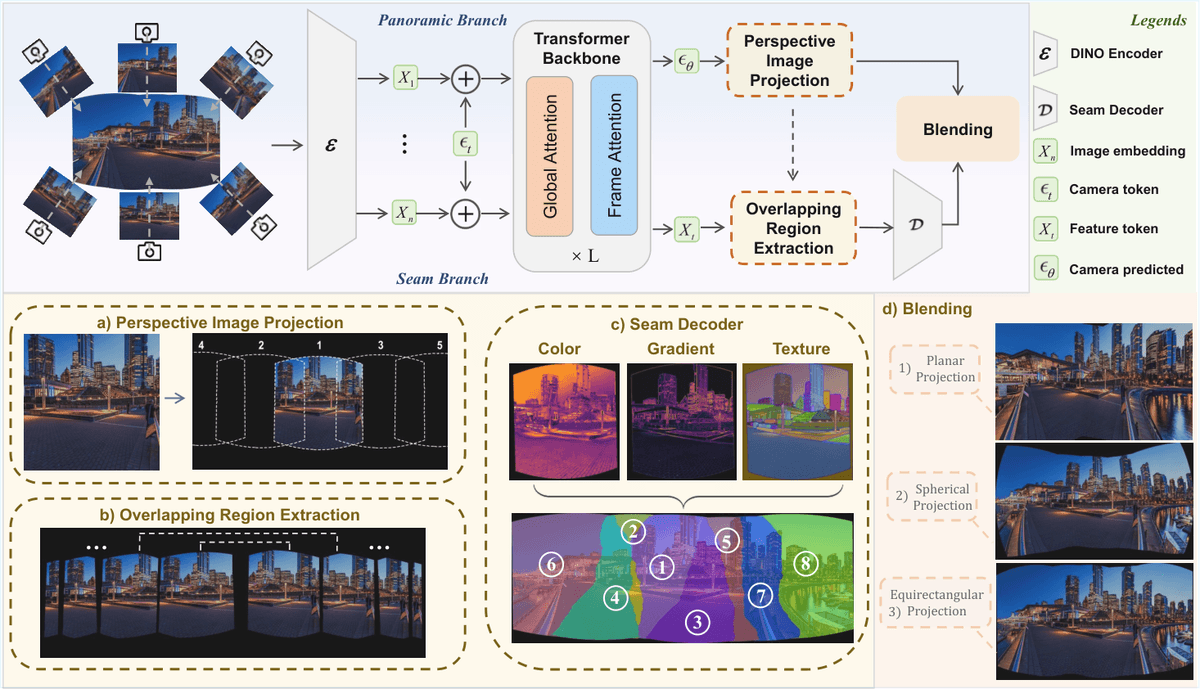
The core idea is straightforward but hard to execute: instead of matching pixels between image pairs, jointly recover the 3D geometry of the whole scene and use camera poses to warp every image onto a shared canvas. The authors adapt the architecture of VGGT, a large vision model trained with 3D supervision that exhibits inherent 3D awareness of feature correspondences, to aggregate features across all input images. The network directly utilizes camera poses to guide image warping in 3D space and selects the optimal projection function from the aggregated multi-image features.
Concretely, each input image is patchified and processed by a pre-trained DINO encoder. A learnable camera token is prepended to the concatenated sequence of image embeddings, and the whole thing is fed through alternating global-attention and frame-attention layers borrowed from a frozen, pre-trained VGGT backbone. The backbone emits two things:
- Camera tokens that get decoded into intrinsics (shared focal length, principal point at image center) and extrinsics (rotation and translation) for every view.
- Feature tokens that feed a seam decoder for blending.
Because alignment is expressed as a projection function driven by camera parameters, Pano360 supports inputs ranging from a few to hundreds of images and generates a geometrically consistent panorama. The same model can output planar, equirectangular, or spherical projections, and can adaptively choose one for a given input set. For scenes with lingering parallax, a small local mesh warp corrects residual misalignments on top of the global 3D projection.
Seams as a joint optimization, not a pairwise search
Blending is the other place where pairwise pipelines fall apart. Traditional graph-cut seam detection considers overlaps two images at a time and easily gets stuck in local optima when three or more images share a region. Pano360 formulates seam mask prediction as an energy minimization where the pixel-wise cost combines three maps:
- A color difference map between overlapping images.
- A gradient magnitude map to steer seams away from sharp edges.
- A texture complexity map that heavily penalizes seams in complex regions and pushes them into homogeneous areas.
The graph-cut solution serves as a pseudo-label to supervise a seam decoder, so at inference time the network predicts globally optimal seam masks for all images in a single forward pass. By integrating color, gradient, and texture terms from all images, the method eliminates artifacts while significantly reducing costly pairwise computations, achieving up to a 10 times speedup over prior pairwise methods in large-scale scenes.
A new dataset built for the failure cases
Existing stitching benchmarks are mostly synthetic and made of image pairs, which is why they don't stress the pairwise-vs-global question. The authors collected a new dataset also named Pano360: 200 real-world scenes split across general tourism (50%), extreme sports like skiing and skydiving (30%), and challenging illumination such as night scenes and strong backlighting (20%). Each scene has 72 images (24 frames at each of three focal lengths) spanning a full 360-degree field of view at 2048x2048 resolution, for 14,400 total frames with ground-truth camera parameters.

The numbers
On the Pano360 test scenes, the model reports a 97.8% success rate at ~5 seconds per panorama, against 83.3% for GES-GSP (~20s), 80.1% for ELA (~90s), and 30.0% for APAP (over 300s). Learning-based baselines that only accept pairs, like UDIS2 and LPC, fail on the multi-image 24-frame cases. On the older UDIS-D pair-stitching benchmark, Pano360 also matches or beats specialized baselines with 25.97 PSNR / 0.852 SSIM without being fine-tuned on that dataset.
Ablations confirm that the three ingredients (pose-guided warping, adaptive projection format, and learned seam masks) each contribute measurably, with the full system reaching a Q-Align quality score of 4.09 versus 2.76 for a baseline that removes all three.
Where it will and won't help
If you're building tools around 360-degree capture, VR content pipelines, drone mapping, or text-to-panorama generation, the ability to stitch tens or hundreds of frames from a handheld capture without SfM preprocessing is the practical win. The paper flags two honest limitations: the current model does not support input images with inherent distortions, and for scenes with extremely large parallax, such as when the same object is captured from significantly different angles, stitching is not achievable without 3D reconstruction. Fisheye inputs and heavily 3D-parallax scenes still need dedicated pipelines.
The bigger takeaway sits under the headline: a foundation model trained for 3D geometry (VGGT) can be repurposed as a general geometric prior for downstream tasks that were traditionally solved with handcrafted correspondences. Panorama stitching is one example, but the same recipe of frozen 3D backbone plus lightweight task-specific heads is likely to eat into other classical multi-view problems next.