
PaIR-Drive Beats Human Drivers by Running Imitation and Reinforcement Learning in Parallel
PaIR-Drive splits imitation and reinforcement learning into parallel branches, breaking the ceiling of sequential fine-tuning and correcting bad human demos.
 Pro
Takeaways
- PaIR-Drive runs imitation and reinforcement learning in parallel branches instead of sequentially fine-tuning.
- Achieves 91.2 PDMS on NAVSIMv1 and 87.9 EPDMS on NAVSIMv2 using DiffusionDrive as the IL backbone.
- Can correct human expert mistakes at inference, lifting bad-human EPDMS by 10.8 points.
- Tree-structured trajectory sampler feeds GRPO with intention-conditioned trajectories for efficient exploration.
- Plug-and-play design lets teams swap IL policies without retraining the RL branch.
- Code released at github.com/zhexilian/PaIR-Drive, trained on 4 NVIDIA L40 GPUs.
End-to-end driving models learn by copying humans, but humans do things like run red lights and drive on the wrong side of the road. A new framework called PaIR-Drive argues that the standard recipe of pretraining with imitation learning and then bolting on reinforcement learning at the end is fundamentally limited, and proposes running the two in parallel instead. The result is a policy that beats sequential RL fine-tuning on the NAVSIM benchmarks and can actually correct human experts when the demonstrations themselves are unsafe.
The trouble with copying humans
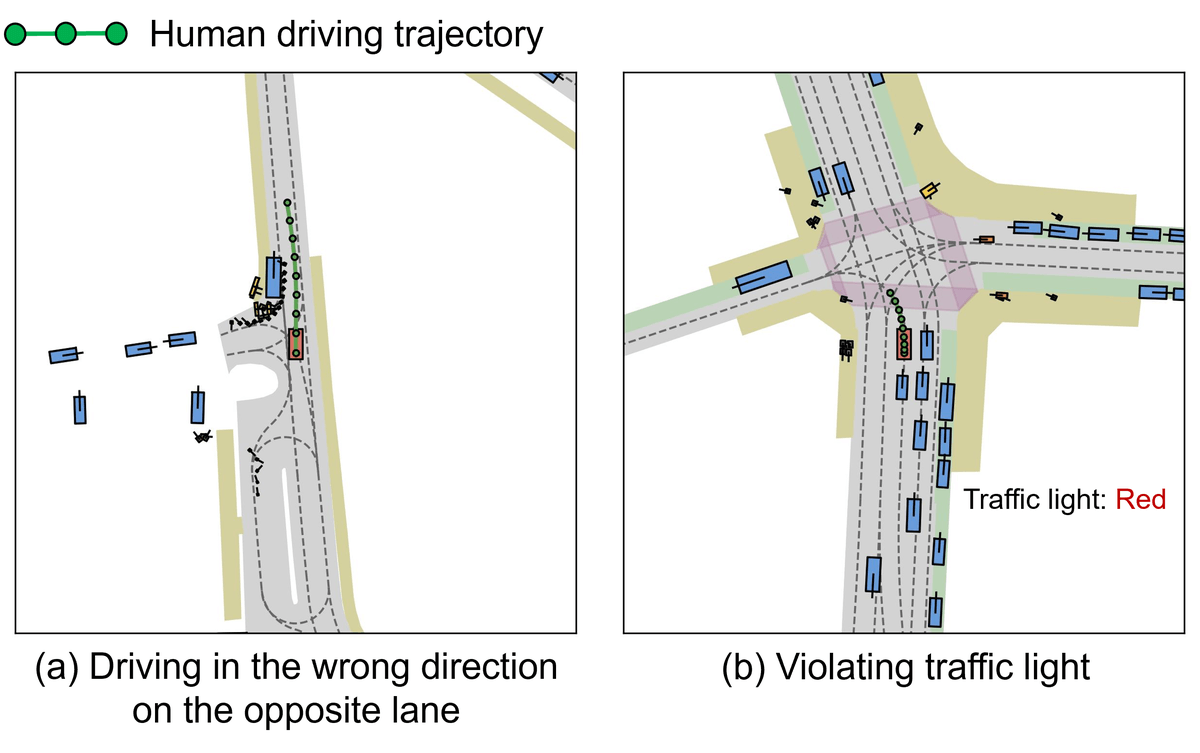
Most modern end-to-end driving stacks (UniAD, VAD, DiffusionDrive, Transfuser) are built on imitation learning, mapping camera and lidar inputs directly to trajectories that match a human driver. The performance of imitation learning is constrained by the quality of human demonstrations, and the authors show concrete failure cases from NAVSIM where drivers went the wrong way on a Singapore street or ran a red light in Las Vegas. Blindly cloning those behaviors is not a great starting point for a safety-critical system.
The community's fix has been to fine-tune the imitation policy with reinforcement learning, either in one shot (train IL, then run RL) or by alternating IL and RL updates. Both approaches share the same policy network, and because imitation and reinforcement learning have different optimization objectives, the fine-tuning scheme can get trapped in a local minimum due to destructive conflicts of inconsistent optimization directions. The paper calls this a performance ceiling: RL cannot stray too far from the pretrained policy without drifting, but staying close means inheriting its limitations.
Two branches, one plan
PaIR-Drive's answer is architectural. Instead of one network trained sequentially, it maintains two parallel branches that share sensor inputs but have separate objectives:
- An IL branch that follows the standard sensor-encoding to perception-fusion to trajectory-decoding pipeline and is supervised by human trajectories with L1 loss. The paper uses Transfuser's decoder, but the authors emphasize this can be swapped for any IL policy.
- An RL branch that takes the BEV feature maps plus a reference trajectory and predicts trajectory point offsets for different driving intentions (left, right, accelerate, decelerate). It is trained with GRPO against simulated rewards.
Crucially, during training the RL branch conditions on the human trajectory, not the IL policy's output. That means the two branches can be optimized independently with no shared gradients or shared parameters getting yanked in conflicting directions. At inference time, the human trajectory is swapped for the IL branch's prediction, and a lightweight reward world model scores the candidate trajectories to pick the final plan.

Because the RL branch never depends on a specific IL checkpoint, you can swap in a stronger imitation policy later without retraining RL. In the paper's own framing, PaIR-Drive is a drop-in enhancement toolkit for any IL-based driving stack.
Tree-structured sampling for GRPO
The RL branch's exploration engine is a tree-structured trajectory neural sampler. Given the reference trajectory and a set of N driving intentions, the sampler predicts small offsets at each timestep, and the trajectory branches out into a tree along the time axis. If every timestep expanded every branch, the tree would be exponential in the horizon, so the authors expand every two steps and prune to candidates with higher exploitative value.
The design choice matters because prior RL-fine-tuned drivers like ReCogDrive and AutoVLA sample trajectories by random perturbation, which is sample-inefficient. Here, an OffsetHead regularizes the offset range for each intention, so the sampler cannot produce absurd trajectories for a given intention token. The resulting trajectory group is fed into GRPO, which computes a group-relative advantage (each trajectory's reward normalized against the mean and standard deviation of the group) instead of needing a separate value network.
The numbers
NAVSIM evaluates driving with PDMS (a product of no-collision, drivable area compliance, ego progress, time-to-collision, and comfort) and its extended EPDMS. Layering PaIR-Drive on top of two IL baselines produces meaningful gains:
| Baseline | IL only PDMS | + PaIR-Drive | + PaIR-Drive (best-of-6) |
|---|---|---|---|
| Transfuser | 84.0 | 89.7 (+5.7) | 93.3 (+9.3) |
| DiffusionDrive | 88.1 | 91.2 (+3.1) | 94.0 (+5.9) |
On NAVSIMv2's EPDMS, PaIR-Drive lifts Transfuser by 6.9 points and DiffusionDrive by 3.6. Head-to-head against sequential fine-tuning on the same Transfuser baseline, PaIR-Drive achieves competitive performance of 91.2 PDMS and 87.9 EPDMS, building upon Transfuser and DiffusionDrive IL baselines, versus 87.9 PDMS for Transfuser with GRPO fine-tuning.

The more surprising result comes from feeding the RL branch the human's own trajectory at inference. On a "human bad v2" split (scenarios where the real driver scored below 80 EPDMS), PaIR-Drive raises the human's own EPDMS by 10.8 points, primarily by fixing driving direction, traffic light, and lane keeping violations. In other words, the RL branch is not just polishing the IL policy, it is capable of overriding suboptimal expert demonstrations at test time.
Ablations worth noting
A few findings developers should register before adopting this:
- The tree structure carries most of the weight. Without it, PDMS drops from 93.3 to 88.8 (offset prediction) or 87.9 (direct trajectory prediction).
- GRPO group size matters more than usual. Going from 5 to 15 trajectories per group lifts PDMS from 89.1 to 93.3, which the authors attribute to the trajectory diversity unlocked by the tree.
- The reward world model alone is not the source of gains. Adding it to a vanilla IL policy only buys 2.7 EPDMS, versus 5.3 with the full PaIR-Drive pipeline.
- Returns diminish with stronger IL baselines. DiffusionDrive gains less than Transfuser, and the authors expect this trend to continue as base policies improve.
What is actually available
The authors have released code on GitHub. The paper positions PaIR-Drive as a modular add-on rather than a monolithic new model, so teams already invested in Transfuser, DiffusionDrive, or another IL stack can in principle attach the RL branch without retraining their perception network. The training runs used four NVIDIA L40 GPUs for 50 epochs, which puts reproduction well within the reach of a mid-size research group.
The broader claim, that sequential IL-then-RL fine-tuning is structurally capped, echoes recent work like Nuro's CIMRL and CoIRL-AD, all pointing at the same friction between a supervised objective that says "imitate" and a reward objective that says "improve." PaIR-Drive's contribution is showing that decoupling the two networks entirely, and only recoupling them at inference, is enough to break the ceiling on a real benchmark.