
Paderborn's IIC Makes Seizure-Detecting AI 87.8% Accurate and Clinically Readable
A new explainable AI approach decomposes wearable signals into interpretable pieces, keeping raw time-series accuracy while telling clinicians which physiological patterns drove each prediction.
 Pro
Takeaways
- New XAI method IIC explains wearable time-series models without sacrificing accuracy from raw-signal training.
- Signals are split into invertible, clinically named components; a weight vector zeros out non-influential ones.
- Hit 99.0% accuracy on state assessment with LSTM, beating SHAP baseline by 3.6 points.
- Reached 87.8% on tonic-clonic seizure detection with transformer across 37 patients from Boston Children's Hospital.
- Provides both local per-window and global cohort-level explanations, unlike saliency maps.
- Requires invertible decomposition; no code release announced, but built on NeuroKit2 and SciPy.
Wearable health monitoring has a trust problem. The neural networks that flag arrhythmias, detect seizures, or track stress on smartwatch data are largely black boxes, and in medicine that opacity carries real cost. A team from Paderborn University, LMU Munich, Mass General Brigham, and Boston Children's Hospital has proposed a method called Inherently Interpretable Components (IICs) that aims to keep the accuracy of deep time-series models while producing explanations a clinician can actually read.
Why time series break most XAI tools
Most explainability tools were built for images or tables. When applied to time series, saliency methods answer where the important region is, but not why it matters, and they miss patterns encoded in latent parameters rather than specific timestamps. The authors point out that concept-based approaches like Concept Bottleneck Models are more intuitive but usually force a performance trade-off, because routing everything through a bottleneck of scalar features throws away the temporal structure an LSTM or transformer would exploit.
IIC tries to get both. The recipe has three moving parts:
- An invertible decomposition that splits the raw signal into components a domain expert already recognizes.
- An extended model that feeds those components through the inverse transform back into the original network, so no retraining is needed.
- A learned weight vector per component that is optimized to zero out anything the network does not actually rely on.
How the decomposition works
Formally, a time series x is transformed into components C_x = F(x), and an extended model M_hat = M(F^-1(C_x)) is defined so the original trained network M can still consume reconstructed inputs. To score importance, each component gets a weight in [0,1], and the optimizer minimizes the sum of weights subject to a penalty when the model output drifts more than a small threshold from the original prediction. A baseline component fixed to the training-set mean is kept out of the optimization so that zeroing everything else still produces a physiologically plausible signal rather than an out-of-distribution array of zeros.
For autonomic nervous system monitoring, the authors hand-crafted component sets for each wearable modality, drawing from established clinical literature:
- Accelerometer: baseline, mean-over-baseline, z-scored outliers, and an activity component derived from Mean Amplitude Deviation.
- Heart rate: mean-over-baseline in the RR-interval domain plus a variability component encoding successive-difference information.
- Electrodermal activity: tonic mean-over-baseline, tonic change, and phasic components decomposed via the NeuroKit toolbox.
- Skin temperature: mean-over-baseline plus separate rising and falling change components.

What the experiments show
The team tested IIC on two real wearable datasets recorded with Empatica E4 devices. The first was a state-assessment task from 14 participants distinguishing supine rest from stepping, using an LSTM. The second was a much harder tonic-clonic seizure detection task with data from 37 epilepsy patients at Boston Children's Hospital, using a transformer. They compared against two baselines: a linear Concept Bottleneck Model (LCBM) and a fully connected network explained with SHAP (FCSHAP).
On state assessment, IIC hit 99.0% accuracy versus 95.4% for FCSHAP and 81.1% for LCBM, with the gap over FCSHAP statistically significant at p=0.0003. On seizure detection, IIC reached 87.8% accuracy against 82.6% for FCSHAP and 63.6% for LCBM, again statistically significant at p=0.0005. Fidelity tests, which measure how often predictions flip when the top-k important components are removed, showed IIC and LCBM causing chance-level performance after removing just one component on the state task, while sufficiency scores confirmed that components IIC labeled unimportant could be masked with 0% flip rate on seizures.

What clinicians actually see
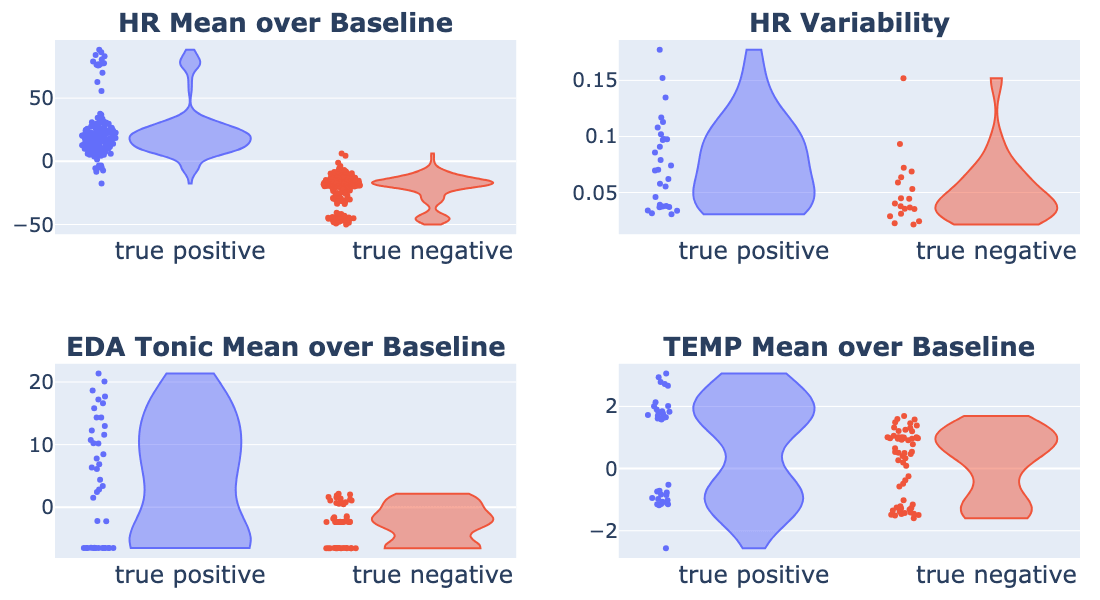
The qualitative results are where the approach earns its keep. For a stepping segment, IIC correctly highlighted the tonic EDA mean-over-baseline and heart-rate mean-over-baseline as the drivers, matching known physiology of physical activity. For a correctly detected seizure, it flagged the accelerometry outlier and activity components alongside heart-rate mean and variability, which lines up with the repetitive motor activity and steep tachycardia characteristic of tonic-clonic events. Because the weight vectors are sparse and defined per named concept, they aggregate cleanly into cohort-level tables, something saliency heatmaps struggle to do.
Caveats worth knowing
IIC is not a drop-in replacement for every XAI stack. The transformation F must be invertible, which rules out non-invertible feature extractors that CBM or SHAP could still handle. Frequency-domain components are compatible in principle but the authors note that raw frequency bins are not inherently interpretable without expert-defined cut-offs. The method also inherits any confounders in the training data. In the seizure experiment, temperature was assigned non-trivial importance even though there is no established seizure biomarker there, which the authors attribute to recording-setup artifacts such as patients being covered by a blanket in the monitoring unit.
Code availability is not mentioned in the paper, though the components rely on standard tooling like SciPy and NeuroKit2. For teams building wearable inference pipelines around LSTMs or transformers, the design pattern is transferable: define an invertible decomposition into clinically meaningful pieces, wrap the trained model with the inverse transform, and optimize per-sample weights to surface which concepts the network is really using.