
Oxford Researchers Verify Neural Safety Controllers 382x Faster Than Current Tools
A new framework verifies neural safety certificates for control systems orders of magnitude faster than SMT solvers, unlocking much larger networks.
Takeaways
- New framework verifies neural control barrier functions via linear bound propagation and McCormick relaxation, avoiding SMT solvers entirely. Paper
- Extends LBP to compute affine bounds on network gradients, not just outputs, by recursively bounding per-layer Jacobian products.
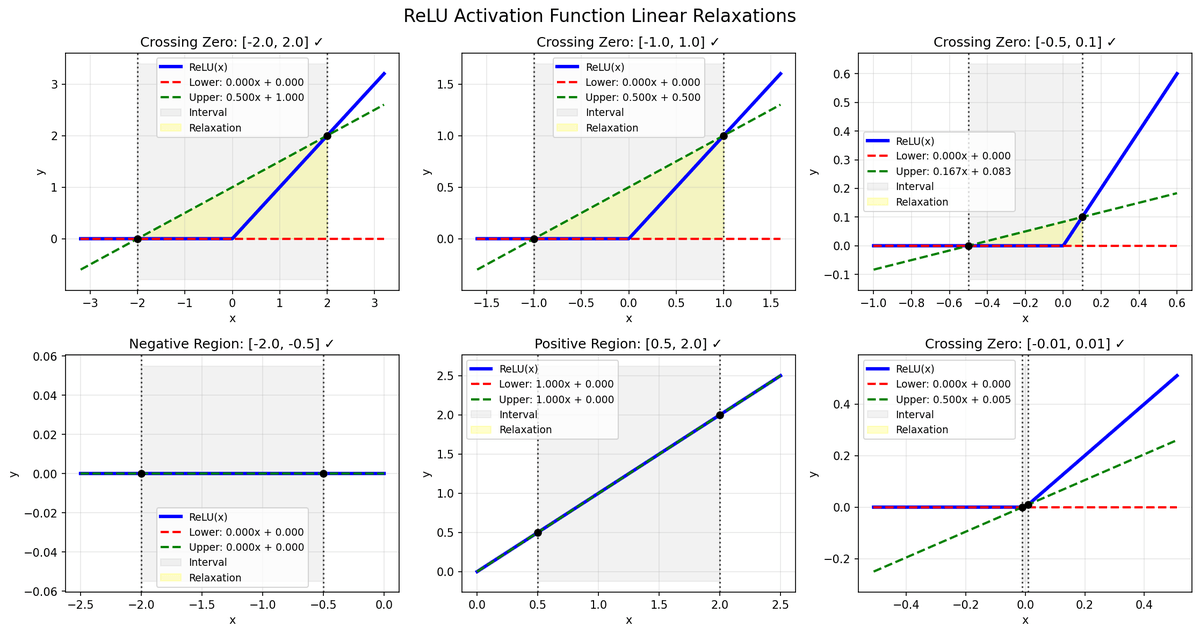
- Supports arbitrary control-affine dynamics and any semidifferentiable activation, including tanh, sigmoid, ReLU, and leaky ReLU.
- Uses a simplicial mesh with adaptive refinement along longest edges, batched across GPU for parallel verification.
- Certifies a [128, 256, 128] tanh network in 145 seconds where dReal times out entirely on smaller networks.
- Code available at github.com/Zinoex/verification-of-neural-cbf-via-lbp; benchmarks include cart-pole and UAV collision avoidance.
Safety certification sounds boring until a drone flies into a wall. For nonlinear control systems, one of the most popular ways to prove a controller will keep the system out of trouble is a control barrier function (CBF), a scalar function whose sign tells you whether the state sits inside a provably safe region. Researchers increasingly parameterize these functions as neural networks, which lets them handle nastier dynamics and more expressive safe sets. The catch: once you train the network, you still have to prove it satisfies the CBF conditions everywhere in the state space, and that proof is where everything falls apart.
A new paper from Oxford, TU Delft, and RWTH Aachen goes after that bottleneck with a technique called linear bound propagation for neural CBF verification. The authors verify neural CBFs using piecewise linear upper and lower bounds on the conditions required for the network to be a valid barrier, extending linear bound propagation (LBP) to also bound the gradients of the network, and combining that with McCormick relaxation to eliminate the need for expensive solvers. The code is on GitHub.
Why verification has been the wall
A CBF is valid if its zero-superlevel set stays inside the safe set and if there always exists a control input that keeps the state's time derivative pointing in a non-decreasing direction with respect to the barrier. Verifying that condition for a neural network means checking a nonlinear inequality involving the network, its Jacobian, and the system dynamics, over every state. Prior work leaned on