
Oxford Rebuilds Clinical Trials Statistics to Triple Drug Testing Power
A new kernel-based test-then-pool method borrows historical control data in clinical trials without inflating false positive rates.
 Pro
Takeaways
- New test-then-pool method uses kernel MMD and equivalence testing to safely borrow historical control data.
- Compares full outcome distributions, not just means, catching variance and tail shifts classic TTP misses.
- Introduces partial bootstrap and partial permutation to keep Type-I error at nominal levels after pooling.
- Proves overall validity and consistency guarantees that earlier equivalence-based TTP frameworks lacked.
- On Mexico's Prospera cash transfer data, achieves 61 percent rejection versus 23 percent for plain mean tests.
- Builds on companion work on kernel tests of equivalence by Liu and Gandy.
Running a randomized controlled trial is expensive, slow, and often ethically fraught, especially when it comes to recruiting patients into a placebo arm. A tempting shortcut is to borrow control data from earlier trials that used similar interventions. The catch: if the historical population differs from the current one, that borrowed data quietly biases your results. A team from the University of Oxford and QuantCo has proposed a new statistical procedure that decides when borrowing is safe by comparing the full outcome distributions rather than just their averages, and it does so with formal guarantees on false positive rates.
The paper, titled Data Fusion with Distributional Equivalence Test-then-pool, tackles a long-standing weakness in the test-then-pool (TTP) family of methods used across pharma statistics.
Where classic test-then-pool breaks down
The TTP framework has two stages: a fusion test that checks whether historical and current controls look compatible, and a causality test that compares the (possibly pooled) controls against the treatment group. The classic version tests the null hypothesis that historical and current control means are equal, and pools the data if that test fails to reject.
That setup has two nagging problems:
- Failing to reject equality of means does not imply the two are actually equivalent, it can simply reflect a lack of statistical power. Small current-control samples routinely get lumped together with heterogeneous historical data.
- This mistake can inflate the Type-I error of the final causal analysis. In plain terms, you end up claiming a treatment effect exists when it does not.
- Mean-based tests miss differences in variance, tails, or overall distribution shape, exactly the places where population drift often shows up.
Swapping means for distributions, and nulls for equivalence
The authors rebuild the fusion test around two ideas that are relatively new to clinical trial methodology.
The first is Maximum Mean Discrepancy (MMD), a kernel-based distance between probability distributions. Rather than comparing just the means of the historical and current controls, MMD embeds both distributions into a reproducing kernel Hilbert space and measures the norm of their difference. With a characteristic kernel (like the RBF), MMD equals zero only when the two distributions are truly identical, so it catches variance shifts, skew, and tail behavior that mean comparisons ignore.
The second is equivalence testing, which flips the usual null hypothesis. Instead of testing "the two controls are identical" and pooling on failure to reject, they test the null that the MMD distance between historical and current controls is at least some threshold theta, and reject only when there is statistical evidence that the distance is smaller. Pooling now requires positive evidence of similarity rather than absence of evidence of difference, which is the right way around for a decision that risks bias.

Partial bootstrap: the technical trick that makes it work
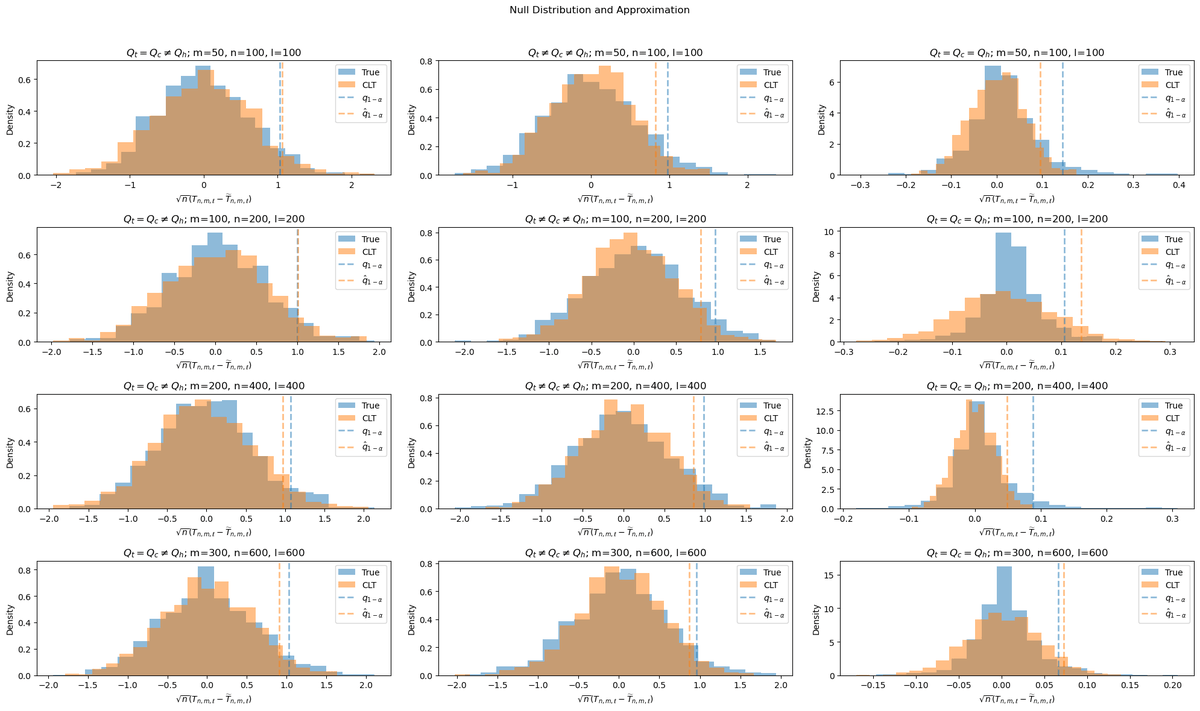
Once historical and current controls are fused, the causality test faces a subtle problem: the pooled control distribution is not identical to the current control, even when the fusion test passes. A standard permutation test between the pooled control and the treatment group would implicitly assume they come from the same distribution under the null, which is not quite true.
The authors introduce two calibration procedures to fix this:
- Partial bootstrap: resample the current control and treatment groups from the same current-control empirical distribution, while independently resampling the historical control. This preserves the correct dependence structure under the null even when historical and current controls differ slightly.
- Partial permutation: permute only between current control and treatment, treating the historical sample as an auxiliary that enters through the test statistic without being shuffled.
Partial bootstrap gives asymptotic validity and generally higher power. Partial permutation gives finite-sample exact validity but tends to produce conservative critical values when treatment and control genuinely differ. The paper proves both procedures maintain the nominal Type-I error rate of the overall TTP pipeline, a guarantee that was not explicitly derived or formally specified in earlier equivalence-based TTP work.
How it performs in practice
On synthetic Gaussian data with mean shifts and variance shifts, the equivalence TTP holds Type-I error near the nominal 5 percent even as historical controls drift away from current controls, while classic TTP visibly inflates its error rate. When the two control groups actually match, the new method pools them and gains statistical power over the no-fusion baseline.

The real-world stress test comes from Mexico's Prospera conditional cash transfer program, using 1998 village-level school enrollment as the outcome and 1997 baselines as historical controls. With only 50 subsampled contemporary control villages, the rejection rates across 1000 simulations tell the story:
| Method | Rejection Rate |
|---|---|
| Equivalence TTP (this paper) | 0.61 |
| Distribution test, no fusion | 0.40 |
| Mean test with fusion | 0.36 |
| Mean test, no fusion | 0.23 |
The equivalence TTP nearly triples the power of a plain mean-based test and outperforms every alternative. The core equivalence machinery it builds on comes from a companion paper on kernel tests of equivalence by Liu and Gandy.
When to reach for it, and when not to
This is a tool for anyone running or analyzing small RCTs where a larger pool of historical control data exists. It is particularly attractive when outcomes are high-dimensional or when the effect of interest lives in the tails rather than the mean, since MMD picks up distributional shifts that mean-only tests miss.
There are limits worth knowing:
- MMD has quadratic computational cost in sample size, which matters for very large trials.
- The equivalence margin theta is a hyperparameter that must be chosen a priori. Too large and you merge distributions that are too different, hurting power. Too small and the fusion test becomes overly conservative and rarely pools.
- Consistency against all alternatives requires either identical historical and current controls, or the treatment effect being larger than the residual historical-to-current gap. When those conditions fail, the test can lose power.
- The framework assumes randomized trial data. Extending it to observational sources would require additional assumptions like ignorability.
No public code repository is linked in the paper, but the algorithms are described in enough detail (including pseudocode for the partial bootstrap and permutation routines) that reimplementation on top of any standard kernel library is straightforward. The Semantic Scholar record tracks the paper's citation activity as the methodology propagates through the clinical statistics community.