
Oxford Audit Proves X Removes Violent Hate Speech no More Than Cat Photos
A global audit of 540,000 tweets shows 80% of hateful posts remained online after five months, with removal rates identical to neutral content.
Takeaways
- Global audit of 540,000 tweets found 80% of hateful posts remained online five months after posting on Twitter.
- Hateful tweets were no more likely to be removed than neutral ones, even when explicitly violent.
- Scams and adult content were removed far more aggressively than hate speech, contradicting stated policy priorities.
- Standalone AI classifiers including GPT-5.1 either over-moderate benign content or miss most hate speech.
- AI ranking places ~50% of hateful tweets in the top 3.2%, making it viable for human triage.
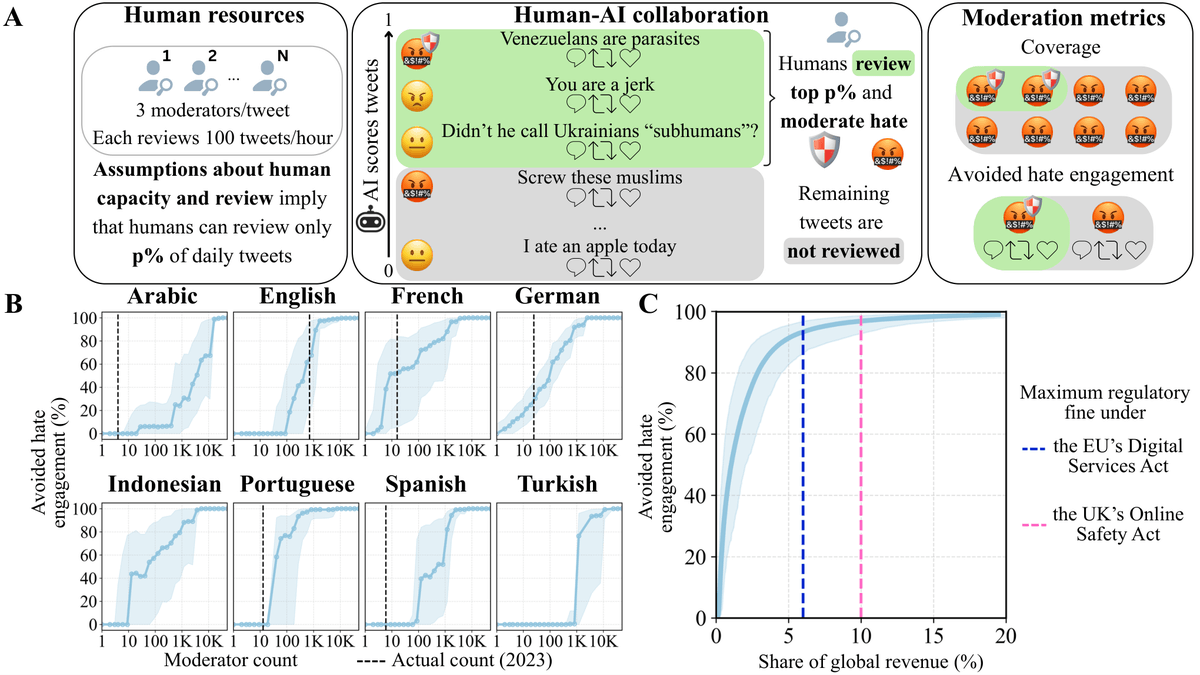
- Preventing 80% of hate exposure would cost 2.9% of revenue, below EU DSA and UK OSA maximum fines. Code and data.
A newly published global audit of Twitter (now X) has quantified something researchers long suspected but rarely measured at scale: hate speech policies on the platform were essentially unenforced, and the gap between what the company promised and what it did was not caused by technical limits. The study from researchers at Oxford, the World Bank, Princeton, and Bocconi audited 540,000 tweets across eight languages and found that a hateful post was no more likely to be taken down than a neutral one, even when it contained explicit calls for violence.
The team also built a simulation showing that a human-AI moderation pipeline could prevent roughly 80% of exposure to hateful content at a cost well below the fines regulators can already impose. That combination of empirical audit and feasibility model reframes online hate as a resourcing decision rather than an engineering problem.
The audit platforms could not run themselves
Prior studies of moderation have leaned on convenience samples like caches of deleted tweets or suspended accounts, which capture only enforcement that already happened. This work instead used a complete 24-hour snapshot of public tweets posted worldwide on September 21, 2022, collected roughly ten minutes after posting. From that firehose of 375 million posts, the authors drew stratified samples across Arabic, English, French, German, Indonesian, Portuguese, Spanish, and Turkish, plus four English-speaking countries (US, India, Nigeria, Kenya).
Every tweet was labeled by three native-speaker annotators into hate, offensive, or neutral, with hateful posts further split into violent versus non-violent by two additional reviewers. The resulting corpus contains 1.6 million labels for 540,000 tweets and is, to the authors' knowledge, the largest manual annotation effort in hate speech research to date.
Five months after posting, the team requeried every tweet and account through Twitter's Compliance API to measure what had actually been removed. The gap between policy and practice was immediate.
Violent hate was as safe as a cat photo
The headline number is stark. Five months after posting, only 20.2% of tweets labeled as hateful were removed on average across languages. When restricted to user suspensions, which are unambiguously platform-initiated, the removal rate drops to 9.2%, with just 9.0% of users who posted hate speech suspended.