
Oxford and SJTU's OmniStream Replaces Three Vision Models With One 400M Backbone
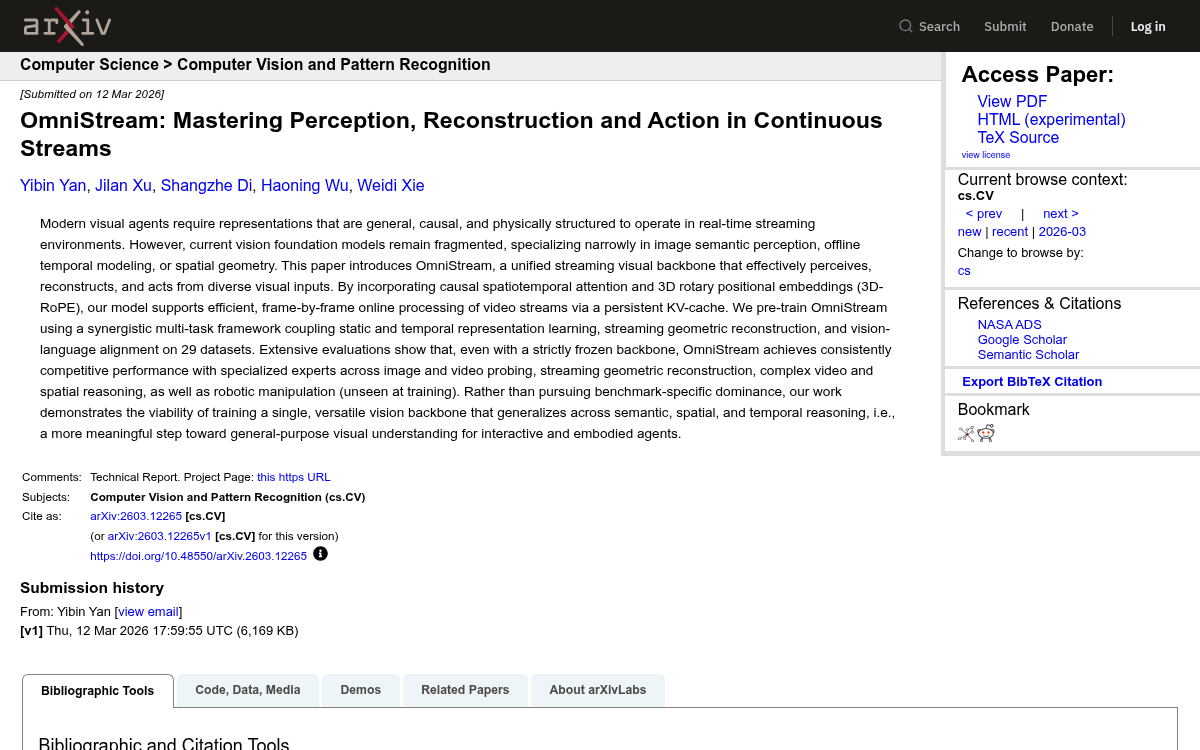
OmniStream turns a frozen DINOv3 backbone into a causal streaming model that handles perception, 3D reconstruction, VQA, and robot control from a single set of features.
 Pro
Takeaways
- OmniStream is a 400M causal streaming vision backbone built on DINOv3 with 3D-RoPE.
- A persistent KV-cache makes it roughly 15x faster than bi-directional recompute at 64 frames.
- Pre-trained on 200M frames across 29 datasets with SSL, geometry, and captioning losses jointly.
- Frozen features hit state of the art 70.6 on VSI-Bench, beating dedicated geometry encoders.
- First encoder shown to transfer to VLA benchmarks with a fully frozen backbone (CALVIN 3.89).
- Code and project page released; model scaling deferred to future work.
Most vision foundation models are one-trick specialists. DINO and SigLIP nail image semantics, V-JEPA handles offline video, and VGGT or DepthAnything crush geometry, but none of them can watch a live camera feed and simultaneously tell you what is in the scene, how far away it is, and where the robot arm should move next. A new paper from Shanghai Jiao Tong University, the Shanghai Innovation Institute, and Oxford's VGG lab argues that this fragmentation is unnecessary, and offers a single 400M-parameter backbone that does all of the above without being fine-tuned for any of them.
The model is called OmniStream, and it is designed for the setting that most production vision systems actually live in: a continuous stream of frames arriving one at a time, under tight latency and memory budgets. The authors formalize this as a strict causality constraint where the output at time t must not depend on any future frame, and then train a single backbone whose frozen features can be reused for image probing, video probing, streaming 3D reconstruction, video question answering, and robotic manipulation.
Why a Frozen Backbone Is the Hard Part
The interesting claim is not that OmniStream tops any single leaderboard. It doesn't. The claim is that the same set of frozen features, produced by one forward pass, is competitive with specialist models across all five domains. Across downstream evaluations the backbone parameters are kept fixed and only small task-specific heads are trained, which is the property that actually matters if you want to deploy one vision encoder behind many downstream systems.

To get there, the authors start from a DINOv3 ViT-L image encoder and add two things: causal spatiotemporal attention, and a 3D rotary positional embedding that extends the 2D RoPE to also encode time. The temporal component is interleaved into the head dimension with a 2:3:3 split across time, height, and width, which preserves most of the pre-trained spatial structure while adding a where-and-when signal.
The KV-Cache Trick That Makes It Streaming
Because attention is masked so tokens can only see the current and past frames, inference becomes incremental. When frame t arrives, the model computes its queries and reuses cached keys and values from frames up to t-1, producing the same output as full causal attention but without recomputing anything over the past stream. In practice this is the difference between a demo and a deployment.
The efficiency numbers are worth pausing on. On an H800 with 224x224 input:
- The bi-directional recomputation baseline reaches nearly 1 second of latency at T=64 and hits an out-of-memory error at T=128.
- OmniStream at T=64 runs in 0.067 seconds, roughly 15x faster, and its memory grows linearly rather than quadratically, so it can extend context to T=512 without OOM.
- Although the model is trained with a window of only 16 frames, it zero-shot extrapolates to continuous streams of up to 110 frames thanks to the 3D-RoPE.
Three Objectives Trained Together
The recipe combines three losses that each target a different axis of understanding, trained jointly on roughly 200M frames drawn from 29 datasets:
- Static and temporal representation learning. A DINOv3-style student-teacher setup that combines DINO, iBOT, KoLeo, and Gram anchoring losses. Images are treated as one-frame streams so the same objective covers both modalities.
- Streaming geometric reconstruction. Feed-forward heads predict per-frame depth maps, ray maps, point maps, and camera pose (as quaternion, translation, and field of view) with an L1 regression loss plus a learned confidence term for depth.
- Vision-language alignment. A Qwen3-0.6B autoregressive decoder is attached during pre-training and trained on captioning, OCR, and grounding, back-propagating gradients into the vision backbone.

The ablations in the paper make a stronger argument for this than the aggregate numbers do. Removing video from the SSL loss drops SSv2 from 69.3 to 63.0 and CALVIN from 3.80 to 3.42. Removing the 3D reconstruction objective collapses monocular depth to 0.471 RMSE and knocks VSI-Bench down 4.8 points. Removing the captioning objective is the worst: VideoMME drops 9.1 points and VSI-Bench falls 12.4 points, and CALVIN collapses from 3.80 to 2.38. The three objectives clearly reinforce each other rather than simply adding up.
How the Numbers Shake Out
With the backbone frozen, OmniStream is broadly competitive with domain specialists:
| Task | OmniStream | Specialist |
|---|---|---|
| ImageNet linear probe | 84.7 | DINOv3-L: 86.7 |
| SSv2 action recognition | 68.5 | V-JEPA2-L: 73.7 / DINOv3: 54.0 |
| DAVIS'17 VOS (J&F) | 71.6 | V-JEPA2: 44.2 / DINOv3: 73.2 |
| Sintel video depth (AbsRel) | 0.314 | CUT3R: 0.421 |
| VSI-Bench spatial reasoning | 70.6 | SpaceMind: 69.6 |
| CALVIN ABC-D (avg length) | 3.89 | OpenVLA: 2.55 |
The two most striking results are on the extremes of the stack. On VSI-Bench, a spatial intelligence benchmark, OmniStream reaches state of the art and surpasses baselines that bolt on dedicated geometry encoders like VLM-3R and SpaceMind, suggesting that the geometric priors are living inside the visual features themselves. On robotic manipulation, OmniStream is the first visual encoder shown to transfer to VLA benchmarks with a fully frozen backbone, hitting 3.885 on CALVIN and 45.8 percent on SIMPLER-ENV while frozen Qwen2.5-VL and LLaVA-Video collapse under the same conditions.
Where It Falls Short
OmniStream trails DINOv3 on pure static image tasks (ImageNet 84.7 vs 86.7, ADE20K 49.1 vs 51.5) and trails V-JEPA2 on SSv2. On KITTI video depth it lags CUT3R (0.136 vs 0.118), and against full-fine-tuning VLA baselines like Paligemma-1 pi0 on SIMPLER-ENV it is still behind. The authors are upfront that the model does not uniformly surpass specialized state-of-the-art methods on every benchmark and that model scaling is left as future work.
What Is Actually Available
The code is public on GitHub and the project page hosts additional details. Practical use cases suggested by the results include:
- Real-time perception pipelines where you want depth, pose, and semantics from one model rather than three.
- VLM backbones for embodied agents where general encoders like SigLIP or Qwen2.5-VL fail to translate to control signals.
- Long-context video reasoning tasks where the KV-cache lets you extrapolate well past training length.
- Research on unified pre-training recipes, since the ablations are clean and the objectives are individually well studied.
The broader point the paper is making is that vision has been converging on unification at the output level, wrapping specialist models behind text interfaces. OmniStream argues the more useful unification is at the representation level, where a single set of features is rich enough that swapping downstream heads is a matter of training a linear layer rather than fine-tuning a giant model. Whether that scales up to the kind of numbers that dominate leaderboards is now largely a question of compute.