
Oxford and MIT's SMPNN Beats Graph Transformers Without Any Attention
Oxford researchers show that wrapping graph convolutions in a Transformer-style block beats Graph Transformers on 100M-node graphs — no attention required
 Pro
Takeaways
- Core finding: Replacing attention with standard graph convolution inside a Pre-LN Transformer block beats all Graph Transformers on large graph benchmarks.
- Scale: SMPNN handles graphs up to 111M nodes and 1.6B edges with O(N+E) complexity — no quadratic attention cost.
- Oversmoothing solved: Residual connections are proven necessary for universal approximation; without them, deep GNNs collapse — with them, 12-layer networks train stably.
- Key results: SMPNN outperforms SGFormer by 3.6+ points ROC-AUC on ogbn-proteins and 6 points accuracy on pokec (1.6M nodes).
- Adding attention barely helps: SMPNN + attention gains under 1% while more than doubling parameters in some configs.
- Paper: arxiv.org/abs/2411.00835 — no public code repo yet, but architecture is straightforward to implement.
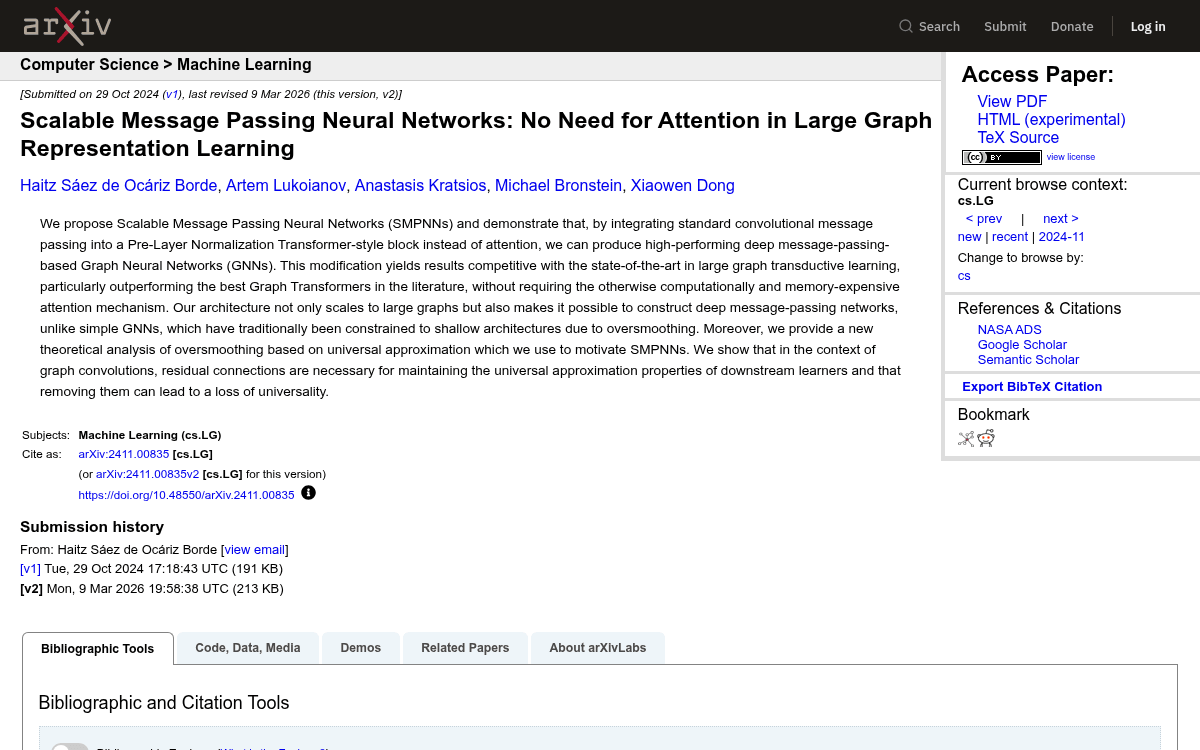
The dominant assumption in large-scale graph learning has been that attention is the key ingredient for strong performance. Graph Transformers have held state-of-the-art results on major benchmarks, and the field has spent years engineering workarounds for their crippling computational cost. A new paper from researchers at Oxford, MIT, and McMaster University challenges that assumption head-on: attention is not the secret sauce. The packaging around it is.
The Two Walls GNNs Keep Hitting
To understand why this matters, you need to know the two problems that have plagued graph learning at scale.
- Oversmoothing: GNNs suffer from the problem of oversmoothing, where the features of all nodes exponentially converge to the same vector over layers, prohibiting the design of deep GNNs. In practice, increasing model depth leads to homogeneous node representations and worse downstream task performance, so many GNNs used in practice remain shallow and often only have a few layers. This keeps GNN parameter counts orders of magnitude below what LLMs use.
- Attention's quadratic cost: The self-attention mechanism in Transformers introduces quadratic computational complexity regarding the number of nodes, and since real-world graphs may contain millions or even billions of nodes, Transformers often struggle to scale to large graphs efficiently. The workarounds , kernelized attention, linear approximations, sparse patterns , can degrade performance or restrict expressive power.
Graph Transformers tried to solve the first problem but created the second. Standard GNNs avoided the second but were stuck with the first. The field has been trading one wall for the other.
The Insight: It Was Never About Attention
The SMPNN paper, led by Haitz Sáez de Ocáriz Borde and co-authored by Michael Bronstein, draws a parallel to the history of LLMs. Attention had already been proposed before the Transformer architecture existed. What made it transformative was how it was packaged , inside a block with residual connections, layer normalization, and a pointwise feedforward network. Traditional GNNs simply stack message-passing layers one after another, ignoring all of that hard-won engineering wisdom from the LLM world.
The core claim of the paper is simple: take that Transformer block, swap attention for a standard graph convolution (GCN layer), and you get a deep, scalable GNN that beats the best Graph Transformers , without ever computing attention at all.
How SMPNN Works, Step by Step
Each SMPNN block applies the following sequence of operations to the node feature matrix X:
- Pre-LayerNorm: Normalize node features before any communication step , following the Pre-LN Transformer convention, which stabilizes training in deep networks.
- Graph Convolution + Residual: Apply a standard GCN layer (degree-normalized neighbor aggregation), then add the input back via a residual connection. A learnable scalar
alpha, initialized at1e-6, gates the convolution output , a trick borrowed from DiT (diffusion transformers) that makes early training behave like an identity function. - Second Pre-LayerNorm + Pointwise Feedforward + Residual: Normalize again, apply a per-node MLP with SiLU activations, and add another residual connection.
The full model stacks N of these blocks, with input/output linear projections. Here is a minimal sketch of a single block:
def smpnn_block(X, A_tilde, W1, W2, alpha1, alpha2):
    # Step 1: Pre-LN + graph conv + residual
    H1 = layer_norm(X)
    H2 = alpha1 * silu(A_tilde @ H1 @ W1) + X
    # Step 2: Pre-LN + pointwise feedforward + residual
    H3 = layer_norm(H2)
    H4 = alpha2 * silu(H3 @ W2) + H2
    return H4
The graph convolution has O(E) complexity in the number of edges, so the overall model is O(N + E) , the same asymptotic class as the best scalable Graph Transformers, but without any attention computation at all.
Why Residual Connections Are Non-Negotiable: The Theory
The paper does not just show this empirically , it proves it. The theoretical contribution reframes oversmoothing through the lens of universal approximation (the ability of a model class to approximate any continuous function to arbitrary precision).
The key result: a graph convolution layer without a residual connection is provably not a universal approximator. The reason is geometric , on a fully-connected graph, a plain convolution maps every input to a matrix where all rows are identical (the global average). This collapses the input space into a lower-dimensional subspace, and any downstream MLP operating on that collapsed representation loses the ability to distinguish inputs that had different per-node features but the same average. The paper provides a universal approximation perspective, demonstrating that residual connections, such as those found in the Transformer block architecture and in the Mamba block, are essential for preserving the universal approximation properties of downstream classifiers.
Adding a residual connection restores injectivity , the mapping becomes one-to-one , and universality is recovered. The paper proves this holds for general graphs under a mild spectral norm condition on the weights, and shows the pathological failure case occurs with probability zero at random initialization.
Benchmarks: Beating Graph Transformers Without Attention
The experiments cover four large OGB (Open Graph Benchmark) datasets and scale up to 100 million nodes. SMPNNs outperform the best Graph Transformers in the literature without requiring the computationally and memory-expensive attention mechanism.
| Dataset | Nodes | SGFormer (best prior) | SMPNN | SMPNN + Attention |
|---|---|---|---|---|
| ogbn-proteins | 132K | 79.53 ROC-AUC | 83.15 | 83.65 |
| pokec | 1.6M | 73.76% | 79.76% | 80.09% |
| ogbn-arxiv | 169K | 72.63% | 73.75% | 74.38% |
| ogbn-products | 2.4M | 89.09% | 90.61% | 90.79% |
On the massive ogbn-papers100M dataset (111 million nodes, 1.6 billion edges), SMPNN scores 66.21% accuracy versus SGFormer's 66.01% , while being simpler and cheaper. The paper also shows that adding attention on top of the base SMPNN yields less than 1% improvement while more than tripling the parameter count in some configurations.
Deep Networks Are Finally Possible
One of the most striking ablation results is the depth experiment. The SMPNN architecture makes it possible to construct deep message-passing networks, unlike simple GNNs, which have traditionally been constrained to shallow architectures due to oversmoothing. Stacking up to 12 SMPNN layers on ogbn-arxiv shows stable or improving performance. Remove the residual connections, and the same network collapses to near-random accuracy at 6 layers , exactly what the theory predicts.
The ablation also confirms the hierarchy of what matters most:
- Residual connections , removing them causes catastrophic degradation (ogbn-arxiv drops from 73.75% to 39.67% at 6 layers)
- Message-passing convolution , the core workhorse; a Linear Transformer baseline (global attention, no local convolution) performs substantially worse
- Pointwise feedforward , modest but consistent gains across datasets
- LayerNorm , generally helpful, though dataset-dependent
- Learnable alpha scalings , small gains, can be dropped for very large graphs to save memory
When to Use It, and When Not To
SMPNN is a strong fit for transductive node classification on large graphs , think social networks, citation graphs, biological interaction networks. It handles graphs with up to hundreds of millions of nodes and edges on a single GPU using mini-batch training with induced subgraph sampling.
The paper is honest about its limitations. The authors note that attention may matter more in settings with long-range dependencies , where nodes need information from distant parts of the graph that local convolution cannot reach in a few hops. They also flag that the benchmarks used have very high connectivity (MaxSCC ratio of 1.0), which may reduce the benefit of global attention. Emerging long-range graph benchmarks are left as future work. Additionally, SMPNN does not use positional encodings, which are computationally prohibitive at scale , and without positional signals, attention may degenerate into near-average aggregations anyway, partly explaining why it adds so little here.
The Real Takeaway
The deeper message of this paper is not just "skip attention." It is that the GNN community has been underinvesting in the architectural scaffolding around graph convolutions , the normalization, residuals, and initialization strategies that the LLM world figured out years ago. SMPNNs' empirical observations are supported by theoretical studies on oversmoothing, which suggest the crucial role of residual connections in mitigating oversmoothing and low-frequency dominance in representations. The paper's code is not yet publicly released as a standalone repository, but the architecture is simple enough to implement from the equations in the paper , the full block is fewer than 10 lines of PyTorch. The work comes from a strong team including Haitz Sáez de Ocáriz Borde and Michael Bronstein, whose tweet summarizes the finding bluntly: for scalable GNNs, attention is not needed , what matters is transformer-style normalization.