
Oxford and DeepMind Show Bad Optimizers Can Silently Destroy Model Generalization
A new theoretical analysis pins down how the choice of preconditioner in stochastic gradient methods can silently wreck generalization when noise and curvature disagree.
 Pro
Takeaways
- New Oxford and Google DeepMind preprint analyzes multipass preconditioned SGD via on-average stability.
- First on-average stability analysis that handles data reuse across multiple passes over the training set.
- Excess risk bounds depend on the effective dimension tr(H⁻¹Σ), tying generalization to loss curvature and noise geometry.
- Optimal preconditioner is P = H⁻¹; Adam-style whitening of noise gives suboptimal statistical rates under misspecification.
- Matching instance-dependent lower bounds prove a bad preconditioner can make excess risk arbitrarily worse.
- Provides explicit spectral alignment constants for inexact-Newton, diagonal, and regularized logistic regression cases.
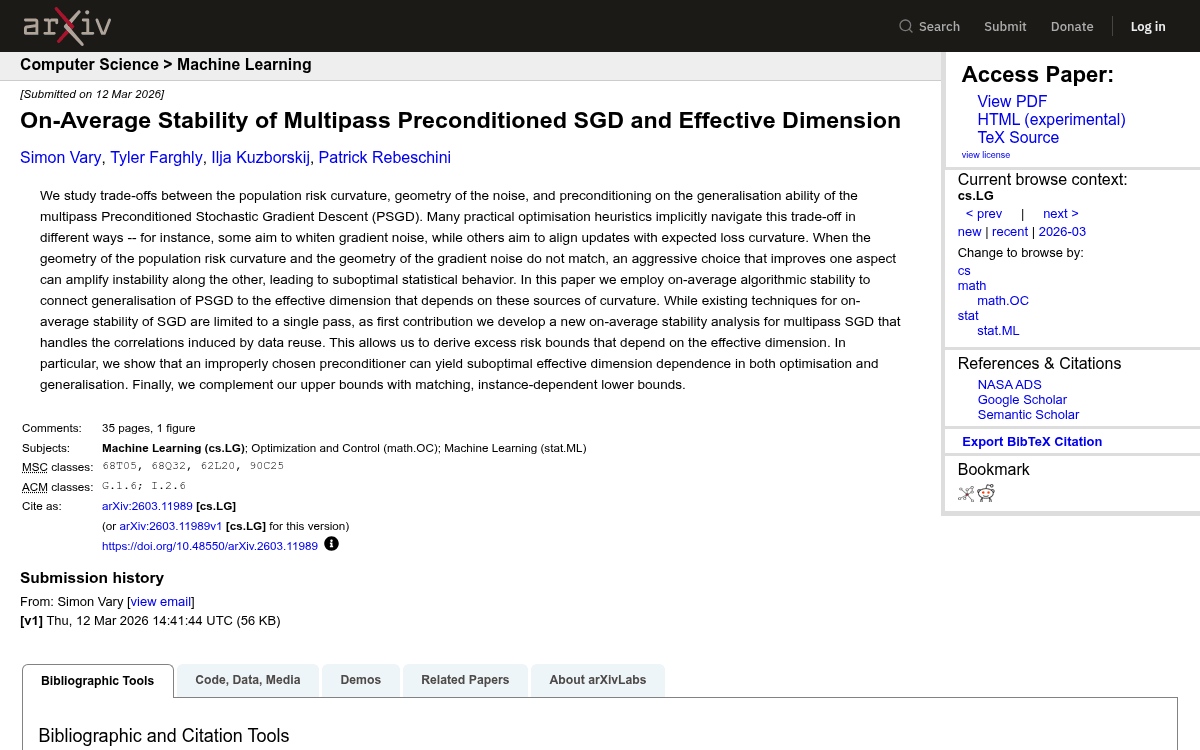
A new preprint from researchers at the University of Oxford and Google DeepMind takes a hard look at something practitioners rarely stop to think about: how the preconditioner inside optimizers like Adam, K-FAC, or SketchySGD interacts with the geometry of gradient noise, and what that means for how well a trained model actually generalizes. The paper derives non-asymptotic excess risk bounds for multipass preconditioned SGD and shows, with matching lower bounds, that a bad preconditioner choice can make generalization arbitrarily worse than the optimal rate.
Three matrices walk into a training loop
The core setup is familiar. You minimize an empirical risk with an update of the form x_{t+1} = x_t - eta * P * grad(loss), where P is a positive definite preconditioning matrix. The authors point out that the learning problem is governed by three sources of curvature: the Hessian of the population risk, the gradient covariance matrix, and the preconditioner chosen by the practitioner.
In an idealized world these three align. In practice they almost never do, and different optimizer families make different bets about which mismatch to fix:
- Methods like Adam and K-FAC target an approximate conditioning where P is roughly the inverse of the gradient covariance, while methods like AdaHessian, PROMISE, SAPPHIRE, and SketchySGD target the inverse of the expected Hessian.
- Whitening the noise (P ≈ Σ⁻¹) can destabilize updates along high-curvature directions.
- Aligning with curvature (P ≈ H⁻¹) can leave noise poorly conditioned.
Until now, no analysis characterized how this three-way mismatch shows up in finite-sample generalization for the multipass setting most real training actually uses.
Why the multipass case was stuck
The technical obstacle is subtle. Generalization bounds for SGD are typically proved via algorithmic stability: perturb one training point and ask how much the final iterate moves. The sharpest version of this argument, on-average stability, gives distribution-dependent bounds but breaks once you do more than one pass over the data, because iterates become correlated with the samples they have already seen.
The workaround in the literature has been to fall back on uniform stability with a global Lipschitz assumption, but this step effectively removes any dependence on the data distribution and its interaction with finer geometric properties of the loss. In other words, you lose exactly the geometry you wanted to study.
What the paper actually proves
The authors develop an on-average stability analysis that handles multipass SGD directly, using a recursive control of the parameter-stability quantity in a weighted Euclidean norm. The payoff is a clean expression for excess risk in terms of the effective dimension tr(H⁻¹Σ), which behaves like a distribution-aware replacement for the ambient parameter count. Concretely, for smooth strongly convex losses they show:
E[excess risk] <= (64 / (lambda_min(PH) * alpha)) *
  ( E[tr(PHP * Sigma_S)] / (t+1)
    + tr(P * Sigma) * (1/sqrt(n(t+1)) + 1/n) )
Two things fall out of this bound. First, the optimal choice P equal to the inverse Hessian recovers the optimal rate, while other choices lead to the suboptimal statistical rate. Second, and more surprisingly, the geometry required to minimise the variance in the optimisation error is identical to the geometry required to minimise finite-sample algorithmic instability. Second-order information is doing double duty as both a speed and a robustness mechanism.
For non-convex losses satisfying a Polyak-Lojasiewicz condition (a curvature-like assumption that guarantees gradient descent still converges linearly), they push the analysis further and show that excess risk no longer depends on a particular P and behaves as if an optimal P was chosen at convergence.
The lower bound is where it bites
Upper bounds alone would be easy to dismiss as loose. The paper closes the gap with instance-dependent lower bounds for single-pass PSGD. The takeaway is uncomfortable:
- For a badly conditioned P, the risk lower bound scales as tr(HΣ)/(ε·t), where ε is the smallest eigenvalue of PH. As P approaches rank-deficiency, the excess risk constant grows without bound, even with a decaying step size.
- Even a well-conditioned P cannot save you if H itself is badly conditioned: plain SGD (P = I) can be worse than optimal by a factor of κ(H).
The authors also introduce a spectral alignment framework that gives an explicit constant C measuring how well P and H⁻¹ agree, with worked examples for inexact-Newton methods (bounded by q² where q is the approximation quality), diagonal preconditioning via Gershgorin discs, and regularized logistic regression.
What this changes for practitioners
This is a theory paper. There is no code release, no benchmark table, no new optimizer named after a gemstone. What it delivers is a principled explanation for a phenomenon that has been floating around the empirical literature: that noise geometry and curvature both matter, and that treating one while ignoring the other can hurt statistical performance in ways that are invisible to standard convergence analysis.
A few concrete implications worth internalizing:
- Under model misspecification, natural gradient descent using the Fisher information is no longer optimal. The analysis shows that in the misspecified regime the right target is the inverse of the expected Hessian, not the gradient covariance.
- The gap between Adam-style and Hessian-based preconditioners is not just about wall-clock convergence, it is a statistical gap that persists in finite samples.
- The effective dimension tr(H⁻¹Σ) is the quantity worth measuring if you want a distribution-aware notion of model capacity, more informative than parameter count and more tractable than uniform stability arguments.
For anyone working on second-order optimizers, sketching-based curvature estimation, or the theory of large-batch training, this gives a rigorous handle on why the mismatch between noise and curvature can quietly undo the gains from a fancier preconditioner.