
Oslo Researchers Map Where Generative AI Breaks Down Designing Inorganic Materials
A sweeping review maps how genetic algorithms, VAEs, diffusion models, and LLMs are tackling inverse design across metal complexes, perovskites, MOFs, and zeolites.
 Pro
Takeaways
- Review maps generative AI methods across transition metal complexes, perovskites, MOFs, and zeolites.
- Diffusion models like MatterGen now define state of the art for crystal structure generation.
- Genetic algorithms remain competitive for low-data, multi-objective design of modular materials.
- LLMs like ChatMOF hit 90% accuracy on MOF inverse design through agentic workflows.
- Field lacks standardized benchmarks; SUN metric is a start but incomplete.
- Synthesizability prediction for inorganics remains an open, high-value research problem.
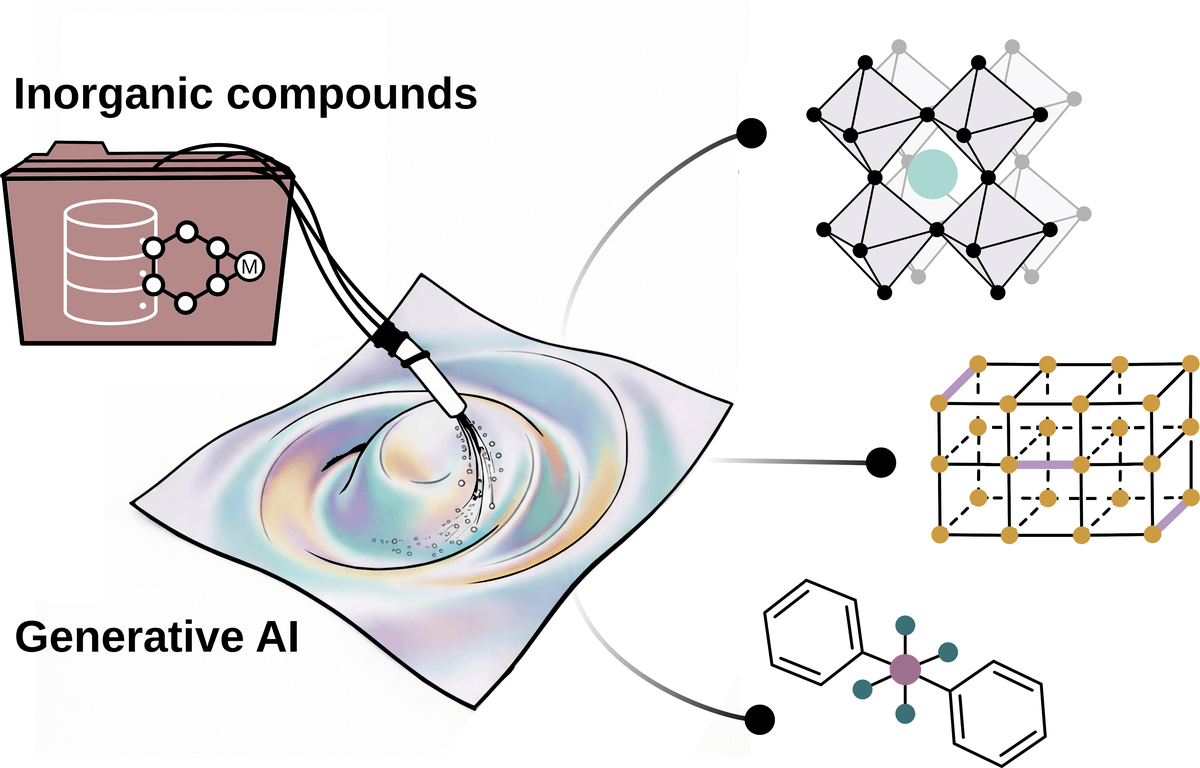
Generative AI has already reshaped drug discovery, but the same tricks fall apart the moment you leave organic chemistry. A new review from the Hylleraas Centre at the University of Oslo takes stock of where the field stands for inverse design of inorganics, tracing how genetic algorithms, VAEs, diffusion models, and LLMs are being bent into shape to handle metal complexes, perovskites, MOFs, and zeolites.
Inverse design flips the usual pipeline. Rather than predicting properties from a structure, you specify the properties you want (a band gap, a CO2 uptake capacity, a catalytic barrier) and let the model propose candidate compounds. The goal is to steer generation toward the tiny slice of chemical space that actually meets the target.
Why inorganics break the organic playbook
Organic molecules are mostly carbon skeletons with a small vocabulary of atoms and predictable bonding. Inorganics are messier. Compared to organics, they bring higher complexity in chemical composition, electronic structure, and geometry, including a wider set of elements, d and f orbital contributions to bonding, and periodicity under symmetry constraints. Crystals add another layer: any generative model has to respect one of 230 possible space groups, which encode the allowed symmetries of a periodic lattice.
The review organizes the field around four material classes with genuinely different physics: transition metal complexes (a metal center surrounded by ligands), non-porous crystals like perovskites, and two families of microporous materials, MOFs (metal nodes plus organic linkers) and zeolites (aluminosilicate cages).