
OSCBench Catches Top Video AI Models Failing Basic Cooking Physics
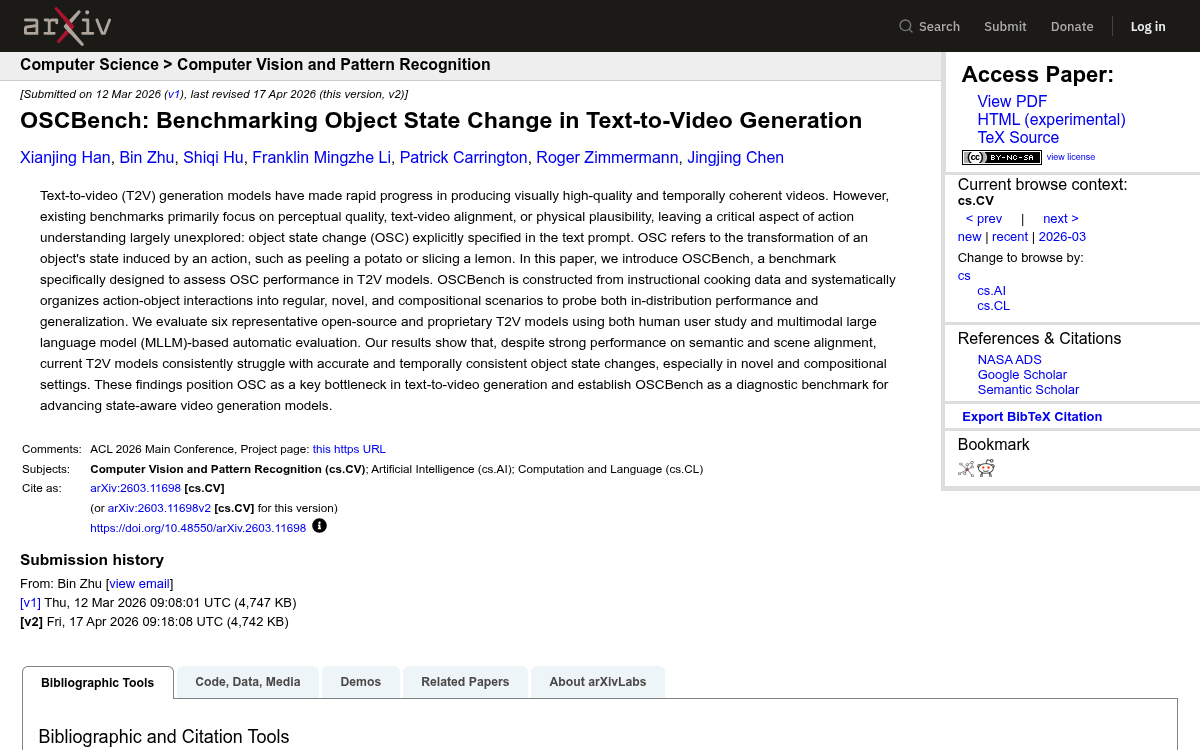
A new cooking-focused benchmark reveals that top text-to-video models can render a chef and a lemon, but botch the actual slicing.
 Pro
Takeaways
- OSCBench evaluates whether text-to-video models correctly render object state changes like slicing, peeling, or mashing.
- Built from HowToChange cooking data with 1,120 prompts across regular, novel, and compositional scenarios.
- Six models tested: Open-Sora-2.0, HunyuanVideo, HunyuanVideo-1.5, Wan-2.2, Kling-2.5-Turbo, and Veo-3.1-Fast.
- Veo-3.1-Fast leads with 0.786 OSC accuracy; Open-Sora-2.0 trails at 0.380 on human scoring.
- Novel action-object pairs cause the sharpest performance drop, exposing memorization over reasoning.
- Uses a three-step Chain-of-Thought MLLM judging protocol that better matches human ratings than black-box scoring.
Text-to-video models look increasingly convincing at first glance, but a new benchmark focused on cooking exposes a stubborn weakness: when a prompt asks the model to actually transform an object, whole lemons often stay whole, apples fail to become slices, and pears sit stubbornly unpeeled. A team from NUS, SMU, CMU, and Fudan built OSCBench specifically to measure this gap between looking right and getting the physics of an action right.
The paper zeroes in on what the authors call Object State Change, or OSC: the transformation an action induces on an object, like a raw carrot becoming peeled or dough being rolled flat. OSCBench tests whether current systems can render that transition faithfully, rather than just producing plausible motion around a stationary object.
Why current benchmarks miss the point
Existing video benchmarks like VBench, EvalCrafter, and PhyWorldBench mostly score perceptual quality, prompt alignment, or physical plausibility such as gravity and collisions. These benchmarks pay limited attention to object state change, leaving a critical dimension of action understanding largely unexplored. A model can score well on "is there a lemon" and "is there a knife" while completely failing to show the lemon becoming sliced over time.
Correct OSC generation requires a model to understand the action semantics expressed in language, infer the intended object transformation, and render a continuous and coherent visual evolution over time. That is a much harder test than semantic alignment, and it is exactly where the authors argue current systems break.
How the benchmark is built
OSCBench is derived from the HowToChange dataset, itself pulled from HowTo100M instructional cooking videos. The raw data has a heavy long-tail bias, so the authors used GPT-5.2 and Gemini-3 together with human experts to group 20 fine-grained actions into 9 action categories and 134 objects into 8 major categories with 28 finer subcategories. From that taxonomy they designed three difficulty tiers:
- Regular: common action-object pairs like slicing lemon or chopping potato.
- Novel: uncommon but physically feasible pairs like peeling berries or mashing grapefruit, which cannot be solved by memorizing training data.
- Compositional: two sequential actions on one object, such as peeling and then slicing a pear.
OSCBench comprises 140 scenarios with 8 action-object combinations each, resulting in 1,120 prompts overall, with an average length of 9.2 words.

Evaluation with a reasoning-guided MLLM
Every video is scored on eight dimensions: subject, object, and action alignment, OSC accuracy, OSC consistency, scene alignment, realism, and aesthetics. The authors run both a human user study and an automatic pipeline using Qwen3-VL-30B, GPT-5-mini, and GPT-5.2 as judges. Instead of using the multimodal LLM as a black-box scorer, they impose a three-step Chain-of-Thought protocol: the model first restates the scoring criterion in its own words, then extracts frame-level visual evidence and briefly explains why it supports the assessment, and only then assigns a discrete score from 1 to 5 explicitly linked to the observed evidence. This structured route measurably improves correlation with human judgments compared to a no-CoT baseline.
What the six models actually do
The team benchmarked four open-source systems (Open-Sora-2.0, HunyuanVideo, HunyuanVideo-1.5, Wan-2.2) and two proprietary ones (Kling-2.5-Turbo and Veo-3.1-Fast). The headline pattern is consistent across human and MLLM evaluators: models score high on subject, object, and scene alignment but drop sharply on state-change accuracy and consistency.

Human scores on OSC accuracy (0 to 1, higher is better):
| Model | OSC Accuracy | OSC Consistency | Action Alignment |
|---|---|---|---|
| Open-Sora-2.0 | 0.380 | 0.428 | 0.518 |
| HunyuanVideo | 0.402 | 0.510 | 0.494 |
| HunyuanVideo-1.5 | 0.524 | 0.608 | 0.656 |
| Wan-2.2 | 0.560 | 0.668 | 0.616 |
| Kling-2.5-Turbo | 0.726 | 0.726 | 0.826 |
| Veo-3.1-Fast | 0.786 | 0.748 | 0.908 |
Even the top model, Veo-3.1-Fast, misses roughly one in five state changes. And the gap widens on harder tiers: novel scenarios show the most severe degradation, indicating that current models struggle to generalize state-change reasoning to uncommon but feasible action-object pairs, while compositional scenarios sit between novel and regular.
Where models fail, concretely
The failure modes are specific and diagnostic. In one qualitative example, Wan-2.2 shows a half-sliced apple reverting to a whole state, Kling-2.5-Turbo produces unreal interactions between the knife and the bowl, and Veo-3.1-Fast introduces an additional apple chunk in the final frame. Actions with subtle or gradual visual signatures are the hardest: performance drops substantially for actions involving complex hand-object interactions or subtle visual transitions, such as peeling, coating, and pressing. Rolling and heating, by contrast, tend to work because the state change is localized and visually obvious.
Another notable finding: for uncommon pairs, models often fall back on memorized associations. When asked to peel berries, Wan-2.2 generated olives instead, which are far more common in peeling footage. That is a strong signal that current systems are pattern-completing over training-data statistics rather than reasoning about action semantics.
What it is useful for
OSCBench is a diagnostic tool, not a training set. If you are building or evaluating a video model, it gives you a targeted way to probe whether your system understands the consequences of actions rather than just their visual style. It is also directly relevant to downstream domains where OSC matters, including robotics data generation, embodied AI simulation, and instructional video synthesis. The main limitation the authors flag is scope: it is cooking-only, and extending to tool use, assembly, or outdoor activities is left as future work.