
Osaka's Tiny MLP Beats Hand-Tuned Control on Affetto's Pneumatic Humanoid by 87%
A compact 13-DOF pneumatic humanoid learns its own inverse dynamics, cutting trajectory tracking error by up to 87 percent versus a PID baseline.
 Pro
Takeaways
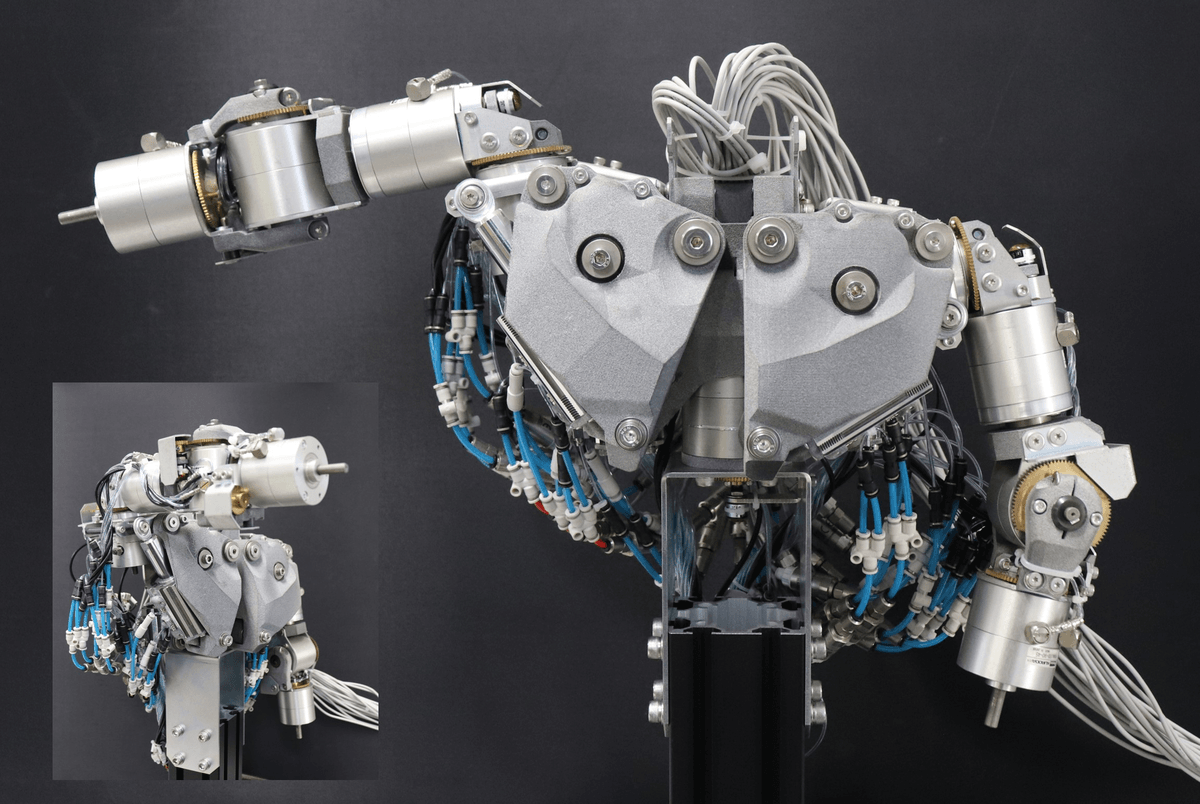
- Osaka team built a compact 13-DOF pneumatic humanoid upper body, 38 cm tall and 5.12 kg.
- Pneumatic transmission lines introduce 230-320 ms actuation delays across the joints.
- A small MLP learns inverse dynamics with future desired angles concatenated into the input.
- Training used 100 trials of random PID-driven motion, yielding 180,000 data points.
- The learned controller cut shoulder flexion tracking RMSE from 8.79 to 1.17, an 87% drop.
- Read the full paper on arXiv.
Pneumatic actuators are the friendly giants of robotics. They squish, they absorb impacts, and they make close contact with humans safe in a way that stiff, geared electric motors never really can. The catch is that they resist precise control: compressed air is nonlinear, friction causes sticking, and the long tubes between the compressor and the robot introduce hundreds of milliseconds of delay. A team at the University of Osaka has now shown that a small multilayer perceptron, trained on random flailing motions, beats a hand-tuned PID controller by a wide margin on a compact 13-DOF humanoid upper body.
The robot is the latest iteration of the Affetto project, a child-sized android built for physical human-robot interaction. Measured from the waist mount, it stands roughly 38 cm tall and weighs 5.12 kg. Two categories of pneumatic actuators drive it: vane-type rotary units and air cylinders. Both have rigid bodies and two air chambers, with torque or force determined by the pressure difference between those chambers.

Why pneumatic control is a nightmare
Controlling pneumatic actuators precisely is difficult because of nonlinearities including pressure dynamics, air compressibility, and friction. This robot is also built for close interaction, so the noisy compressor and valves have to sit far away from the body. That means long tubes, and long tubes mean delay. Measurements confirm a substantial and consistent baseline lag inherent to the air transmission lines, roughly 230 ms to 320 ms.
Classical approaches to this problem, from sliding-mode control to adaptive backstepping, typically require careful analytical modeling of a single joint. Scaling that up to 13 coupled joints, each with its own tube length, actuator quirks, and gravitational load, is impractical. So the authors asked a different question: is the robot at least reproducible enough that we can just learn its dynamics from data?
The reproducibility test
Before touching any neural network, they characterized the hardware. Three properties mattered:
- Transmission delay from valve command to actual movement, measured at 230-320 ms.
- Minimum activation pressure, dominated by internal static friction, which produces stick-slip effects that make slow motion jerky.
- Trial-to-trial reproducibility, tested by sending the same 60-second random pressure sequence to all 26 valves across 11 trials.
The RMSE matrices for all pairs of trials came out overwhelmingly light in color, indicating very low error between trials for almost all joints. Given the same initial state and command sequence, the system follows a nearly identical trajectory. That deterministic behavior, despite the messy underlying physics, is what makes a data-driven controller feasible in the first place.
Teaching an MLP the inverse dynamics
The controller is deliberately simple: a standard three-layer multilayer perceptron with an input layer of 20 neurons, a hidden layer of 200 neurons with tanh activation, and an output layer of 8 neurons. The clever part is what goes into that input vector.
Rather than only feeding the network the current state, the authors concatenate current joint angles, velocities, and chamber pressures with the desired joint angles from tau steps in the future. The network then has to output the valve commands needed right now to reach that future state. Based on empirical results, the lookahead period tau was set to 9 time steps, approximately 300 ms. That number was chosen to match the measured transmission delay from Experiment I.
Training data was harvested by letting a loosely tuned PID controller chase a random-walk reference trajectory around the workspace. 100 trials of 60 seconds each yielded 180,000 time-stamped data points for the four selected joints of the left arm. The PID controller here is just a driver to explore the state space, not a target of imitation.

PID gets crushed
On an unseen trajectory recorded by manually guiding the arm, the learned inverse model tracked the reference far more closely than the PID baseline. PID exhibits a consistent lag behind the reference, a direct consequence of the uncompensated system delay, and struggles to overcome gravity, noticeably undershooting when lifting the arm. It also produces jerky motion from stick-slip phenomena, especially during slower movements.
The trained network smooths out the stick-slip, compensates for gravity, and eliminates the lag. For the left shoulder flexion joint, the data-driven controller reduced RMSE from 8.79 to 1.17, a reduction of nearly 87 percent. Similar improvements appeared across all four tested joints.
What is actually new here
The headline is not that neural networks beat PID; that story is old. The interesting contribution is more subtle:
- Prior work on delay compensation in pneumatic systems was almost entirely restricted to single-joint experimental rigs with hand-crafted models. This paper does it on a coupled 4-DOF subsystem of a real humanoid, learning the coupling between shoulder abduction, flexion, rotation, and elbow flexion from data alone.
- The delay compensation trick, embedding future desired states as input features, is a data-driven analogue of classical preview control that requires no explicit model of the delay dynamics.
- The authors show that even a compact, high-DOF pneumatic robot with 2.5 m transmission lines is reproducible enough for supervised learning to work at all, which was not obvious given the friction and compressibility involved.
Where it falls short
The current controller is a static mapping, so it does not model the fact that the true delay actually varies with actuator state and load. Tracking very fast movements is limited by the physical actuation delay, while tracking very slow movements is challenged by stick-slip effects. The model also assumes a constant time delay throughout the actuators, though the true delay varies with actuator state and external loads. The authors flag recurrent networks and online adaptation for picking up objects as the natural next steps, along with scaling from the 4-DOF arm to the full 13-DOF body.
The paper does not publish a code repository or trained weights, so anyone wanting to reproduce the approach on their own pneumatic hardware will need to start from the equations and hyperparameters described in the paper. Still, for anyone building compliant robots for close human contact, the recipe is refreshingly boring: measure your delay, embed a lookahead of matching length in your training inputs, and let a modest MLP figure out the rest.