
Osaka's CALIPER Tells Streaming AI Exactly When to Retrain After Drift
CALIPER tells streaming ML systems exactly how much post-drift data to collect before retraining, without touching the model itself
 Pro
Takeaways
- CALIPER is a new method that determines exactly how much post-drift data to collect before retraining a streaming ML model, without accessing model internals.
- It works by testing whether the post-drift window exhibits "state dependence" -- a property of well-sampled dynamical systems -- using lightweight weighted local regression.
- Evaluated across 4 datasets, 3 model families (KRR, MLP, Transformer), and 2 drift detectors (ADWIN, KSWIN), CALIPER matches or beats the best fixed window size in every setting.
- Against incremental (online SGD) baselines, gains are dramatic: MLP on MoCap shows MSE of 7.1 vs 412.6 for incremental updates after sudden drift.
- The algorithm is model-agnostic, detector-agnostic, label-free, and adds negligible compute overhead to any streaming pipeline.
- Code and datasets are open-source on GitHub; the paper is available on arXiv.
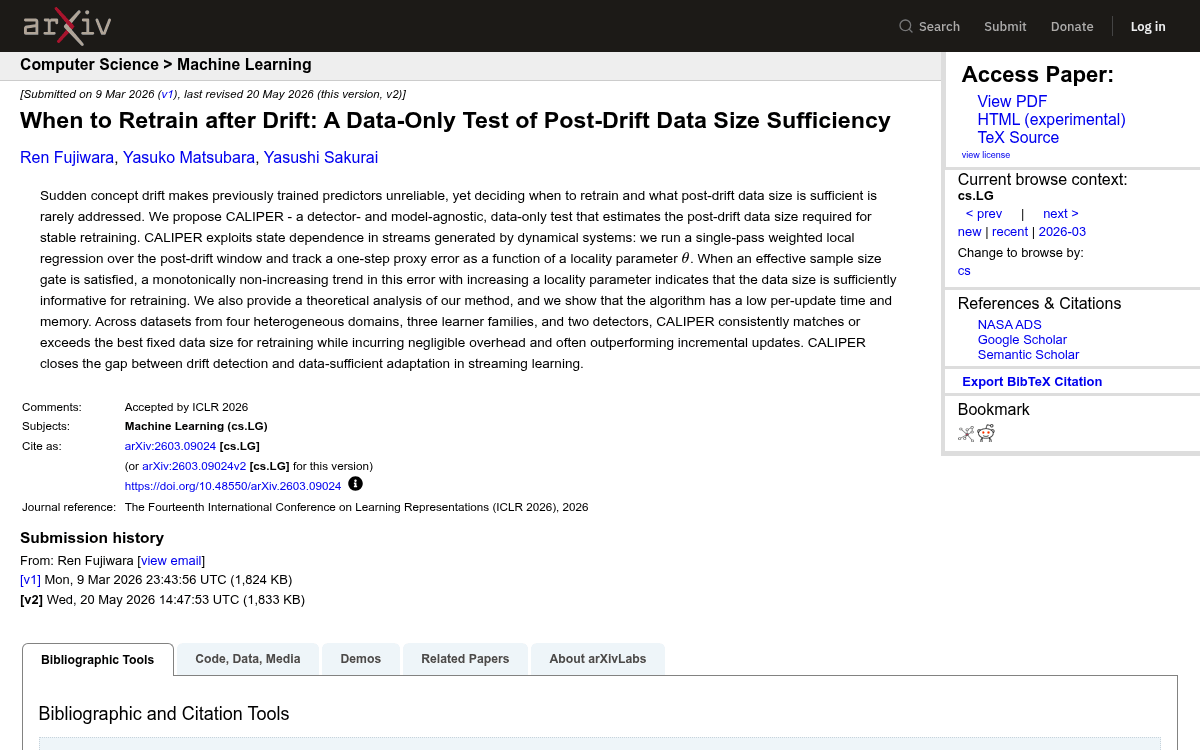
Every production ML system that processes live data streams faces a silent crisis the moment a sudden concept drift hits: the model is now wrong, a detector has fired, and nobody knows how long to wait before retraining. Retrain too early and you overfit to a handful of noisy post-drift samples. Wait too long and a stale model keeps making bad predictions. Researchers at the University of Osaka have now published CALIPER, a method that answers this exact question purely from the data stream itself, without ever touching the downstream model.
The gap nobody was filling
Concept drift -- when the statistical relationship between inputs and outputs changes over time -- is one of the most common failure modes for deployed ML. Models trained on historical data can suffer performance degradation due to concept drift, where the inter-relationship between features and labels changes between training and production. The standard toolkit for handling this includes detectors like ADWIN and KSWIN, which watch the stream and raise an alarm when a shift is detected.
But detection is only half the battle. Window-based detectors such as ADWIN and KSWIN decide whether and when a drift occurs, but they are silent about the post-drift data sufficiency problem. In practice, this gap is critical: choosing a post-drift window that is too short leads to unstable retraining and oscillations, whereas waiting for an overly long window prolongs the use of a stale pre-drift model. Making things worse, repeated probe-and-train approaches that retrain complex predictors such as deep neural networks to gauge readiness are computationally prohibitive in streaming scenarios.
The practical workaround today is to pick a fixed window size -- say, 512 samples -- and retrain once that many post-drift points have arrived. The problem: the fixed size with the best prediction accuracy varies widely. For example, the MLP model achieves its highest accuracy on TEP with a data size of 512, whereas the same setting yields the lowest performance on MoCap. There is no single right answer, and guessing wrong is costly.
State dependence as a readiness signal
CALIPER -- short for Cumulative Assessment of Locality Indicator for Post-drift Estimation of Retraining-size -- reframes the problem. Instead of asking "has enough time passed?", it asks a structural question about the data itself: does the post-drift window already exhibit the kind of local regularity that makes a stream learnable?
The key insight borrows from nonlinear dynamics. Assuming the data are generated by a (possibly nonlinear) dynamical system, CALIPER exploits state dependence to infer a sufficient post-drift data size without retraining. State dependence is the property that nearby states in a time series tend to evolve similarly -- if two points in feature space are close together now, their one-step futures should also be close. When a post-drift window has enough data to exhibit this property reliably, it is ready for retraining.

How it works, step by step
CALIPER runs as a lightweight online algorithm that processes each new data point in a single pass. At every timestep after a drift alarm, it executes four steps:
- Normalize and split the window. The post-drift buffer is normalized and divided into a reference set of consecutive (input, next-step) pairs and a single query point -- the most recent observation.
- Effective Sample Size (ESS) gate. Using an exponential kernel parameterized by a locality parameter
theta, CALIPER computes how many "effective neighbors" the query point has at the tightest locality setting. If there are fewer thanC * (d+1)effective neighbors (wheredis the feature dimension), the window is too small and CALIPER waits for more data. - Weighted local regression sweep. For each value of
thetaon a fixed grid (e.g.,[0, 0.1, 1.0, 2.0, 4.0, 8.0, 16.0]), CALIPER fits a tiny weighted linear regression to predict the query's next step, using kernel weights that emphasize nearby reference points. A higherthetameans tighter locality -- only the closest neighbors get significant weight. - Monotone locality test. CALIPER checks whether the cumulative one-step prediction error decreases monotonically as
thetaincreases. If tighter neighborhoods consistently produce better predictions, the data exhibits state dependence and retraining is triggered.
The logic is elegant: in a well-sampled dynamical system, zooming in on local neighborhoods should always help. If it does not -- if tighter locality makes predictions worse at some point -- then the window is too sparse and the local structure has not yet emerged from the noise.
Here is a minimal sketch of the core decision logic:
def caliper_check(X_post_drift, theta_grid, C=3):
    # Normalize, split into reference pairs and query
    Z = normalize(X_post_drift)
    X_h, Y_h = Z[:-2], Z[1:-1]   # reference: (state, next_state)
    x_q, y_q = Z[-2], Z[-1]      # query point
    # Compute distances from query to all reference points
    dists = ||X_h - x_q||  # shape: (n-2,)
    r = dists / mean(dists)
    # ESS gate at tightest locality
    w_max = exp(-theta_grid[-1] * r)
    ESS = sum(w_max)**2 / sum(w_max**2)
    if ESS < C * (d + 1):
        return False  # not enough data yet
    # Sweep theta, accumulate proxy errors
    errors = []
    for theta in theta_grid:
        w = exp(-theta * r)
        beta = weighted_least_squares(X_h, Y_h, w)
        errors.append(||y_q - x_q @ beta||)
    # Trigger if error is monotonically non-increasing
    return all(errors[i] >= errors[i+1] for i in range(len(errors)-1))
What the benchmarks show
Across four datasets (MoCap, TEP, Automobile, Dysts), three model families (KRR, MLP, Transformer), and two detectors (ADWIN, KSWIN), CALIPER matches or exceeds the best fixed data size for retraining without per-dataset tuning, improves post-drift error and recovery, and outperforms incremental updates with negligible overhead.
The comparison against incremental updates (online SGD, no explicit retraining) is particularly striking. For MLP, CALIPER yields large gains on MoCap and Dysts -- for example, MoCap MSE 7.106 vs. 412.6 for incremental; Dysts: 0.432 vs. 71.75 -- indicating that purely local incremental steps can be unstable under drift. Incremental learning, the default fallback in many streaming systems, simply cannot recover from abrupt shifts the way a full retrain on a well-chosen window can.
On computational cost: across all combinations, the wall clock time curves are essentially flat and the mean cost per step is small; occasional spikes align with model retraining and are not caused by CALIPER. The lightweight local regressions CALIPER runs are negligible compared to the cost of the downstream model itself.
Where it fits and where it does not
CALIPER is designed for a specific and common scenario: sudden, abrupt drift in time-series streams where the underlying process has some dynamical structure. It is a post-detection tool -- it assumes a drift alarm has already been raised by a separate detector like ADWIN or KSWIN. It does not replace those detectors; it answers the question they leave open.
Good fits for CALIPER include:
- Industrial sensor streams (process control, manufacturing) where regime changes are abrupt
- Financial time series with sudden market-structure shifts
- Any streaming prediction pipeline using KRR, MLP, Transformer, or tree-based models
- Systems where retraining is expensive and triggering it prematurely is a real cost
The paper is also candid about limitations. CALIPER relies on distance-based local neighborhoods to form localized fits, and naive nearest-neighbor weighting can be unreliable in very high dimensions: neighborhoods become sparse, effective sample sizes can collapse, and the localized regression can degrade unless the post-drift window is sufficiently large. For very high-dimensional raw inputs like image streams, the authors recommend pairing CALIPER with a compact upstream representation. The method also assumes the stream follows some dynamical law -- it is less suited for purely i.i.d. classification tasks where no temporal structure exists.
The real breakthrough
What makes CALIPER genuinely novel is not just that it works, but that it works without any access to model internals, ground-truth labels, or held-out test data. CALIPER produces these estimates without observing the post-drift test segment or relying on model-specific internals, closing the gap between drift detection and data-sufficient adaptation. It is a pure data-side test -- plug it into any pipeline, with any model, using any detector, and it will tell you when to pull the trigger on retraining.
The theoretical backing is also meaningful. Under a stylized dynamical model, passing the monotone-locality test implies stronger state dependence; under standard regularity assumptions, this can be favorable for learnability on a suitable local region -- providing a principled basis for post-drift sample sizing. This is not a heuristic that happens to work on benchmarks; there is a formal argument for why the trigger correlates with retraining readiness.
The source code and datasets are publicly available on GitHub, making it straightforward to drop CALIPER into an existing streaming pipeline alongside whichever drift detector is already in use.