
Osaka Researchers Show Your Handwriting Reveals How Badly You Slept
A 28-day study finds that subtle neuromotor changes in handwriting can flag low-recovery nights, hinting at wearable-free health monitoring on tablets.
 Pro
Takeaways
- Handwriting kinematics can classify a person's low-recovery days above chance, tested over 28 days with 13 students.
- Uses Sigma-Lognormal features fit via the SynSig2Vec extractor and a per-user Random Forest.
- Lowest heart rate gave the strongest signal at PR-AUC 0.438, versus a 0.25 chance baseline.
- All four sleep metrics (HRV, lowest HR, avg HR, total sleep) stayed significant after FDR correction.
- Performance did not vary across task type or time of day, suggesting the signal is in general movement dynamics.
- Points to non-invasive, tablet-only sleep monitoring, though no code or model has been publicly released.
Your handwriting apparently knows how badly you slept last night. A new arXiv paper from researchers at Osaka Metropolitan University and collaborators in Switzerland shows that a personalized classifier fed with pen-stroke kinematics can reliably flag days when a person's heart rate variability, resting heart rate, or total sleep dips into their personal worst quartile, all without any wearable on the wrist during the day.
Why handwriting carries a physiological signal
Handwriting is fine motor control, and fine motor control is regulated by the autonomic nervous system. Poor sleep tilts that system toward sympathetic (stress) dominance, which subtly changes how the brain sequences the muscle impulses that drive each pen stroke. Prior work has shown that ADHD in children can be classified from pen strokes with 91.67% accuracy, that early neurodegenerative disease can be spotted from signatures at a 3% error rate, and that aging is reflected in the same neuromotor parameters. What no one had shown was whether these features could pick up day-to-day fluctuations inside a single healthy person, where the effect sizes are far smaller.
The Sigma-Lognormal trick
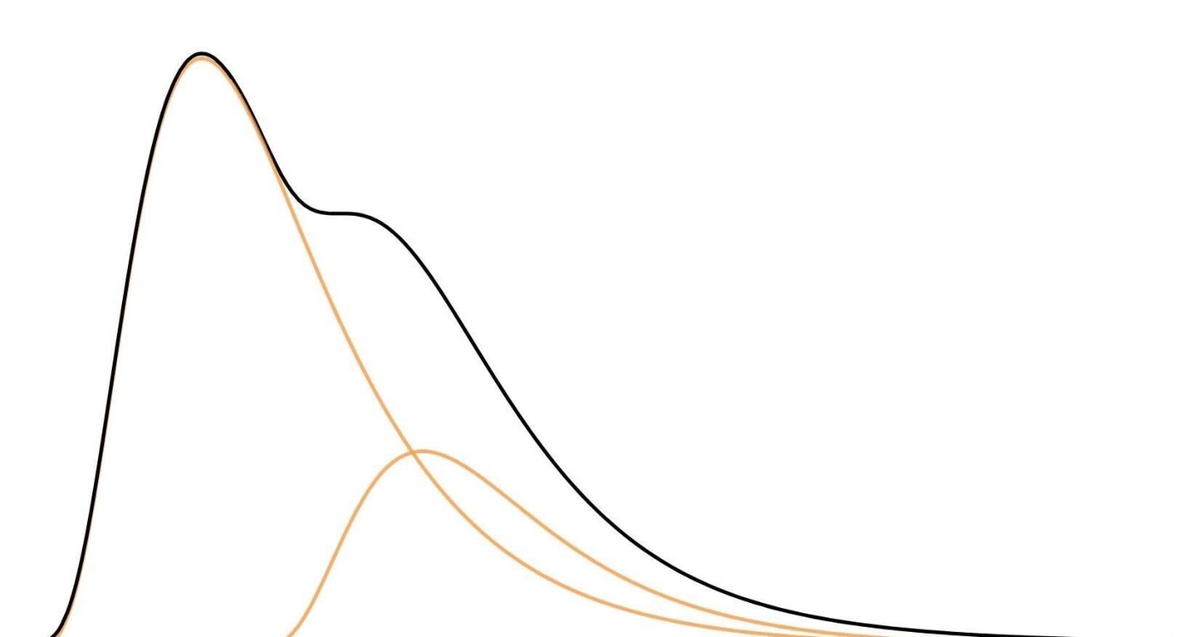
The core tool is the Sigma-Lognormal model, a decades-old formalism from the Kinematic Theory of Rapid Human Movements. It represents the velocity profile of every stroke as a sum of lognormal-shaped impulses, each parameterized by an amplitude D (how strong the motor command was) and an onset time t_0 (when the brain fired it). Fitting the model to a stroke gives you a compact readout of neuromuscular control quality, including reconstruction indicators like signal-to-noise ratio and the number of lognormals needed to explain the trace.
The team used the open-source SynSig2Vec extractor to fit the model, then computed the mean and standard deviation of five basic features across each writing task, giving ten features per sample. On their dataset the reconstruction hit a mean SNR of 24.1 dB, indicating a clean fit.
The 28-day in-the-wild setup
Thirteen university students wrote on a Wacom IoT Paper tablet sampling at 480 Hz three times a day, after waking, after lunch, and before bed, for 28 days. Each session included five short tasks: drawing circles, triangles, squares, and writing two short Japanese phrases ("I ate ice cream" and "I spilled coffee"). Overnight, an Oura Ring logged HRV, average heart rate, lowest heart rate, and total sleep duration. That yields 420 handwriting samples per participant paired to 28 nightly labels.

Labels were personalized: a day counted as "low recovery" if a metric fell into the participant's own worst quartile, avoiding cross-person confounds like naturally lower resting heart rates. A Random Forest was trained per participant with Leave-One-Day-Out cross-validation, so all 15 samples from a held-out day were kept entirely out of training.
Results that hold up after correction
With a baseline PR-AUC of 0.25 (the positive-class rate), the classifiers cleared the bar on all four sleep variables, and every test survived Benjamini-Hochberg correction for multiple comparisons:
- Lowest heart rate: PR-AUC 0.438 (the strongest signal)
- Average HRV: 0.391
- Average heart rate: 0.365
- Total sleep duration: 0.352
Cardiac metrics beat sleep quantity, which fits the biology: HRV and resting heart rate directly index autonomic recovery, whereas total time in bed only correlates with it. Friedman tests found no significant differences across the five task types or three daily timings, meaning drawing a circle at breakfast works about as well as writing a phrase before bed. One participant reached a PR-AUC of 0.729 on lowest heart rate, though several stayed close to chance.

What this is good for, and what it isn't
The practical hook is straightforward: kids already write on tablets in school, adults sign things on touchscreens, and none of that requires charging a ring or wearing a watch to bed. If the effect generalizes, a background service could estimate recovery state from natural note-taking. There is no released model or dataset yet, but the pipeline is fully reproducible from the SynSig2Vec repo and off-the-shelf Random Forests.
Caveats are real. The cohort is 13 sleep-deprived university students, models are strictly per-person (a general classifier is not on offer), and inter-user variance is large enough that some individuals will get little signal. The study also detects a binary "bad quartile" state, not a continuous score, so it is closer to an anomaly flag than a sleep tracker replacement. Still, showing that within-person daily variation is visible in stroke kinematics at all is the actual breakthrough here, since prior handwriting-health work almost exclusively separated patient groups from healthy ones, where effect sizes are much larger.