
Oregon State's Robot Learns Real-World Walking With 5 Minutes of Data
A new sim-to-real method for legged robots skips motion capture and time alignment, closing dynamics gaps with under five minutes of hardware data.
 Pro
Takeaways
- New method matches sim and real by comparing joint sensor distributions instead of aligning trajectories in time.
- Uses averaged 1D Wasserstein distances per joint, computable in O(n log n) with no motion capture.
- Under noisy conditions, achieves 18.7% parameter error versus 86.3% for observation-only L2 matching.
- Reduces Go2 quadruped hardware drift from 2m+ to ~0.4m using under five minutes of real data.
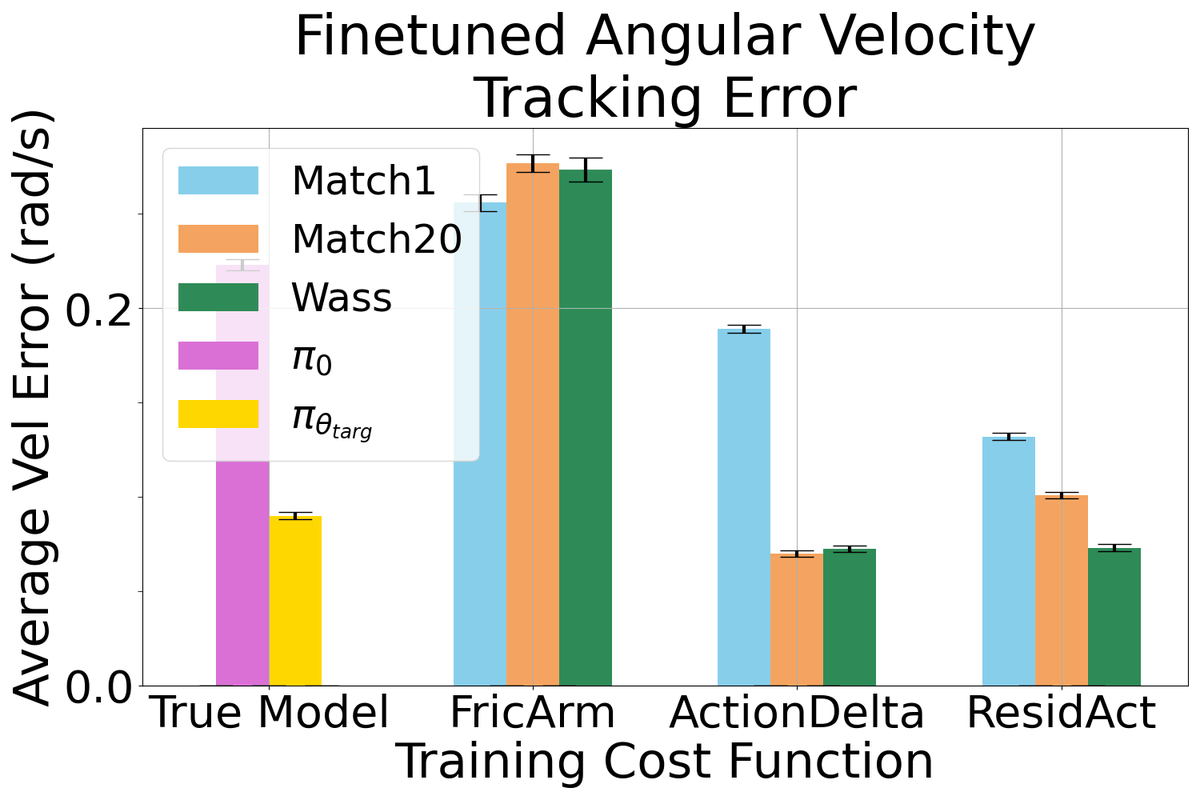
- Enables bipedal walking on a quadruped by finetuning in the adapted simulator with CMA-ES.
- Fails when the initial policy cannot produce informative hardware trajectories, as seen on the Digit humanoid.
Training a walking robot in simulation and shipping the policy to real hardware almost never works cleanly. The physics engine gets friction, damping, and actuator lag slightly wrong, and a controller that looked flawless on a workstation drifts, stumbles, or falls once it meets the real world. A new paper from Jeremy Dao and Alan Fern of the Collaborative Robotics and Intelligent Systems Institute at Oregon State proposes a stripped-down fix: match the statistical distributions of joint sensor readings between sim and real, rather than trying to align trajectories in time. The paper demonstrates the approach on a Unitree Go2 quadruped with less than five minutes of real-world data and no motion capture.
Why time-aligned system ID keeps breaking
The dominant recipe for closing the sim-to-real gap is to run the same action sequence in both the simulator and on hardware, then tune simulator parameters until the resulting trajectories overlap. That workflow requires motion capture, privileged sensing, and carefully controlled initial conditions. For legged systems, the assumption falls apart quickly. Small differences in initial pose or contact timing cause simulated and real rollouts to diverge within a second or two, and stochastic contacts mean identical actions can produce different outcomes on hardware.
Standard dynamics randomization, the workhorse of sim-to-real RL, has a subtler problem. It does not try to close the gap so much as make policies robust to it. Wider randomization ranges slow training and can push policies into overly cautious gaits. As tasks get more agile, that trade-off gets uglier.