
Oregon State's MR-CUSSP Lets Robot Teams Identify Their Context 4x Faster
A new framework called MR-CUSSP tackles how robot teams should coordinate when the rules of the environment are hidden and must be discovered together.
 Pro
Takeaways
- New paper formalizes multi-robot planning with hidden context as an MR-CUSSP problem.
- CIMOP algorithm coordinates robots to visit landmarks that quickly collapse a shared belief over contexts.
- LCBS extends Conflict-Based Search with lexicographic A* for preference-aligned, collision-free multi-robot paths.
- With 35 robots, CIMOP plans under two minutes versus 40 to 80 minutes for baselines.
- LCBS holds 100% success at a five-second time budget where Pareto and scalarized baselines fail.
- Code and hardware demo with five mobile robots available at the project link.
Robot teams operating in the real world rarely get a clean brief. An underwater fleet might need to prioritize avoiding coral one moment and conserving energy in a strong current the next, but the correct priority depends on conditions the robots cannot sense individually. A new paper from Oregon State University and Northeastern University tackles this problem, introducing a formal planning framework and two algorithms that let robots coordinate to figure out their operating context before executing preference-aligned plans.
The paper by Rustagi, Wray, and Saisubramanian formalizes the setup as a Multi-Robot Context-Uncertain Stochastic Shortest Path (MR-CUSSP) problem and proposes a two-stage solution. Code is available at the authors' MR-CUSSP repository.
Why one robot cannot see the whole picture
Without prior knowledge of the underlying context, robots must actively gather information before task execution, since operating under an incorrect context leads to inefficient coordination or unsafe behavior. In domains like salp swarms and disaster rescue, informative observations require joint sensing in specific configurations. The motivating example runs throughout the paper: salp-inspired underwater robots need to distinguish between a coral zone and an eddy current zone, which requires several units to form a ring around a crevice and take synchronized flow measurements. A single robot only sees local velocity, which is insufficient to infer the global pattern.
Prior planning methods do not fit cleanly here. Existing preference-based planning approaches typically assume the relevant preference ordering is known a priori, and do not model its dependence on latent context that must be inferred from observations. Multi-objective multi-agent path finding (MO-MAPF) approaches instead compute a Pareto frontier over objectives, but picking a solution from that frontier for execution ultimately requires knowledge of the true context. Active information gathering methods generally assume each robot can sense independently.

The two-stage recipe
MR-CUSSP models the world as a stochastic shortest path problem where the state includes both a physical location and a hidden context. Each context maps to a strict lexicographic priority over objectives (say, coral damage beats energy beats time to goal). Robots share a belief over which context is active and update it only when they collect a valid joint observation at a designated landmark state. The authors define a belief entropy metric that counts how many contexts still have non-zero probability, and the goal of stage one is to drive that number to one as quickly as possible.
The two algorithms are:
- CIMOP (Coordinated Inference for Multi-Objective Planning): computes joint plans to visit landmark states in an order that accelerates belief collapse through informative observations. It works out the minimum team size needed at each landmark to yield maximum entropy reduction, ranks landmarks by expected information gain, and assigns the nearest available robots.
- LCBS (Lexicographic Conflict-Based Search): once the context is known, LCBS produces collision-free paths that respect the strict priority ordering. It extends classical Conflict-Based Search with a low-level Lexicographic A* planner that compares candidate paths using vector costs under lexicographic order rather than a scalar sum.
The key trick in LA* is that node selection and state updates are governed by lexicographic comparison, so lexicographically-worse path candidates for a state are discarded immediately. The search directly and efficiently optimizes the strict priority ordering. That sidesteps the common workaround of weighting objectives with geometric scalars, which requires knowing objective magnitudes in advance.
How it performs
The team evaluated the approach across three simulated domains (sample collection with salps, a heavy-lift warehouse, and forest firefighting) plus a hardware run with five mobile robots in the Robotarium testbed. The context inference results are striking. For five robots, CIMOP reaches zero entropy within 20 steps in the salp and warehouse domains, compared to 60-80 steps for the baselines, and collapses substantially faster in the forest firefighting domain where baselines require several hundred steps.

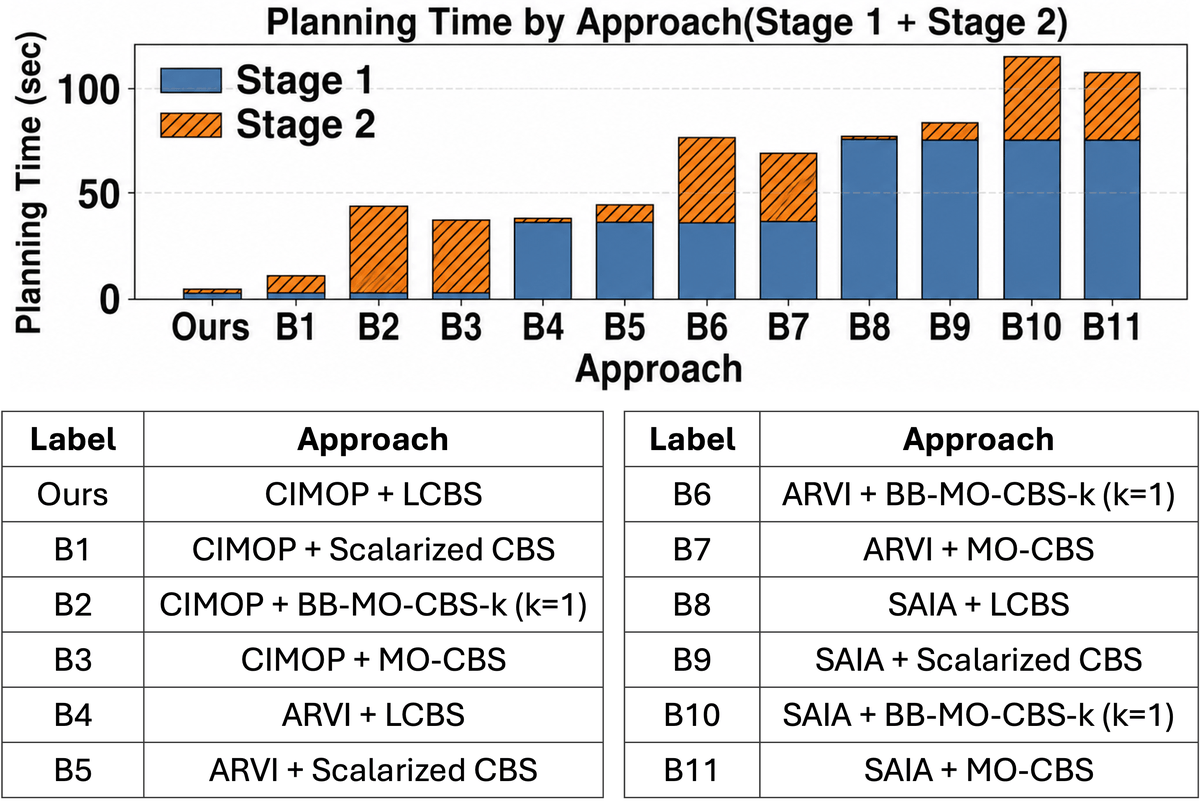
Scalability results are even more dramatic. For 35 robots, CIMOP consistently plans in under two minutes, while ARVI exceeds 40 minutes and SAIA exceeds 80 minutes. On the second stage, LCBS holds up under aggressive time budgets, maintaining 100% success across all budgets and remaining consistent even at five seconds, while BB-MO-CBS (k=1), MO-CBS, and Scalarized CBS drop significantly as the time limit decreases. On real robots, the full two-stage pipeline finishes in under six seconds, versus 40 to 120 seconds for alternative combinations.
Where it fits and where it breaks
This work is most useful in settings that share three properties: a small set of possible operating regimes, informative observations that genuinely require coordinated robot configurations, and objectives that admit a strict priority ordering rather than a soft trade-off. Warehouses switching between backlogged, congested, and human-traffic modes; underwater fleets navigating mixed ecological zones; and aerial firefighting teams reading wind and smoke conditions all fit the template.
The limitations are worth flagging. The formulation assumes landmarks are predefined and that observations at those landmarks either fully collapse the belief or reveal nothing, an idealization the authors acknowledge and plan to relax by supporting noisy observations in follow-up work. It also assumes contexts induce strict lexicographic orderings, which is cleaner than most real preferences. And because the planner uses most-likely-outcome determinization to build a graph for CBS-style search, robots occasionally hit states with no prescribed action at execution time and have to replan.
The broader contribution is separating the two problems, gathering information jointly and then executing under a known priority, and giving each half an algorithm shaped to its structure rather than forcing a Pareto frontier through a system that no longer needs one.