
Oregon State's Cassie Robot Sees in 360 Degrees, Conquers Stairs Without Rendering Costs
Oregon State researchers train a Cassie bipedal robot to walk, step, and climb in any direction using four depth cameras and a rendering-free training trick.
 Pro
Takeaways
- Oregon State's No More Blind Spots is the first vision-based omnidirectional bipedal locomotion controller.
- Teacher policy trains on cheap height maps with PPO; student learns from depth images via DAGGER distillation.
- Buffer-duplication augmentation with randomized velocity commands cuts student training from 144 to 20 hours.
- Deployed on Cassie with four RealSense D455 cameras and a Jetson Orin Nano, under 20 ms latency.
- Robot climbs 0.5 m blocks forward, 0.35 m sideways, and 0.2 m in reverse across stairs and ridges.
- Teacher exceeds 85 percent success on hard terrain while cutting energy versus a defensive blind baseline.
Bipedal robots have gotten remarkably good at walking forward on uneven ground, but they mostly do it with their eyes closed. Researchers at Oregon State's Collaborative Robotics and Intelligent Systems Institute have now trained a Cassie robot to walk, sidestep, and reverse over blocks and stairs using a full 360-degree ring of depth cameras, and they did it without drowning their simulator in rendering costs. The team calls the result the first demonstration of vision-based omnidirectional bipedal locomotion.
Why blind robots keep stubbing their toes
Blind reinforcement learning controllers rely on proprioceptive feedback (joint angles, base orientation, velocities) to keep their balance, and they work well on well-structured surfaces but struggle with unknown obstacles and significant terrain variations because they cannot sense or anticipate changes before making foot placements. The obvious fix is to give the robot cameras, but that opens a much nastier problem in simulation.
Rendering depth or RGB images for complex environments is expensive, which slows training and limits throughput, and these difficulties are amplified in the omnidirectional setting, where the volume of visual data increases by at least a factor of four. Prior bipedal vision work sidestepped this by only looking forward or by feeding the policy a pre-computed height map, which in turn requires very careful sensor calibration and global odometry at deployment time.
A teacher who never has to see
The core trick is a student-teacher split where only the student ever touches a rendered image. The teacher policy is trained with PPO in MuJoCo using a cheap privileged height map centered on the robot, so reinforcement learning happens fast. The student, which is what actually deploys, learns by imitation from the teacher and receives egocentric depth images from four cameras encoded through a shared ResNet-18.

Both policies sit on top of a frozen blind locomotion controller from prior Oregon State work. The final action is the sum of a base action produced by the frozen blind policy and a modulating action produced by a trainable perception-conditioned network. On flat ground the modulator can output nearly zero and let the blind controller do its thing; on stairs or blocks it nudges the gait to lift feet cleanly.
The augmentation that cuts training 10x
Because rendering is the bottleneck, the team squeezes more supervision out of every rendered frame. For each trajectory buffer, they duplicate the state sequence and inject random velocity commands, X between -0.6 and 1.0 m/s, Y between -0.6 and 0.6 m/s, and yaw rate between -0.4 and 0.4 rad/s. The teacher re-evaluates on each perturbed command and the student is trained to match via KL divergence. One rendered depth image becomes many training examples.
The numbers are stark. With the pretrained blind policy plus data augmentation, the student converges in 20 hours on 110 million samples. Without either component, the same student needs 144 hours and 900 million samples. Even the teacher's PPO training drops from 216 to 152 hours when initialized from the blind controller.
How it holds up on rough ground
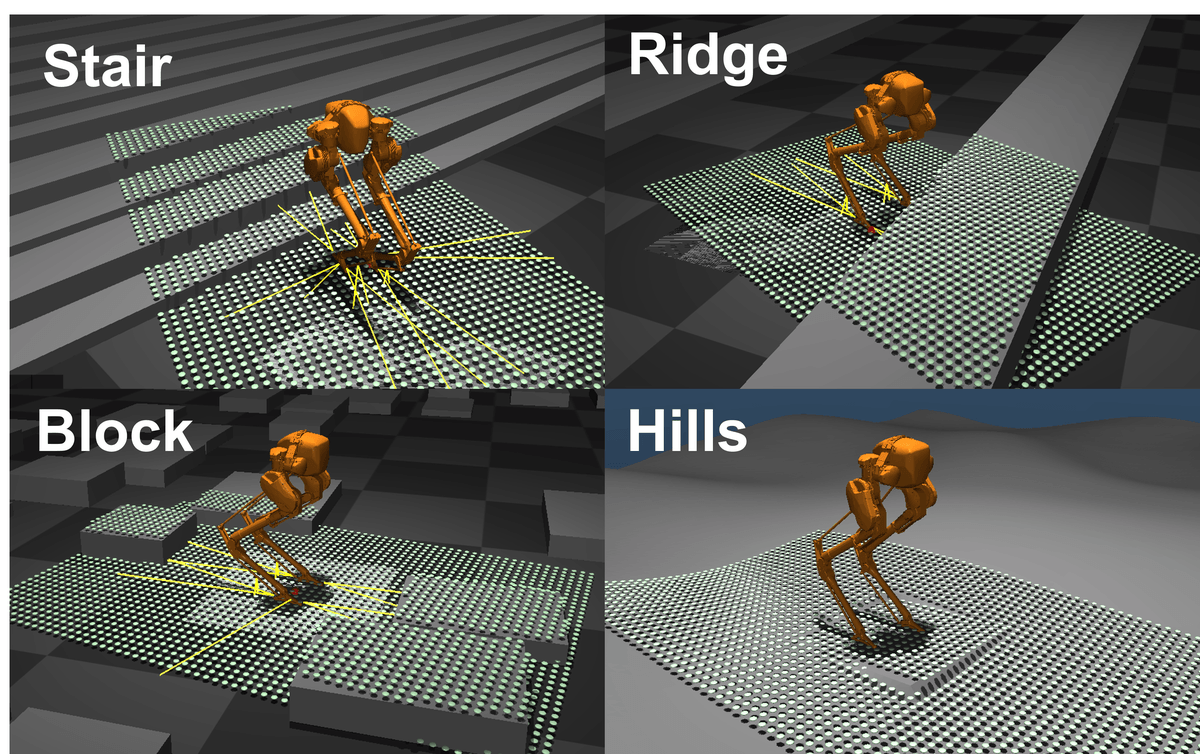
In simulation the researchers evaluated four variants: a stock blind policy, a blind policy with terrain labels, the privileged teacher, and the depth-image student. They ran 100 episodes on flat-easy, ridge-hard, stair-hard, and block-hard terrains scored on success rate, foot collisions, terminations from foot collisions, and cumulative joint energy in kilojoules.

The teacher clears 85 percent success even on hard terrain, and the vision-only student trails close behind. The blind baseline tops out around 60 percent termination-by-collision on block-hard and burns over 35 kJ per episode because it converges to a defensive, high-stepping gait that anticipates unseen obstacles. The student cuts energy substantially by only lifting feet when it actually sees something to clear.
On the real robot
Deployment sits on a Cassie fitted with four Intel RealSense D455 cameras and an NVIDIA Jetson Orin Nano handling the ResNet encoder. Each camera streams depth at 90 FPS, post-processed with hole-filling and distance-clipping filters before being passed to the ResNet-based vision encoder running on the Jetson, which produces a compact vision embedding at 90 Hz. The embedding is shipped over UDP to an Intel NUC that runs the rest of the policy, with total pipeline latency under 20 milliseconds.
In the real lab, Cassie stepped up onto blocks as tall as 0.5 meters walking forward, 0.35 meters sideways, and 0.2 meters in reverse. The lower reverse limit is a morphological constraint from the conrods, not a policy failure.
What it is good for, and what it is not
- Best use case: cluttered indoor spaces or uneven natural terrain where a robot needs to move in any direction without stopping to re-plan.
- Weaknesses: hardware-limited step heights in sideways and backward directions, no dynamic-obstacle reasoning, and the training pipeline still needs a beefy simulation setup (120 CPU cores in this work).
- Availability: the paper appears at the IEEE-RAS Humanoids conference, but the authors have not released code or trained weights alongside it.
The broader takeaway is methodological. This work is a template for any legged system that wants panoramic vision without paying the rendering tax during RL, and the buffer-duplication augmentation is a cheap idea that anyone training a distilled vision policy could try in an afternoon.