
OPFA Lets One Robot Policy Master 11 Different Hands With 8 Demos
A new framework lets a single robot policy transfer skills across 11 different hands and grippers, cutting per-embodiment data needs by roughly 9x.
 Pro
Takeaways
- OPFA trains one manipulation policy across 11 grippers and dexterous hands via a shared geometric latent space (paper).
- A KPConv plus geometric transformer encoder maps each hand's reachable-state point cloud into a fixed latent action.
- A single unified decoder predicts joints in a universal hand model, avoiding per-embodiment heads.
- Cross-embodiment co-training lifts success rates by more than 50% versus single-source training.
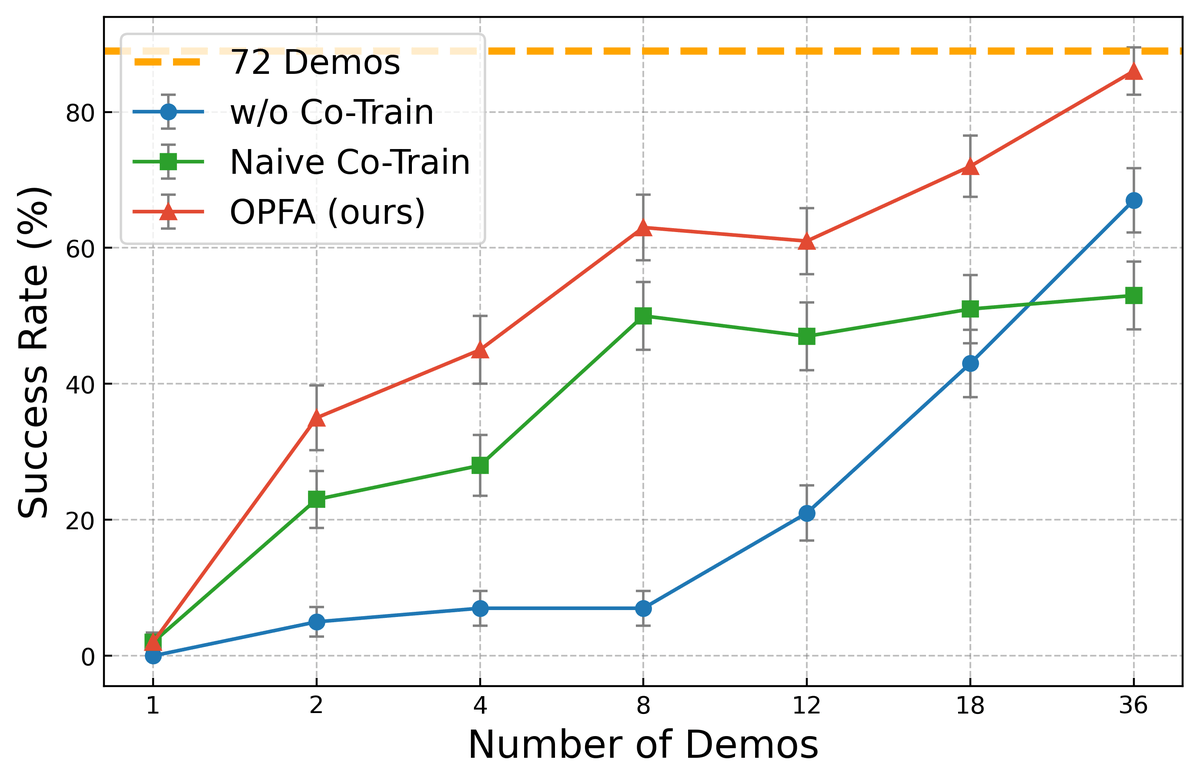
- Eight demonstrations on a new hand match a model trained with 72 demonstrations.
- Built on top of 3D Diffusion Policy; project page at mujc2021.github.io/opfa, no code released yet.
Robot manipulation policies are notoriously stuck to the hardware they were trained on. Swap the gripper for a five-finger dexterous hand and you generally need to recollect all your demonstrations from scratch. A team from Shanghai AI Laboratory, Tsinghua, CUHK, USTC, and NVIDIA is proposing a way around that with One-Policy-Fits-All (OPFA), a framework that co-trains a single policy across grippers and dexterous hands with wildly different degrees of freedom, and lets a new end-effector reach strong performance with only a handful of demos.
The paper reports that cross-embodiment co-training can improve success rates by more than 50% compared to single-source training, and that with just eight demonstrations from a new hand, OPFA can match the performance of a model trained on 72.
Why cross-embodiment training keeps breaking
The core headache is that different end-effectors have fundamentally different action spaces. A parallel-jaw gripper has one degree of freedom. A Shadow Hand has more than twenty. Naively concatenating datasets fails because variations in action spaces and structural disparities between embodiments make joint training across multiple data sources unstable.
Previous work tried two workarounds. Foundation models like RDT-1B, Octo, and pi-zero standardize the action space around the end-effector, which works well when the end-effector is always a simple gripper. Approaches like DexVLA bolt on a separate action decoder for each embodiment. Both fall apart on dexterous hands: unified action heads lose fine finger geometry, and per-embodiment decoders can only train on their own tiny slice of data, so they overfit hard in low-data regimes.
Turning actions into geometry
OPFA sidesteps the mismatch by refusing to predict joint angles directly. It predicts a Geometry-Aware Latent Representation (GaLR): a fixed-dimension vector that describes the 3D shape of the hand in its current pose. Since every hand, from a two-finger gripper to a Shadow Hand, occupies physical space, the point cloud of its reachable configurations gives a common language.

The pipeline runs in two stages. First, an encoder-decoder is trained without any manual labels. For each embodiment, the authors sample reachable joint configurations, run forward kinematics to get a point cloud, then encode it with KPConv 3D convolutions at three downsampling levels followed by a geometric transformer over "superpoints." A key trick is a semantic positional embedding: each superpoint gets a 2D index (which finger it belongs to, and which segment along that finger) so the transformer knows a thumb tip is a thumb tip whether it belongs to a LEAP hand or an Inspire hand.
The decoder side is the second innovation. Rather than training a separate head per embodiment, OPFA defines a hypothetical universal hand containing every physically meaningful joint across all end-effectors. The unified decoder always predicts this full joint set, and at inference the system just reads off whichever joints the target hand actually has. Because the decoder sees data from every embodiment simultaneously, it does not overfit when a new hand shows up with only eight demos.
Plugging into existing policies
The trained encoder-decoder pair is base-policy-agnostic. The authors drop it into DP3 (3D Diffusion Policy), replacing action prediction with GaLR prediction and swapping the proprioceptive state input for its GaLR encoding. The diffusion denoising then runs entirely in the shared latent space, and the pretrained decoder converts the denoised latent back into joint angles for whatever hand is running.
The numbers
Experiments span 11 end-effectors including UMI, Robotiq-2F, Robotiq-3F, Leap, Allegro, Shadow, Ability, Schunk SVH, XHand, and both tactile and non-tactile Inspire Hands, across 14 manipulation tasks. The authors compare against two baselines: single-embodiment training, and naive co-training with per-embodiment decoders.
In spatial generalization tests, where each embodiment only sees demos from its own workspace region and must generalize to regions covered by other hands, OPFA dominates. On the Inspire Hand, banana-picking jumps from 10% (solo training) to 98% with OPFA. Bucket-lifting on XHand goes from 1% to 94%.

Few-shot results widen the gap further. When nine different embodiments each contribute only eight demonstrations for spray-picking, naive co-training sometimes performs worse than solo training because of action conflicts between geometrically incompatible hands, while OPFA hits a 93% success rate on the Leap Hand and 62.1% average, a 20+ point gain.
Real-world experiments used a UR5e arm with XHand, Inspire, Leap, and Robotiq-2F across seven tasks including deformable manipulation (pulling tissues), long-horizon sequences (sweeping with a broom, closing a drawer), and precision work (pressing a syringe plunger). OPFA achieved the best score on the large majority of task-embodiment combinations, often 100%.
What it does not solve
A few honest limitations:
- OPFA still assumes a shared robot arm across embodiments. The unification is at the end-effector level, not the full manipulator.
- The semantic positional embedding uses a finger-and-segment indexing scheme designed around anthropomorphic-ish hands. Very exotic morphologies would need the scheme extended.
- Some tasks show OPFA winning by small margins or trailing on individual embodiments, particularly Tissue on Inspire Hand where it dropped below both baselines.
- The authors have released a project page with videos, but no public code or model checkpoints are announced in the paper.
Why it matters
The deeper contribution is a reframing. Cross-embodiment learning has often been treated as an action-space alignment problem or a giant-dataset problem. OPFA argues it is really a geometry problem, and that the reachable-state point cloud of a hand is enough of a shared substrate to fuse data from radically different morphologies without labels or human-hand priors like MANO. If that holds up at scale, teams building manipulation foundation models could stop training separate decoders per gripper and start pooling every dexterous-hand teleop dataset ever collected into a single training run.