
OpenDriveLab's OMEGA Makes Self-Driving AI Face 5x More Near-Crashes
A multi-institutional team introduces OMEGA, a training-free sampler that steers diffusion-based traffic simulators toward physically valid, controllable, and safety-critical scenes.
 Pro
Takeaways
- OMEGA is a training-free sampler that guides diffusion-based traffic generators using constrained optimization inside a KL trust region.
- Scene validity on nuPlan jumps from 32.35% to 72.27%, and to 81.95% zero-shot on Waymo.
- Goal-conditioned controllability improves from 11% to 80% valid scenes without breaking multi-agent realism.
- OMEGA-Adv formulates ego-attacker interaction as a Nash game, producing 5x more near-collision frames under 3 seconds TTC.
- Two-phase denoising separates macro-level layout (Warm-up) from frame-by-frame reactive refinement (Rolling-Zero).
- Currently costs about 5 seconds per 8-second scene; project page at opendrivelab.com/OMEGA.
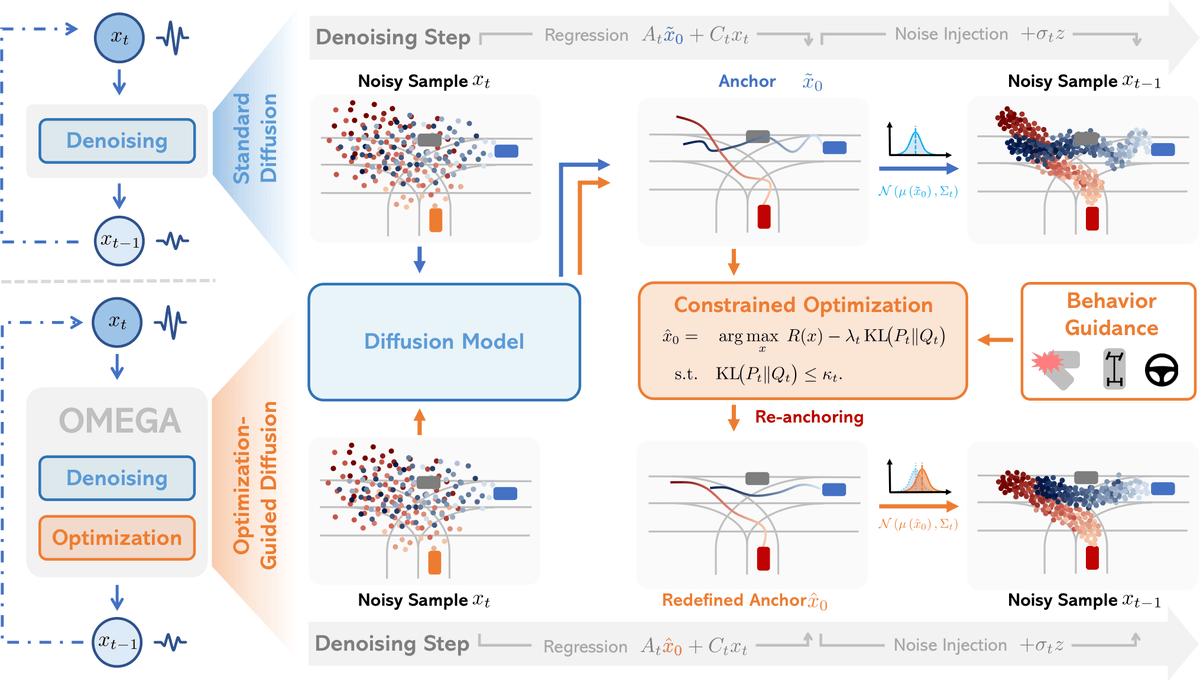
Self-driving cars need to be tested against the rare, dangerous edge cases that almost never show up in normal driving logs: aggressive cut-ins, near-collisions, sudden merges. A new paper from OpenDriveLab and collaborators at the University of Hong Kong, Beijing Institute of Technology, Nanyang Technological University, NVIDIA Research, and Yinwang Intelligent Tech tackles this shortage with OMEGA, a training-free wrapper that plugs into an existing diffusion-based scene generator and steers it toward realistic, controllable, and safety-critical multi-agent traffic.
On nuPlan, the fraction of generated scenes that satisfy all physical and behavioral checks jumps from 32.35% to 72.27%, and under goal-conditioned generation it climbs from 11% to 80%. In adversarial mode, the same framework produces 5x more near-collision frames with time-to-collision under three seconds, without breaking scene realism.
Why diffusion-based traffic sims keep going off the rails
Diffusion models are good at reproducing the shape of naturalistic driving distributions, but two problems keep breaking them at inference time. First, small numerical inconsistencies accumulate across denoising steps, so trajectories that looked plausible at high noise end up violating basic kinematics, drifting off-road, or clipping through other vehicles by the time noise is fully removed. Second, safety-critical interactions live in the thin tails of driving datasets, so a model trained on logs will almost never sample them on its own.
Prior workarounds all have costs. Reinforcement-learned classifier guidance and finetuning-based adversarial variants require extra training. Gradient-based methods like CTG and DPS propagate gradients through the denoiser using local linearizations that can point in the wrong direction. Hard projection or clipping approaches enforce feasibility but introduce discontinuities that break distributional consistency.
Re-anchoring inside a KL trust region
OMEGA reframes each reverse diffusion step as a constrained optimization problem. Standard DDPM sampling predicts a clean estimate