
OpenClaw Rebuilds Hospital AI Agents Like a Linux Operating System
A design proposal wraps LLM agents in OS-style isolation, document-passing, and paged memory to make them safe enough for actual clinical workflows.
 Pro
Takeaways
- New paper proposes an Agentic Operating System for Hospitals built on the OpenClaw agent framework.
- Uses Linux-style multi-user isolation so each clinical agent runs as a constrained principal, not a root-level tool user.
- Patient and clinician agents coordinate through a shared document store with event notifications, giving full auditability.
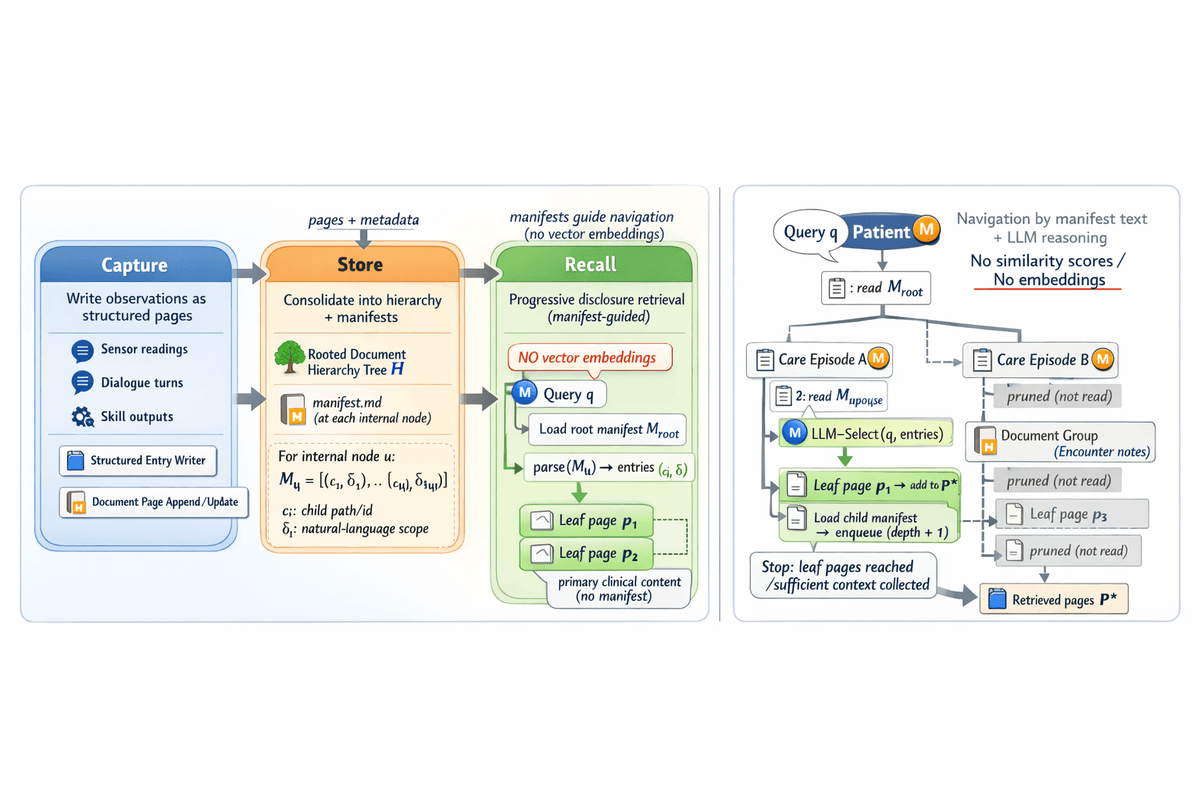
- Introduces a page-indexed memory architecture for long-term patient context instead of flat vector retrieval.
- All actions must go through a curated medical skills library, removing raw shell or filesystem access.
- Design-only paper: no benchmarks, no released clinical evaluations, built on the open-source OpenClaw project.
Hospitals are one of the most tempting deployment targets for LLM agents and one of the most dangerous. A new architecture paper called When OpenClaw Meets Hospital proposes treating a clinical AI deployment less like a chatbot and more like a multi-user operating system, borrowing ideas from Linux to keep autonomous agents from doing something catastrophic to a patient record.
The authors argue that today's agent stacks give the model too much freedom. Deploying autonomous agents in healthcare environments remains difficult due to reliability limitations, security risks, and insufficient long-term memory mechanisms. Their proposal, built on top of the open-source OpenClaw agent framework, is to constrain what an agent can do at the infrastructure layer instead of trusting prompts and guardrails.
Why hospital agents keep breaking
Clinical work is not a single task. It is dozens of long-running processes (triage, medication reconciliation, discharge planning, cross-specialty consults) that share the same patient context and have to be auditable after the fact. Generic agent frameworks handle this badly for three reasons:
- Tool calls typically execute with broad system privileges, so a single bad plan can touch anything the agent can reach.
- Memory is usually a flat vector store, which loses the temporal and document structure that a patient chart actually has.
- There is no clean separation between the agent representing the patient and the agent representing the clinician, even though their trust levels and permissions differ.
The four pieces of the proposed OS

The design borrows the mental model of a Unix system and drops LLM agents in as user-space processes. It has four components working together:
- A restricted execution environment inspired by Linux multi-user systems. Each agent runs as an isolated principal, and every action goes through a kernel-style check rather than an unfiltered tool call.
- A document-centric interaction paradigm. Patient agents and clinician agents do not chat directly. They read and write shared documents (notes, orders, care plans), and the system emits event notifications when a document changes. This makes every exchange inspectable after the fact.
- A page-indexed memory architecture for long-term clinical context. Instead of stuffing a whole chart into a context window or hoping a RAG retriever surfaces the right chunk, memory is organized into pages that can be addressed, versioned, and paged in on demand.
- A curated medical skills library that lets the agent compose clinical task sequences on the fly, but only out of vetted primitives. The skill interface is the only way the agent can act on the world.
Skills as the only exit door
The most interesting design choice is that the agent has no unrestricted shell. Everything it can do is expressed as a skill in the library, and skills are the boundary where resource isolation and permission checks live. That is very different from the mainstream agent pattern of exposing raw tools like execute_python or filesystem access and hoping the model behaves.
Practically, this means a clinician-side agent that wants to, say, adjust a medication order must invoke a skill that already encodes the checks (allergy conflicts, dosage bounds, who is allowed to sign the order) rather than composing that logic on the fly. The kernel enforces isolation between the patient agent's world and the clinician agent's world, and the document store is where they meet.
What OpenClaw brings to the table
The infrastructure sits on top of OpenClaw, a free and open-source autonomous artificial intelligence agent that can execute tasks via large language models and organizes capabilities as a curated skill library. OpenClaw already has the skill-directory pattern the authors need. The repository follows a modular architecture with an agent core for message processing and conversation context management, and a model router providing a unified BYOK interface to Claude, GPT, Gemini, and others. The paper extends that base with the multi-user isolation, document bus, and paged memory that clinical deployment demands.
What it is, and is not
This is an architecture proposal, not a benchmark paper. There are no accuracy numbers, no head-to-head comparisons against a baseline agent on clinical tasks, and no released hospital dataset. The authors position the work as the design of an Agentic Operating System for Hospital, a computing layer whose job is coordination, safety, transparency, and auditability rather than raw medical reasoning.
That framing is useful, and also its main limitation. If you are looking for evidence that agents built this way reduce documentation errors or shorten triage time, it is not here yet. What is here is a blueprint that treats clinical safety as a systems problem instead of a prompting problem, and that argues the right unit of trust is a signed skill, not a chat turn. Anyone building agent infrastructure for regulated domains, not just healthcare, will find the isolation model and the document-as-message-bus pattern worth stealing.