
Only OpenAI's gpt-4o-mini-tts Actually Follows Voice Instructions, Study Finds
A new human-evaluated benchmark tests whether instruction-guided text-to-speech models actually deliver the emotion, age, and emphasis their prompts ask for.
 Pro
Takeaways
- New E-VOC corpus collects 60,000+ human ratings evaluating instruction-guided TTS across four expressive dimensions.
- Five systems tested: Parler-TTS large and mini, PromptTTS++, UniAudio, and OpenAI's gpt-4o-mini-tts.
- gpt-4o-mini-tts is the only model that reliably maps adverbs like slightly and extremely to ordered acoustic changes.
- All models default to adult-sounding voices, with near-zero F1 scores on child voice prompts.
- Best word-level emphasis accuracy is 0.265, barely above the 0.143 random-guess baseline.
- Corpus will be released publicly to train automated judges as scalable proxies for human perceptual evaluation.
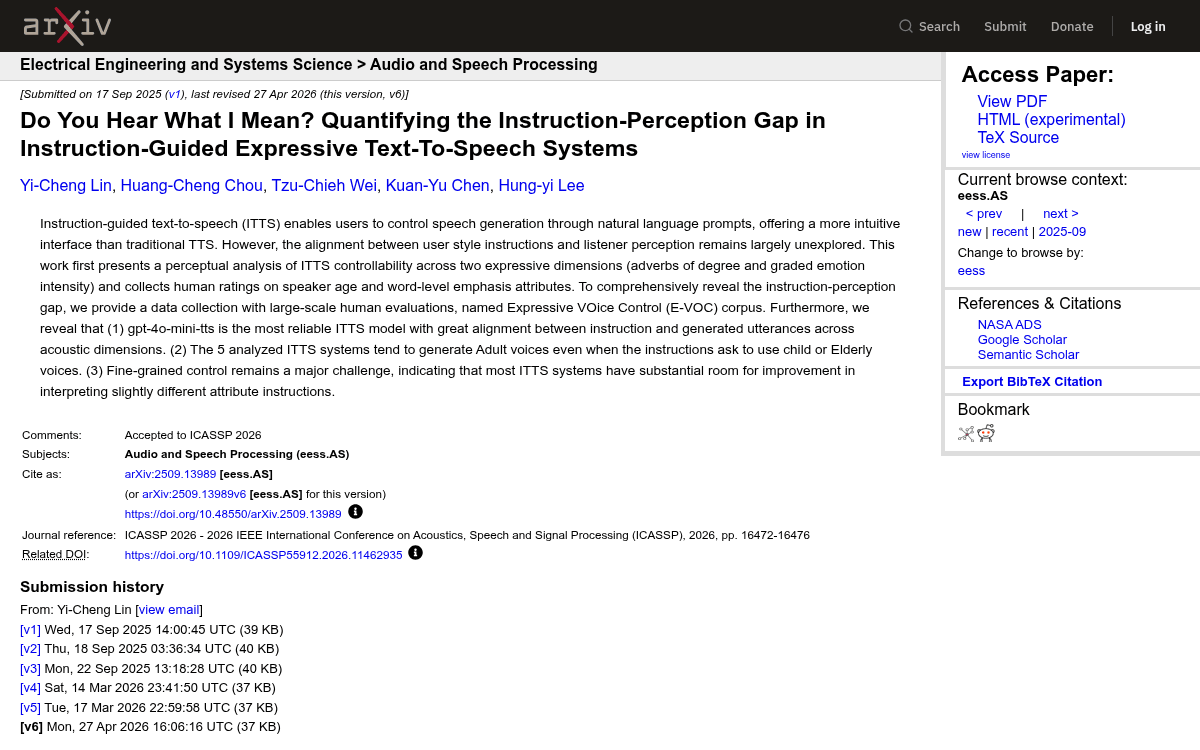
Instruction-guided text-to-speech (ITTS) lets you steer a voice with plain English: read this joyfully or speak like a child. It sounds like the perfect interface, but nobody has really checked whether listeners actually hear what you asked for. A new study from National Taiwan University, USC, and University of Michigan does exactly that, and the results expose a wide gap between what users type and what human ears perceive.
The team built a benchmark called the Expressive VOice Control (E-VOC) corpus and ran five leading ITTS systems through it. Only OpenAI's gpt-4o-mini-tts reliably translated instructions into perceptible acoustic changes. Everything else, including granular age control and word-level emphasis, remains largely broken across the field.
Why coarse metrics were hiding the problem
Standard TTS evaluation leans on Mean Opinion Score for naturalness and Word Error Rate for intelligibility. Those metrics fall short in measuring instructional fidelity, the precise alignment of synthesized speech with fine-grained user prompts. Prior work on instruction alignment either used categorical classifiers (does it sound happy: yes or no) or single overall relevance scores. Neither tells you if ecstatic actually sounds more intense than content, which is exactly what a storyteller or game designer needs.
The authors argue that classifier predictions are tied to their training data and may inherit dataset biases, making them unreliable indicators of how listeners actually perceive expressive attributes. So they ran the evaluation the hard way, with humans.
Four tasks, five systems, 60,000 ratings
The benchmark defines four control dimensions:
- Adverbs of Degree: Does
slightly,very, andextremelyactually shift loudness, pitch, and speaking rate in order? - Emotion-Intensity Adjectives: Can models render an ordered ramp like Satisfied, Content, Happy, Overjoyed, and Ecstatic, drawn from the NRC Emotion Intensity Lexicon?
- Speaker Age: Child, Teenager, Adult, or Elderly, on demand.
- Word-level Emphasis: Can the model stress a specific target word in a sentence?
Five systems were tested: Parler-TTS large and mini, PromptTTS++, UniAudio, and gpt-4o-mini-tts. Native English speakers recruited through Prolific rated audio on 5-point Likert scales or forced-choice tasks, with gold-standard check utterances from CREMA-D and EMNS filtering out unreliable annotators. At least five workers labeled each utterance.
Only gpt-4o-mini-tts climbs the ramp
On the acoustic side, gpt-4o spans a wide LUFS range with a predictable ordering from slightly to extremely, and it cleanly separates high and low pitch prompts into distinct F0 bands. The Parler models compress everything into a narrow band, PromptTTS++ is nearly flat on loudness, and UniAudio just stays quiet regardless of the instruction.
The graded emotion task tells the same story. gpt-4o was the only system to demonstrate reliable control over graded emotional intensity across all four emotion categories. Listener ratings for gpt-4o increased smoothly along the Happy graded words (from Satisfied to Ecstatic) and the Surprised ones (from Intrigued to Surprised). UniAudio occasionally exhibited reversed trends, with listeners rating mid-level adjectives as more intense than stronger ones.
Everyone sounds like an adult
Age control is where the whole field falls apart. The best accuracy was Parler-large at 0.294, with gpt-4o-mini-tts at 0.289. Class-wise F1 scores show why: models can produce adult and teenager voices, but child voices are near-zero across all systems. The confusion matrix for gpt-4o is especially telling. When prompted for a child voice, listeners heard adult 121 times out of 180. When prompted for elderly, they heard adult 163 times.
Current ITTS models gravitate toward a default adult-like voice with limited control over other age categories. That is almost certainly a training data problem, since adult voices dominate every large speech corpus.
Word emphasis is essentially guessing
The emphasis task exposes another weakness. gpt-4o achieved the highest accuracy, yet its score of 0.265 indicates that even the best-performing model struggled. With about six candidate words per sentence plus an unclear option, random guessing would land near 0.143, so the best model is barely doing better than a coin flip. Parler-mini, PromptTTS++, and UniAudio come in at 0.134, 0.130, and 0.040 respectively.
What this means for building with ITTS
If you are shipping a product that needs expressive voice, the practical implications are blunt:
- Use gpt-4o-mini-tts if you need reliable prosodic dials like loudness, pitch, and speaking rate to respond to adverbial instructions.
- Do not trust any ITTS system to render a convincing child or elderly voice from an instruction alone. Consider reference audio or specialized voice cloning instead.
- Avoid prompt-based word emphasis for anything that matters, like assistive reading or dialogue systems. SSML-style explicit markup remains more predictable.
- For graded emotion, the safe bet is coarse categorical prompts (
happy) rather than intensity words (ecstaticvscontent), unless you are on gpt-4o.
The deeper contribution is the corpus itself. The authors will release E-VOC publicly, and they explicitly pitch it as training data for automated judges. One promising direction is using the dataset to train and validate spoken language models like Gemini as scalable proxies for human perceptual judgments. An automated judge of that kind would accelerate ITTS research by enabling faster and more reproducible evaluation cycles, which is the piece the field has been missing: a scalable way to measure whether new models actually close the instruction-perception gap, or just claim they do.