
Only o3 Can Run Economics Models End-to-End While Rivals Fabricate Numbers
A benchmark of twelve LLMs on discrete choice modelling reveals which models can actually specify and estimate econometric utility functions, and which hallucinate.
 Pro
Takeaways
- Twelve LLMs benchmarked on specifying and estimating Multinomial Logit choice models across five prompt configurations.
- Only GPT-o3 in agentic mode could correctly estimate its own specifications by running self-generated Python code.
- Non-agentic models hallucinated log-likelihoods and parameter estimates that could not be independently reproduced.
- Chain-of-thought prompting consistently outperformed zero-shot, especially by preventing missing alternative-specific constants.
- Several models produced better specifications with only a data dictionary than with the full raw dataset attached.
- Open-weight Llama and Gemma variants struggled to generate valid, convergent specifications out of the box.
Discrete choice models are the workhorses of transport economics, health economics, and marketing research. They let analysts estimate how people trade off travel time against cost, or how income affects mode choice. But building one is painful: even with a handful of variables, the number of plausible utility specifications explodes combinatorially, and picking a good one requires balancing statistical fit with behavioural theory. A new study asks a simple question: can large language models take over parts of that workflow?
The team behind the paper ran a controlled bake-off across twelve versions of seven leading model families and found that some LLMs can genuinely help, one can do the entire pipeline end-to-end, and several fail in ways that would embarrass anyone who trusted them.
The specification problem, in plain terms
A Multinomial Logit (MNL) model predicts which option a person picks from a discrete set (car, bus, train, air) based on a utility function built from attributes like travel time and cost. Modellers propose a candidate specification, estimate its parameters, examine both goodness-of-fit statistics and theoretical plausibility, and then refine the specification, balancing parsimony, model fit, and behavioural assumptions. That loop is slow, expertise-driven, and difficult to automate with classical methods because domain knowledge (like the fact that the cost coefficient should be negative) is hard to encode as a constraint.
How the benchmark was set up
The authors tested each LLM across five experimental configurations that vary along three axes:
- Modelling goal: just suggest a specification, or suggest and estimate it.
- Prompting strategy: zero-shot versus chain-of-thought, where CoT walks the model through descriptive analysis, collinearity checks, and behavioural constraints before it writes utility functions.
- Information available: the raw CSV plus a data dictionary, or the data dictionary alone.
The dataset was a standard Apollo inter-city mode choice sample with 1,000 observations across four alternatives (car, bus, air, rail), with attributes for in-vehicle time, cost, access time, plus demographics. Every specification produced by an LLM was independently re-estimated in Apollo to catch hallucinated log-likelihood values. The models tested included GPT-4o, o3, and o4-mini-high, Claude 4 Opus and Sonnet, Gemini 2.5 Flash, DeepSeek V3.2, Mistral le Chat, plus the open-weight Gemma 3 and Llama 3 and 4 variants.
Only one model could actually estimate its own specs
The most striking finding concerns end-to-end estimation. Among all evaluated LLMs, only ChatGPT-o3 successfully suggested valid MNL specifications and produced estimation results by executing self-generated Python code that could be independently replicated. When the authors re-ran o3's code in Apollo, results matched to within 1 percent for a small number of values.
Every other model either mis-estimated or fabricated the numbers. In our experimental setup, ChatGPT-o3 operated in an agentic mode with access to external computational tools, most importantly, to load the attached dataset as a file and execute self-generated Python code in an execution environment. These tools enabled "correct" end-to-end estimation. The non-agentic models had no code interpreter, so when they claimed to have estimated a model, they were just generating plausible-looking numbers.
Chain-of-thought and less data both help
When restricted to just suggesting specifications (leaving estimation to a proper solver), the picture becomes more competitive. Two patterns stood out:
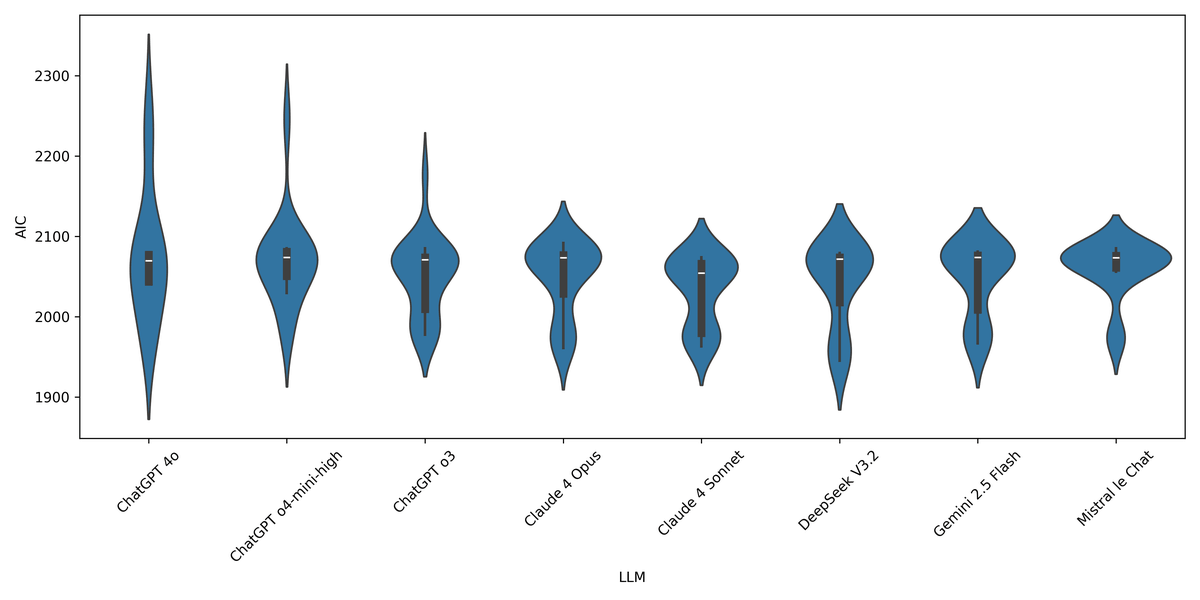
- CoT prompts cleaned up recurring mistakes. Under zero-shot, GPT-4o systematically omitted alternative-specific constants, which are essential for labelled alternatives. Under CoT, all generated specifications included them, and most models produced better AIC scores.
- Withholding raw data sometimes improved performance. Notably, ChatGPT 4o, o4-mini-high, Claude 4 Opus, Mistral le Chat, and DeepSeek all produced better-fitting specifications in this limited information setting than in their respective full information experiments (Experiments 3 and 4). The authors hypothesise that parsing a CSV eats into the reasoning budget the model would otherwise spend on behavioural theory.
Who won on model fit
The best specification across all experiments came from DeepSeek V3.2 under limited information, with a log-likelihood of -956.68 and an AIC of 1,945.36. Claude 4 Sonnet led under structured CoT prompting with full data, and Claude models generally explored a wider space, generating more candidate specifications than the GPT or Gemini variants. Claude 4 Sonnet also produced the most complex utility functions on average, with 4.67 variables, 1.22 socioeconomic terms, and 0.72 interactions per specification.
Where the open-weight models fell over
The open-weight side of the leaderboard looked bleak. Open-weight models (Llama and Gemma), in contrast, showed both lower generation capabilities and higher proportions of specifications with issues, even under repeated execution. Closed-weight models that performed well in the single-run analysis continued to do so on average, while open-weight models that generated weaker specifications remained consistently less competitive.
Gemma 3 produced usable outputs in only one configuration, and even those needed manual filtering. Llama's inference API could not accept file uploads at the time, so it was only evaluable in the limited-information setting. The authors are careful to note this reflects out-of-the-box behaviour, not architectural ceilings, and fine-tuning could plausibly close the gap.
What this means for practical use
The paper is a proof of concept, not a shipping product, but the practical guidance is concrete:
- Use structured prompts. Walking the model through descriptive analysis and behavioural constraints before asking for utility functions consistently improves quality.
- Consider giving the model less data. A well-written data dictionary can outperform dumping the raw CSV.
- Only trust estimation results from agentic setups. If the model does not have a code interpreter, treat any numbers it produces as fabricated until independently re-estimated.
- Keep a human in the loop. Convergence failures, missing constants, and wrong-signed coefficients still appear frequently enough that expert oversight is non-negotiable.
No code repository or benchmark suite accompanies the paper, but the prompts, dataset (from the Apollo package), and one shared o3 transcript are documented well enough to reproduce the core experiments. For anyone working on assisted specification, hybrid human-LLM workflows, or agentic scientific tooling, this is a useful map of where the frontier currently sits.