
OneMillion-Bench Exposes How AI Fails Real Professional Work Worth $1M
OneMillion-Bench tests 35 frontier AI agents on 400 expert-level professional tasks worth over $1M in labor — and even the best models pass less than half
 Pro
Takeaways
- $OneMillion-Bench introduces 400 expert-curated tasks across Law, Finance, Healthcare, Industry, and Natural Science worth over $1M in professional labor value.
- 35 frontier models were evaluated; even the top performer (Claude-Opus-4.6 with search) passes fewer than 44% of tasks at the professional standard.
- Web search hurts weaker models — adding retrieval caused several systems to drop in Expert Score and Pass Rate due to noisy evidence integration.
- Deep research agents (o3-DeepResearch, Sonar-DeepResearch) underperform the best search-enabled generalist models despite their specialized pipelines.
- Tasks use negative rubrics (scores from -20 to +10) penalizing hallucinations, norm violations, and instruction failures — mirroring real professional accountability.
- The evaluation harness is open-source on GitHub under Apache-2.0; the paper is on arXiv.
Most AI benchmarks still look like exams. Multiple choice questions, coding puzzles, math problems with clean answers. But the work that actually costs money in the real world looks nothing like that. It looks like an M&A lawyer verifying cross-border compliance clauses, an actuary auditing an insurance reserve under IFRS 17, or an investment analyst building a multi-step valuation model under strict constraints. A new benchmark called $OneMillion-Bench is designed to test exactly that kind of work.
The benchmark gap no one talks about
As language models evolve from chat assistants to long-horizon agents capable of multi-step reasoning and tool use, existing benchmarks remain largely confined to structured or exam-style tasks that fall short of real-world professional demands. The saturation of traditional benchmarks like MMLU has made it increasingly hard to tell which models are actually ready to do professional work versus which ones are just good at standardized tests.
$OneMillion-Bench is a benchmark of 400 expert-curated tasks spanning Law, Finance, Industry, Healthcare, and Natural Science, built to evaluate agents across economically consequential scenarios. The name is literal: the total estimated monetary value of all tasks in the benchmark exceeds $1 million USD, calculated by multiplying the time a senior expert would need to complete each task by their prevailing market hourly wage.
Unlike prior work, the benchmark requires retrieving authoritative sources, resolving conflicting evidence, applying domain-specific rules, and making constraint decisions, where correctness depends as much on the reasoning process as the final answer. That last point is critical. Getting the right answer by accident, or through shallow reasoning, doesn't count.

How the tasks were built
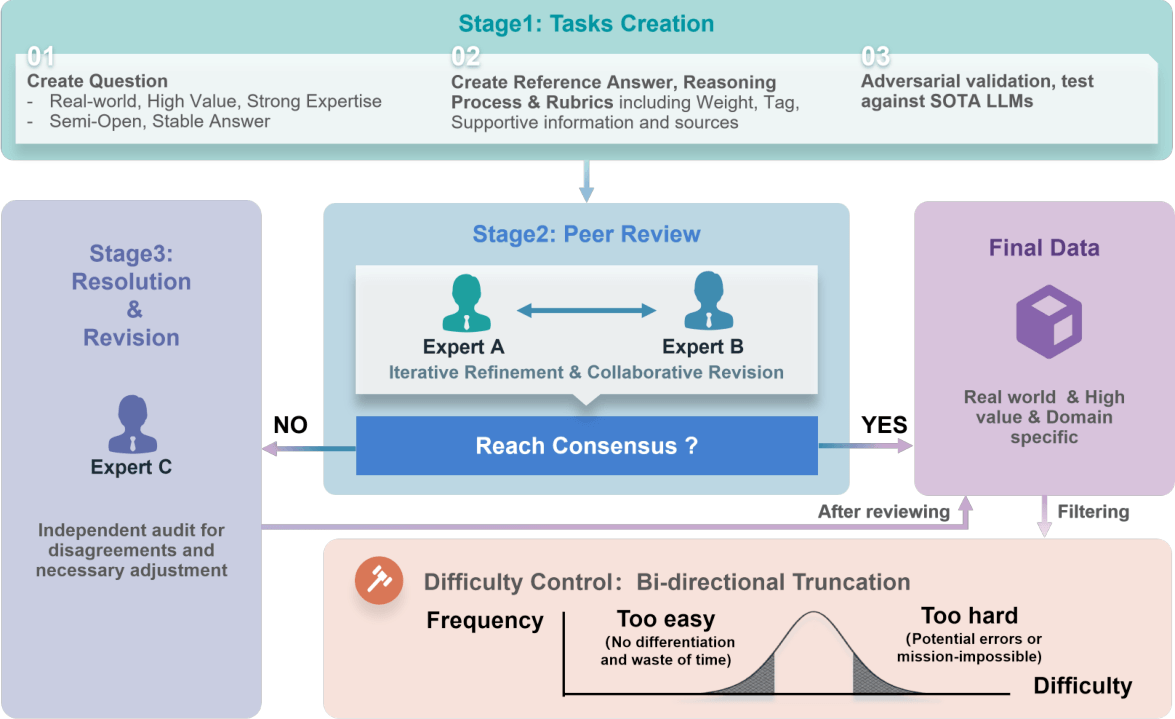
The benchmark spans 5 macro-domains, 37 sub-domains, and 92 third-level categories. The task creation process involved over 2,000 expert hours and went through a rigorous three-stage pipeline:
- Task Creation: A domain expert designs a task, writes a reference answer, and defines detailed scoring rubrics. Critically, the task is then tested against frontier agents , it's only kept if multiple agents fail to pass it. This adversarial validation ensures the benchmark stays discriminative.
- Peer Review: A second specialist in the same sub-domain independently reviews the task for clarity, fairness, and domain accuracy. Iterative revisions continue until consensus is reached.
- Resolution: For contested or risky tasks, a third expert performs an independent audit before the task is finalized.
The benchmark also applies a bidirectional difficulty filter: tasks that every model solves trivially are removed, and tasks where every model scores near-zero are reviewed to distinguish genuinely hard problems from poorly designed ones.
One distinctive design choice is the inclusion of negative rubrics. Scoring uses asymmetric weights ranging from -20 to +10. Agents can lose points for violations of industry norms, factual hallucinations, unsafe outputs, or failures in basic instruction following. This mirrors how professional work is actually evaluated , a wrong compliance call isn't just "not helpful," it's actively harmful.
The benchmark is also bilingual: 200 tasks in English and 200 in Chinese. The Chinese set isn't a translation , it's purpose-built around China-specific regulations, accounting standards, and legal frameworks like the Cybersecurity Law and local healthcare insurance policies.
What the leaderboard actually reveals
The team evaluated 35 models across three categories: vanilla models (no tools), search-enabled agents (same models with web search), and specialized deep research agents like o3-DeepResearch and Sonar-DeepResearch. The results are humbling across the board.
Claude-Opus-4.6 achieves the best overall performance among vanilla models and remains the top performer with search enabled. The search-enabled setting amplifies the advantage: both the overall Expert Score and Pass Rate in the top row indicate that a high Expert Score corresponds to a greater proportion of questions surpassing the passing threshold. With web search enabled, Claude-Opus-4.6 reaches an Expert Score of 63% on the Global set and a Pass Rate of 43.5% , meaning it fully meets the professional standard on fewer than half of the tasks.
Several findings stand out:
- Web search isn't always a win. For weaker models, adding search actually hurts performance. Hunyuan-2.0-Thinking dropped from an Expert Score of 34.7 to 30.2 and its Pass Rate fell from 8.5% to 3.0% when search was enabled. Retrieval introduces noisy or conflicting evidence that weaker models can't filter effectively.
- Deep research agents don't dominate. Specialized systems like o3-DeepResearch scored competitively in the mid-tier (Expert Score ~46%) but were outperformed by the best search-enabled generalist models. Longer research pipelines don't automatically translate to better rubric compliance.
- Finance is the hardest domain. Performance varies markedly by domain , Finance consistently yields the lowest Expert Scores across models, while Healthcare and Law tend to be higher for top systems.
- Pass Rate exposes shallow gains. Many models reach Expert Scores of 45-50% but have Pass Rates below 25%. This means models are partially satisfying many rubrics rather than fully meeting the professional standard on a meaningful fraction of tasks.
The rubric-type breakdown adds another layer. Models score highest on structure and formatting (most can produce well-organized outputs) but struggle most on factual accuracy and analytical reasoning. Web search helps the most on factual retrieval tasks for strong models, but instruction following is the most fragile capability , adding search can cause models to deviate from explicit constraints when they get distracted by retrieved content.
The real insight: search amplifies what's already there
Perhaps the most practically useful finding is what the paper calls the "efficacy amplifier" effect. Strong models improve across multiple rubric types when given web search. Weak models often degrade. This means search access is not a leveler , it's a multiplier. If a model doesn't already have robust evidence filtering and planning, giving it access to the web makes things worse, not better.
The paper also finds that official provider scaffolds (Anthropic's, OpenAI's, Google's) consistently outperform third-party routing through OpenRouter. For Claude-Opus-4.6 and Gemini-3-Pro-Preview, the gap is particularly large. In some cases, a model without web search but using the official scaffold outperforms the same model with web search running through OpenRouter. Scaffold quality can matter more than tool access.
What it's not good at (yet)
The benchmark has real limitations worth knowing. It currently covers only five domains , energy, climate science, and public policy are absent. The rubric-based evaluation relies on LM-as-a-judge, and the paper shows that different judge models produce different absolute scores (GPT-5.2 is the strictest, GLM-5 the most lenient), though model rankings stay stable. Temporal sensitivity is also a challenge: all models perform significantly worse on time-sensitive questions than on temporally agnostic ones, with top models like Claude-Opus-4.6 showing a 15-20% performance drop.
The benchmark also doesn't yet have a fully automated process evaluation , rubric scoring still depends on model judges rather than deterministic checkers, which limits scalability.
Where to find it
The evaluation harness is available at humanlaya/OneMillion-Bench on GitHub, released under an Apache-2.0 license with CI workflow signals and dependency manifests. The benchmark is designed to be expanded over time with new domains and updated tasks to prevent contamination.
The findings highlight a significant reliability gap, demonstrating that current models often fail to maintain the consistency and evidence-grounding required for autonomous professional labor. $OneMillion-Bench shifts the evaluative focus from mere surface-level correctness toward a framework that prioritizes grounded, compliant, and economically consequential decision-making as the true metric for agentic maturity. For teams building agents for high-stakes professional use cases, that gap is the number that matters.