
OmniForcing Turns a 3-Minute Video Generator Into 25 FPS Streaming
OmniForcing distills a 19B bidirectional audio-visual diffusion model into a streaming generator, hitting 25 FPS on one GPU with 0.7s time-to-first-chunk.
 Pro
Takeaways
- OmniForcing distills LTX-2 (14B video + 5B audio) into a streaming autoregressive generator running at ~25 FPS on one GPU.
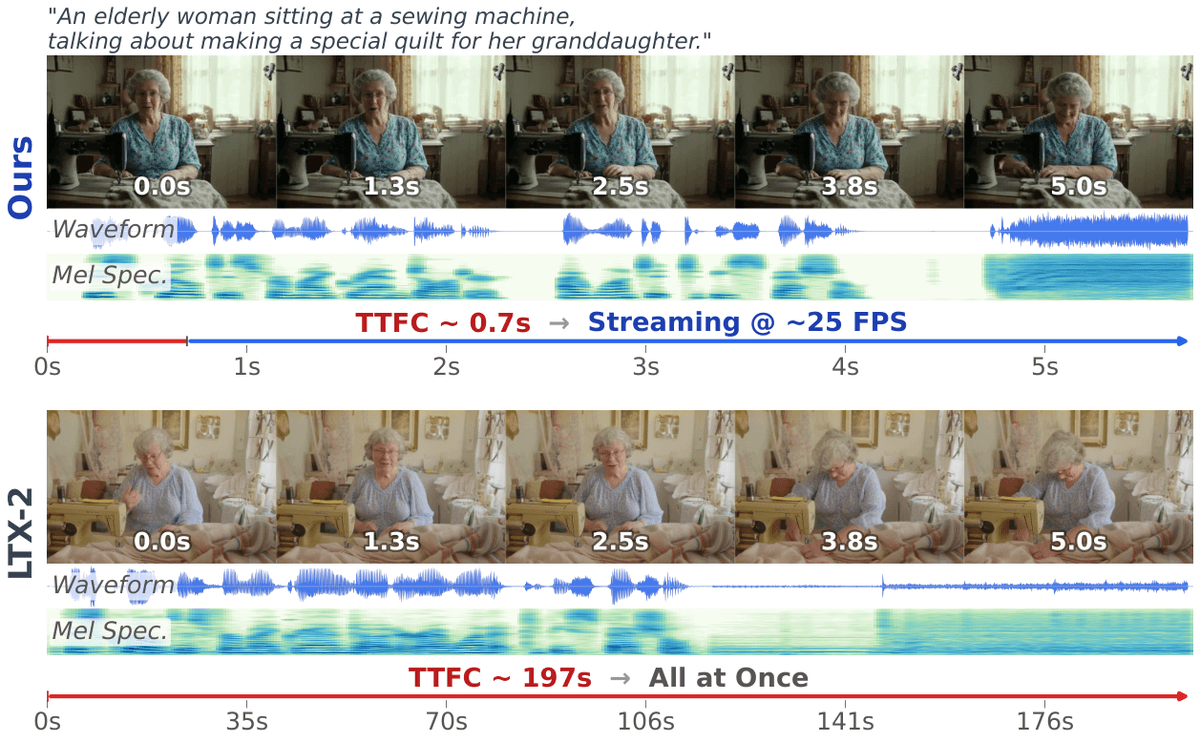
- Delivers a 35x speedup: 5.7s wall-clock and 0.7s TTFC for a 5-second 480p clip versus 197s offline.
- Introduces Asymmetric Block-Causal Alignment with a Global Prefix aligned on 1-second macro-blocks.
- Audio Sink Tokens with Identity RoPE fix Softmax collapse and gradient explosions from sparse causal audio attention.
- Joint Self-Forcing Distillation lets the model correct its own cross-modal drift during long rollouts.
- Code is available; training needs 8x+ H200 GPUs, inference runs on a single GPU.
Joint audio-visual generators like LTX-2 and Veo 3 can spin up synchronized video and matched soundtracks from a single prompt, but they force you to wait. A 5-second clip can take over three minutes because the model has to think about every frame and every audio sample at once, in both directions. A new framework called OmniForcing from JD Explore Academy, Peking University, Fudan, and HKU takes that offline monster and turns it into a streaming autoregressive generator that runs at roughly 25 FPS on a single GPU.
The latency wall in joint audio-visual diffusion
Recent joint audio-visual diffusion models achieve remarkable generation quality but suffer from high latency due to their bidirectional attention dependencies, hindering real-time applications. Bidirectional attention means every token attends to every other token in the sequence, so the model cannot emit frame 1 until it has processed the entire timeline. On the teacher model here, LTX-2, that translates to roughly 197 seconds to generate a sequence offline.
Prior workarounds either split the problem into cascaded video-then-audio pipelines (which breaks joint modeling and can't stream) or apply causal distillation techniques like CausVid and Self-Forcing that so far only work for video-only architectures. Pushing those causal tricks onto a dual-stream model breaks in ugly ways, which is the actual research problem the paper solves.
Why naive causal distillation blows up
The core issue is that video and audio live at wildly different rates in latent space. In LTX-2, the video VAE produces 3 latent frames per second while the audio VAE produces 25. A strict frame-by-frame causal mask on that mismatched grid does two bad things:
- It shifts the model from a globally-informed posterior to a truncated causal one, and the shift is asymmetric because audio blocks contain far fewer tokens than video blocks.
- For the first audio tokens in a new block, the attention denominator becomes tiny. The Softmax collapses toward a one-hot vector, and the exponential nonlinearity amplifies small logit perturbations into exploding gradients and NaN losses under bf16.
The ablation in the paper confirms this: with no stabilizer at all, training simply diverges into Softmax collapse.

The three fixes: alignment, sinks, and self-forcing
OmniForcing bundles three ideas that together make causal distillation stable on a dual-stream backbone.
Asymmetric Block-Causal Alignment with a Global Prefix. Instead of aligning frame-to-frame, the authors align modalities at 1-second macro-blocks. A zero-truncation Global Prefix prevents multi-modal synchronization drift by treating the initial latents (which exist at t≈0 because of causal VAE strides) as a shared block that is always visible to everything downstream, similar to a system prompt in an LLM. Inside each 1-second block, attention is bidirectional; across blocks, it is strictly causal.
Audio Sink Tokens with Identity RoPE. To fight the sparsity problem, they prepend learnable sink tokens to the audio stream. These act as a soft global memory buffer that expands the attention denominator for early audio tokens, restoring entropy and killing the gradient explosion at the source. Because these tokens are abstract and should not carry temporal position, they are pinned with an Identity RoPE constraint where cos(θ) = 1 and sin(θ) = 0, so rotary embeddings degenerate into an identity map and don't inject spurious time bias.
Joint Self-Forcing Distillation. Autoregressive models drift during long rollouts because they must condition on their own imperfect outputs, not ground truth. Stage 3 -- Joint Self-Forcing DMD: The model autoregressively unrolls its own generations during training, enabling dynamic self-correction of cumulative cross-modal errors from exposure bias. A frozen bidirectional teacher scores the trajectory via a KL objective, so the student learns to recover from its own mistakes rather than pretending it never made any.
How the pipeline runs in practice
Training happens in three stages on top of LTX-2:
- Bidirectional DMD (2,000 steps): Standard Distribution Matching Distillation compresses many-step diffusion into a few-step student while keeping full-sequence attention intact.
- Causal ODE Regression (3,000 steps): The block-causal masks and Audio Sink Tokens are switched on. The student regresses onto the Stage I teacher's ODE trajectories so its weights adapt to the truncated receptive field without full generation.
- Joint Self-Forcing DMD (2,000 steps): The model unrolls its own audio and video blocks and matches the teacher's distribution, forcing the two streams to stay synchronized under their own accumulated drift.
At inference, a Modality-Independent Rolling KV-Cache exploits the fact that the 14B video branch and 5B audio branch share no data dependency inside a transformer layer except at cross-modal attention boundaries. Per-step context is reduced to O(L) and the two streams run concurrently on a single GPU, opening the door to asymmetric tensor parallelism when scaling out.
The numbers
On JavisBench, OmniForcing lands close to its bidirectional teacher while running dramatically faster:
| Model | FVD ↓ | FAD ↓ | CLIP ↑ | DeSync ↓ | Runtime |
|---|---|---|---|---|---|
| LTX-2 (teacher, 19B) | 125.4 | 4.6 | 0.318 | 0.384 | 197s |
| JavisDiT++ (2.1B) | 141.5 | 5.5 | 0.316 | 0.832 | 10s |
| MMAudio (cascade) | , | 6.1 | , | 0.849 | 15s |
| OmniForcing (19B) | 137.2 | 5.7 | 0.322 | 0.392 | 5.7s |
The DeSync score, which measures cross-modal timing drift, is particularly striking: 0.392 versus 0.832 for the strongest joint baseline. That gap is where the Global Prefix and Self-Forcing pay off. Interestingly, on VBench the distilled student slightly beats the teacher on aesthetic quality (+0.026) and imaging quality (+0.020), a phenomenon that has been reported in other DMD distillations.

What it is good for, and what it isn't
OmniForcing targets the interactive and streaming end of generative video: live avatars, game cutscenes generated on the fly, low-latency previews inside creative tools, and any application where waiting three minutes per five seconds of output kills the interaction loop. The framework achieves real-time streaming at ~25 FPS with an ultra-low Time-To-First-Chunk (TTFC) of ~0.7s, which is fast enough to feel responsive.
The tradeoffs are honest. The restricted causal receptive field costs a bit on FVD and FAD versus the bidirectional teacher, and audio-text consistency (TA-IB, CLAP) is slightly below the teacher because audio has less context to work with at any given step. This is also a heavy piece of infrastructure: the official repo lists a minimum of 8x H200 GPUs (141GB), with 32x H200+ (4 nodes x 8 GPUs) recommended for faster training. Inference is a single-GPU story, but training is decidedly not.
Code and availability
The official implementation is on GitHub, built on the LTX-2 codebase with separate packages for the core model, pipelines, causal masking, and distillation. Two variants are provided: Self-Forcing DMD (main branch), the recommended autoregressive self-forcing rollout with DMD loss, and Causal DMD (causal-dmd branch), a block-wise DMD training path without self-forcing rollout. A full HTML version of the paper is on arXiv, and demos live on the project page.
The bigger takeaway is architectural. Streaming video diffusion has been converging on a stable recipe over the last year, and OmniForcing shows that the same recipe generalizes to multi-modal streams if you're willing to think carefully about token density, positional encoding, and where the Softmax will collapse. The 35x speedup is the headline, but the actual contribution is a stability blueprint for future dual-stream causal distillations.