
OKH-RAG Proves Evidence Order Alone Boosts AI Reasoning Accuracy by 10%
A new RAG framework treats the sequence of retrieved evidence as a first-class signal, outperforming set-based hypergraph retrieval on multi-step reasoning tasks.
Takeaways
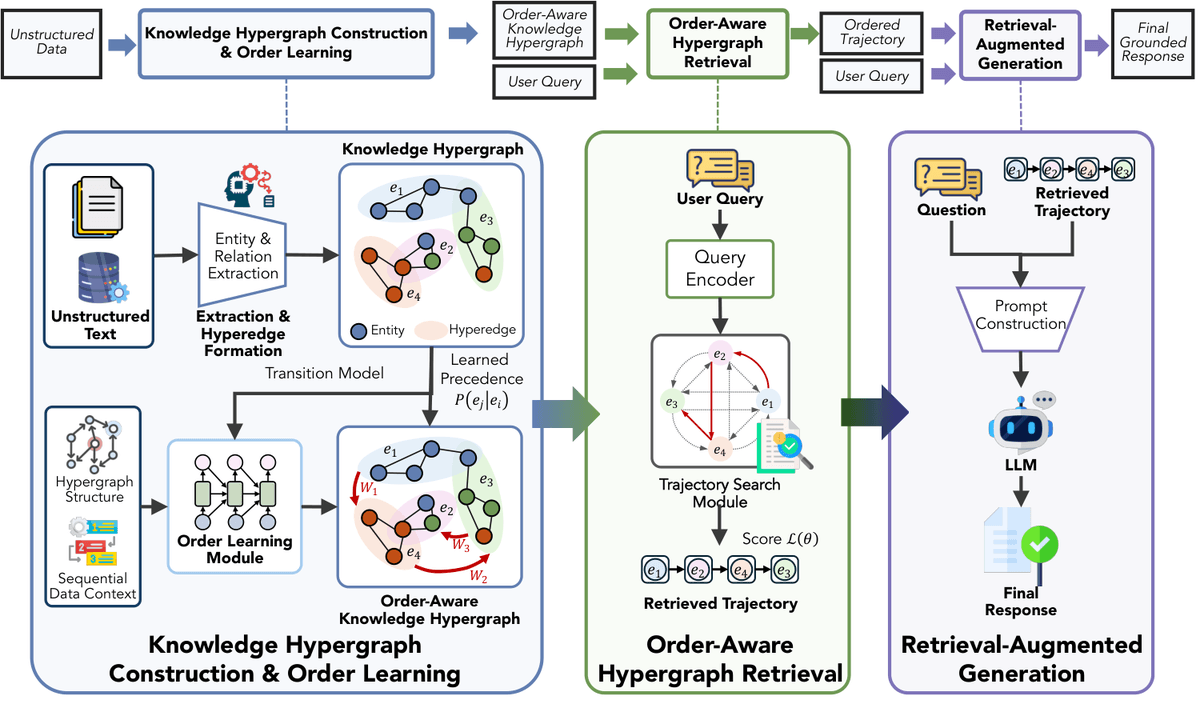
- OKH-RAG treats evidence order as a first-class structural property, reformulating retrieval as trajectory inference over hypergraph edges.
- A low-rank bilinear transition model learns precedence from document order, entity overlap, and retrieval feedback, no timestamps needed.
- Beam search optimizes five terms: relevance, order coherence, precedence, entity continuity, and phase coverage.
- On CyPortQA, OKH-RAG scores 0.534 overall vs 0.511 for HyperGraphRAG and 0.287 for Text-RAG using the same GPT-4o generator.
- Shuffling the retrieved trajectory alone drops accuracy by 0.047, isolating order as an independent driver of quality.
- Best fit for processes with causality and evolution; requires domain-specific relation vocabulary and precedence rules to deploy.
Most retrieval-augmented generation systems quietly assume that the order in which evidence is retrieved does not matter. Whether you get fact A then fact B, or B then A, the language model is supposed to figure it out. A new paper argues that assumption breaks down for a wide class of real-world reasoning problems, and proposes a retrieval framework where the sequence of evidence is modeled explicitly.
The method, called Order-Aware Knowledge Hypergraph RAG (OKH-RAG), reformulates retrieval as trajectory inference over a hypergraph. Instead of pulling the top-k relevant facts and dumping them into a context window, it searches for ordered chains of higher-order interactions that reflect how a process actually unfolds.
Why unordered retrieval falls short
Graph-based RAG methods represent knowledge as entities and binary relations, enabling graph traversal, path-based reasoning, and community-level summarization. They remain fundamentally limited by binary representations that decompose higher-order dependencies into pairwise edges. Hypergraphs fix part of that gap by allowing a single edge (a hyperedge) to connect any number of entities at once, so a multi-factor interaction like storm + port + advisory + operational_response stays intact rather than getting shredded into pairs.
Even hypergraph RAG has a blind spot. Existing methods typically treat hyperedges as static facts, failing to capture the dynamics, temporal evolution, and ordering of higher-order interactions. If a hurricane's Category 2 status at T-48 hours arrives after a port closure notice at T-12 in your prompt, the model has to reconstruct the timeline on its own.