
Ohio State's AVA-Bench Exposes What Vision AI Backbones Actually Can't See
A new benchmark cracks open vision foundation models by isolating 14 core perceptual skills, revealing where each backbone actually shines or fails.
 Pro
Takeaways
- AVA-Bench diagnoses vision foundation models across 14 atomic visual abilities instead of one aggregate VQA score.
- 218K image-question pairs from 26 datasets isolate skills like depth, OCR, counting, and spatial reasoning.
- Language-supervised SigLIP-1/2 and AIMv2 rank highest on average; DINOv2 wins vision-centric tasks.
- A 0.5B Qwen2 evaluator preserves VFM rankings while cutting GPU hours by roughly 8x versus 7B Vicuna.
- Failures on composite tasks usually trace to one weak skill, not general visual incompetence.
- Paper, code, and dataset are open-source, accepted to CVPR 2026.
Picking a vision backbone today feels like guesswork. You wire DINOv2, SigLIP, SAM, or CLIP into a multimodal stack, run a big VQA benchmark, and hope the numbers mean something. A new CVPR 2026 paper argues that these aggregate scores hide more than they reveal, and proposes a diagnostic benchmark that treats visual perception like a set of separable primitives instead of one monolithic skill.
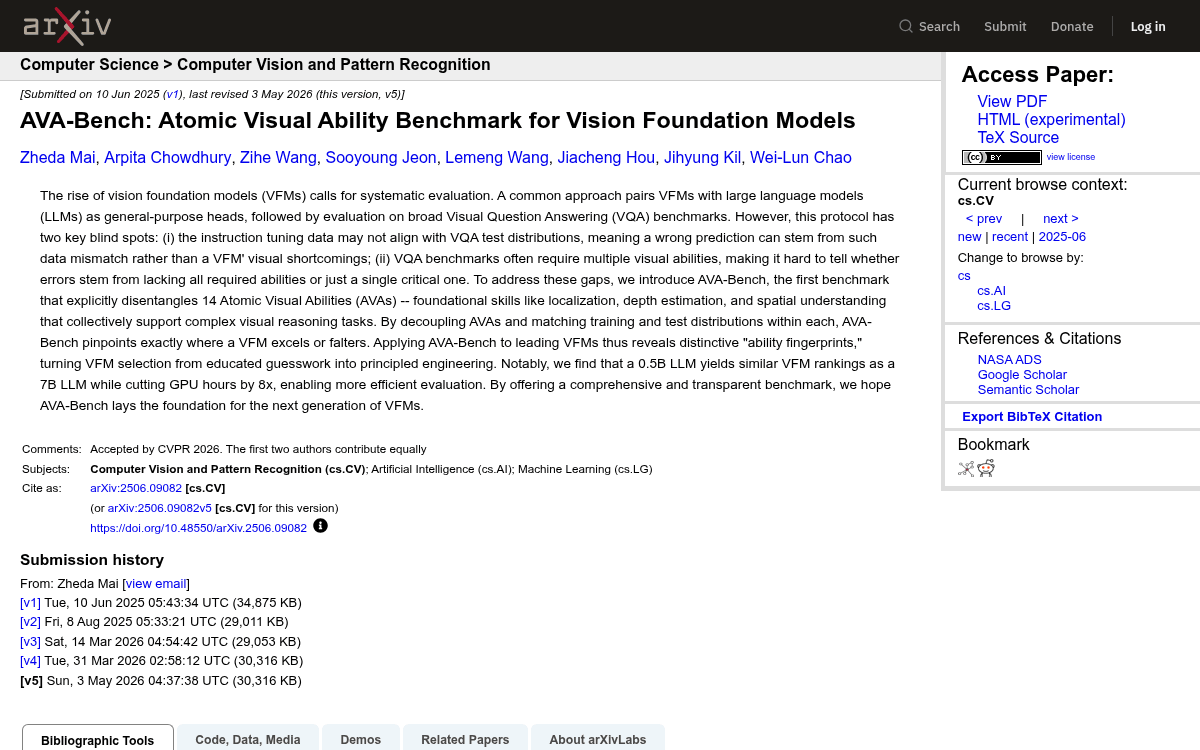
AVA-Bench, from researchers at Ohio State, Adobe Research, and Boston University, breaks visual understanding into 14 Atomic Visual Abilities and tests vision foundation models (VFMs) on each one in isolation. The result is a per-model fingerprint that shows exactly which perceptual skills a backbone has and which it lacks.
Why aggregate VQA scores mislead
The standard evaluation recipe pairs a frozen VFM with an LLM head, fine-tunes on instruction data, then measures accuracy on broad VQA benchmarks. This protocol has two potential blind spots: discrepancies between instruction tuning data and the test VQA datasets mean a miss-prediction might arise from data mismatch rather than genuine visual deficiencies, and typical VQA benchmarks require multiple visual abilities simultaneously, obscuring the exact cause behind a model's incorrect predictions.
The classic example: a question like "How many yellow dogs are facing backward on the left of the stop sign?" needs counting, color, orientation, localization, and spatial reasoning all at once. If a model misses it, which skill actually broke down? Aggregate accuracy shrugs.
Fourteen skills, tested one at a time
AVA-Bench evaluates VFMs across 14 carefully identified AVAs, including localization, counting, spatial reasoning, orientation, absolute and relative depth estimation, and recognition of textures, colors, objects, actions, emotions, optical characters (OCR), and scenes. Each ability is probed on its own with matched training and test distributions, so a model's score reflects the skill and not some data-mismatch artifact.

The isolation trick often comes from giving away the parts of a question that would otherwise conflate abilities. For depth estimation, the model gets an explicit bounding box on the target object so localization is not part of the challenge. For color, tight boxes are drawn on low-variance regions to strip out semantics and clutter. In summary, AVA-Bench comprises 218K meticulously curated image-question pairs that robustly isolate individual AVAs, carefully control dataset balance, visibility, and systematically prevent annotation biases. The pairs come from 26 source datasets spanning open-domain scenes, remote sensing, wildlife, and indoor/outdoor imagery.
How the evaluation runs
The pipeline follows LLaVA-style two-stage training with an added third stage per ability. The VFM stays frozen throughout:
- Pretrain a connector between the frozen VFM and a frozen LLM on image-text pairs.
- Instruction-tune the connector and LLM on standard visual instruction data.
- For each of the 14 AVAs, fine-tune the connector plus a LoRA adapter on that ability's training split (roughly 6K to 10K samples), then evaluate on its held-out test set.

Metrics are ability-appropriate: absolute depth and counting use a normalized mean absolute error relative to ground-truth, localization uses Generalized IoU, color uses CIEDE2000, OCR uses Average Normalized Levenshtein Similarity, and all other AVAs use standard accuracy metrics.
The ability fingerprints
Running the benchmark across leading VFMs (SigLIP-1/2, CLIP, InternVL-2.5, AIMv2, DINOv2, SAM, MiDaS, RADIOv2.1) produces distinctive per-model profiles. Highlights from the results table:
- Language-supervised backbones dominate on average. SigLIP-1/2 and AIMv2 emerge as the most versatile VFMs, achieving the highest average rank across all AVAs, highlighting the critical role of language supervision in enhancing general visual capability.
- Self-supervised DINOv2 wins on vision-centric skills. For vision-centric AVAs such as localization, absolute depth estimation, and orientation, the SSL-based DINOv2 performs comparably or better than language-supervised counterparts.
- OCR needs language pretraining. Language-centric tasks such as OCR strongly favor language-supervised VFMs. DINOv2 and SAM score near single digits on ANLS while SigLIP-2 lands around 81.
- Everyone is decent at low-level perception. VFMs universally excel at low- to mid-level AVAs such as texture, relative depth estimation, and object recognition, regardless of their training objectives.
- Even weak models have specialties. SAM tops color recognition; DINOv2 tops orientation.
A useful diagnostic trick with bounding boxes
Because AVA-Bench can add or remove auxiliary information, it can localize the source of a composite failure. On spatial reasoning, all VFMs score near-perfectly when given ground-truth bounding boxes. Strip those boxes out and the task becomes localization plus spatial reasoning, and the ranking suddenly mirrors each model's localization score. That is direct evidence that failures on messy VQA questions usually trace back to a specific weak skill, not a general lack of visual competence.
You do not need a 7B evaluator
One of the more practical findings is about the evaluation LLM itself. A significantly smaller 0.5B LLM (Qwen2) achieves similar relative VFM rankings comparable to a 7B Vicuna-1.5, while dramatically reducing evaluation costs by approximately 8x. For anyone benchmarking backbones at scale, that swap turns a costly protocol into something you can actually iterate on.

When to use it
AVA-Bench is aimed at VFM selection and diagnosis, not at ranking end-to-end MLLMs. If you are building a specialized multimodal system, say a document reader or a remote-sensing pipeline, the AVA fingerprints tell you which backbone actually has the perceptual skills you need before you commit to a training run. It is less useful if you want a single leaderboard number for a general-purpose assistant, since the point of the benchmark is to refuse that reduction.
The paper, code, and dataset are all released, along with an arXiv preprint. Given that VFM choice is still largely folklore in the multimodal community, having a diagnostic tool that swaps educated guesswork for measured ability profiles is a genuinely useful contribution.