
Ohio State and Amazon Splice Vision AI Models Together, Cutting Compute by 60%
New research shows heterogeneous vision foundation models like CLIP, DINOv2, and SigLIP 2 can be stitched together to fuse complementary strengths at low cost.
 Pro
Takeaways
- Heterogeneous vision foundation models like CLIP, DINOv2, and SigLIP 2 can be reliably stitched together with the right training recipe.
- Standard stitching approaches (layer feature matching, task loss training) fail on foundation models, especially at shallow stitch points.
- Final Feature Matching plus task-loss fine-tuning is the two-stage fix that consistently beats both constituent models.
- Self-stitch baselines confirm gains come from genuine knowledge fusion, not just added stitch-layer capacity.
- The VFM Stitch Tree shares early layers and specializes late ones, giving a compute-aware knob for multi-VFM MLLMs.
- VST-22 recovers 45% of two-VFM gains at 4.3% overhead; VST-14 recovers 84% at 39% overhead.
Vision foundation models have multiplied over the past few years, and multimodal systems increasingly load several of them side by side to cover different visual skills. A new paper from Ohio State and Amazon researchers, Revisiting Model Stitching In the Foundation Model Era, asks a blunt question about that trend: do we actually need to run all of them end to end, or can we splice their internals together into a single, cheaper network that keeps the strengths of each?
The answer, with the right training recipe, is yes. The authors revisit model stitching, which connects early layers of one model to later layers of another via a light stitch layer, for vision foundation models that vary in objectives, data, and modality mix such as CLIP, DINOv2, and SigLIP 2. They also introduce a modular architecture called the VFM Stitch Tree that recovers most of the accuracy gains of running multiple encoders while cutting compute dramatically.
Why old stitching recipes break on foundation models
Model stitching started as a diagnostic. Prior work found that models trained on the same dataset remain stitchable with negligible accuracy drop despite different initializations or objectives. That result relied on models trained on identical data such as CIFAR-10, so it does not clearly transfer to today's foundation models trained on very different corpora with different objectives (contrastive image-text, self-supervised distillation, sigmoid loss, and so on).

The researchers first tried the two standard stitching recipes and both fell apart. Conventional approaches that match the intermediate features at the stitch point or optimize the task loss end-to-end struggle to retain accuracy, especially at shallow stitch points. Two specific failure modes emerged:
- Layer Feature Matching (LFM) forces the stitch layer to reproduce the target's intermediate features. It does that job well, but small mismatches get amplified by the frozen layers above and blow up the final representation.
- Task Loss Training (TLT) optimizes cross-entropy directly. At shallow stitch points, gradients have to travel back through many frozen target layers with weak pooled-token supervision, leaving the stitch layer poorly conditioned. Stitching DINOv2 to SigLIP 2 at layer 2, TLT collapsed to 25.1% accuracy, well below either standalone model.
The fix: match features at the end, not at the seam
Their remedy is a two-stage recipe. First, pre-train the stitch layer with Final Feature Matching (FFM): instead of matching the seam, minimize the L2 distance between the stitched model's penultimate features and the target's penultimate features. Then fine-tune the stitch layer with the task loss. FFM is label-free, and because it aligns representations at the point that actually feeds the head, small local errors do not accumulate.
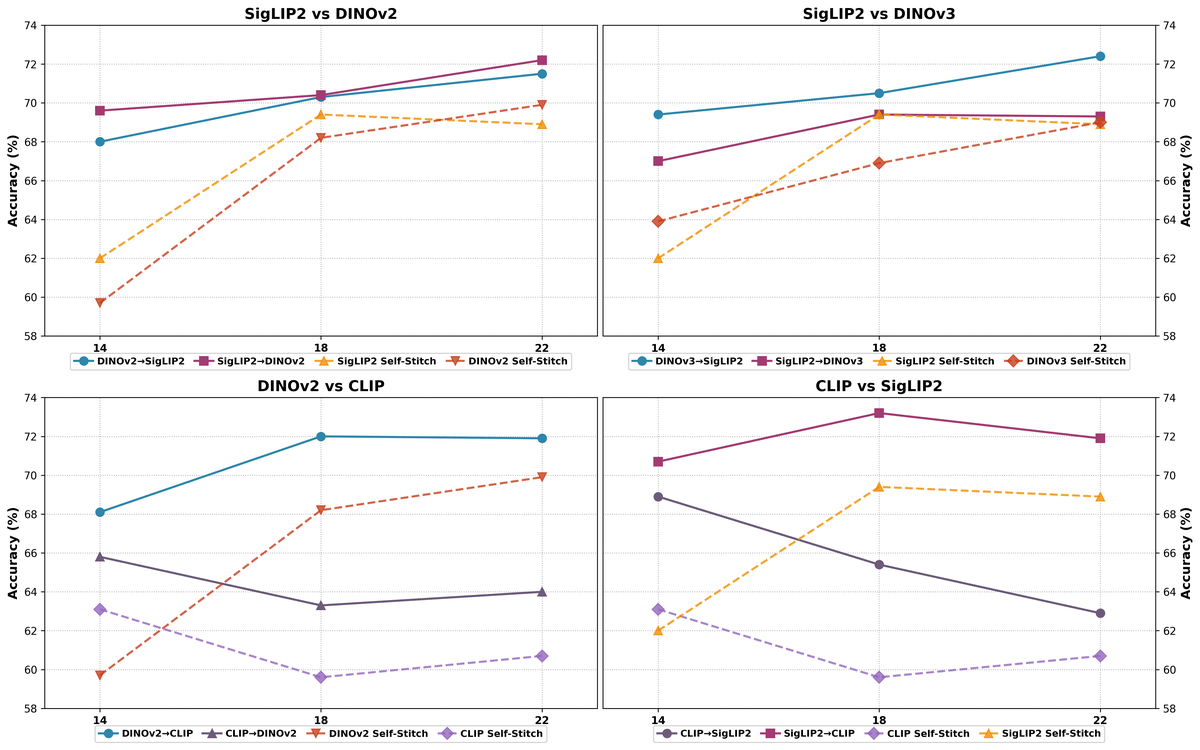
The results are consistent across datasets and tasks. On fMoW, iNaturalist, FGVC-Aircraft, and ADE20K segmentation, stitched models beat both standalone linear probes. For deep stitch points, the stitched model can surpass either constituent model at only a small inference overhead for the stitch layer. One neat detail: even though FFM only supervises the final output, it implicitly keeps the intermediate features well aligned too.

Ruling out the boring explanation
An extra parameter block plus fine-tuning could explain gains all by itself, so the paper introduces a self-stitch baseline: insert the same trainable stitch module into a source-only or target-only network. The cross-VFM stitched model consistently beats both self-stitch controls by roughly 2-3 points at optimal layers, which is real evidence that DINOv2's perceptual structure and SigLIP 2's semantic grounding are genuinely complementary rather than redundant.
There is one caveat worth noting. When CLIP is used as the source, the stitched model beats CLIP itself but cannot match the stronger target. The interpretation is that a weak encoder discards information the downstream layers cannot recover, similar to how swapping in a weaker backbone in a detection pipeline degrades performance even with a strong decoder.
From probe to production: the VFM Stitch Tree
The practical payoff is an architecture the authors call the VFM Stitch Tree (VST). Multimodal LLMs like MoF-LLaVA, OpenVLA, and Cambrian-1 stack multiple VFMs, paying a linear cost in memory and latency for each one. VST shares the early layers across all encoders and keeps only the later, more specialized layers separate, joined by stitch layers.

Instantiated in a LLaVA model with CLIP + DINOv2 and a Qwen 3B LLM, VST gives a controllable knob:
- VST-22 (one specialized layer per encoder, 4.3% extra backbone cost) recovers 45% of the accuracy gain that running both encoders in full would deliver.
- VST-14 (nine specialized layers, 39% extra) recovers 84% of that gain.
- The naive two-VFM baseline costs 100% extra backbone compute for the full gain.
For a hypothetical four-VFM Cambrian-style setup, stitching at layer 14 cuts backbone overhead from 300% to 117% versus running four encoders independently. That turns a binary deploy-or-not decision into a continuous accuracy-efficiency curve, which is genuinely useful for anyone building visual encoders into latency-constrained systems.
What to take away
The specific results matter, but the bigger shift is conceptual. Stitching used to be a probe for asking whether two networks learned similar representations. This work reframes it as a practical fusion mechanism: heterogeneous encoders trained on different data and objectives are not just compatible up to a linear map, they are often complementary, and a small trained module can pull that complementarity out. That opens a path to composing existing VFMs rather than pretraining new ones from scratch, and it suggests a cheaper way to scale the visual side of multimodal LLMs.