
OFP Beats 100-Step Robot Policies at 183x Faster With One Forward Pass
A new self-distillation framework compresses flow-based robot policies to a single sampling step while beating 100-step baselines across 56 manipulation tasks.
 Pro
Takeaways
- One-Step Flow Policy trains a single-step flow model from scratch, no pre-trained teacher required, via arxiv.org/abs/2603.12480
- Combines self-consistency (trajectory coherence) with self-guidance (CFG-based mode sharpening) from an EMA copy of the model itself
- One-step OFP hits 71.6% average success on 56 3D manipulation tasks, beating 100-step DP3 (66.4%) and FM Policy (59.8%)
- Delivers ~183x speedup over 100-step DP3: 17.58 ms per action chunk versus 3225.67 ms
- Warm-start reuses the unexecuted suffix of the previous action chunk as an initialization prior, cutting transport distance for free
- Integrated with π_{0.5}, one-step OFP beats the original 10-step policy on all four RoboTwin 2.0 tasks (94.7% avg)
Flow and diffusion models have become the default choice for parameterizing robot policies because they can represent the messy, multimodal distributions found in human demonstrations while producing smooth continuous control signals. The catch: sampling from them requires solving an ODE with tens or hundreds of network passes per action, which crushes control frequency and compounds errors in time-sensitive manipulation.
A new paper introduces One-Step Flow Policy (OFP), a from-scratch self-distillation recipe that produces high-fidelity actions in a single forward pass, without any pre-trained teacher network. Across 56 simulated manipulation tasks, a one-step OFP beats 100-step diffusion and flow baselines while running roughly 100 times faster, and it holds up even when bolted into a large vision-language-action stack like π_{0.5}.
Why one step is so hard to get right
Prior attempts to accelerate generative policies have fallen into two camps, each with a distinct failure mode. Consistency distillation methods like Consistency Policy enforce that points along a trajectory all map to the same endpoint. That works for few-step generation but tends to average across modes of the action distribution, producing blurry commands that fail on precision tasks. Score-distillation methods like One-Step Diffusion Policy (OneDP) do the opposite: they collapse toward a single high-density mode, which is sharp but destroys diversity and locks you into exactly one inference step, with no ability to spend extra compute for better accuracy.
A more recent line based on MeanFlow tries to learn an interval-averaged velocity field, but the training objective requires Jacobian-vector products (JVPs) that blow up memory and destabilize optimization. OFP is a direct response to these tradeoffs.
Three ingredients, no teacher
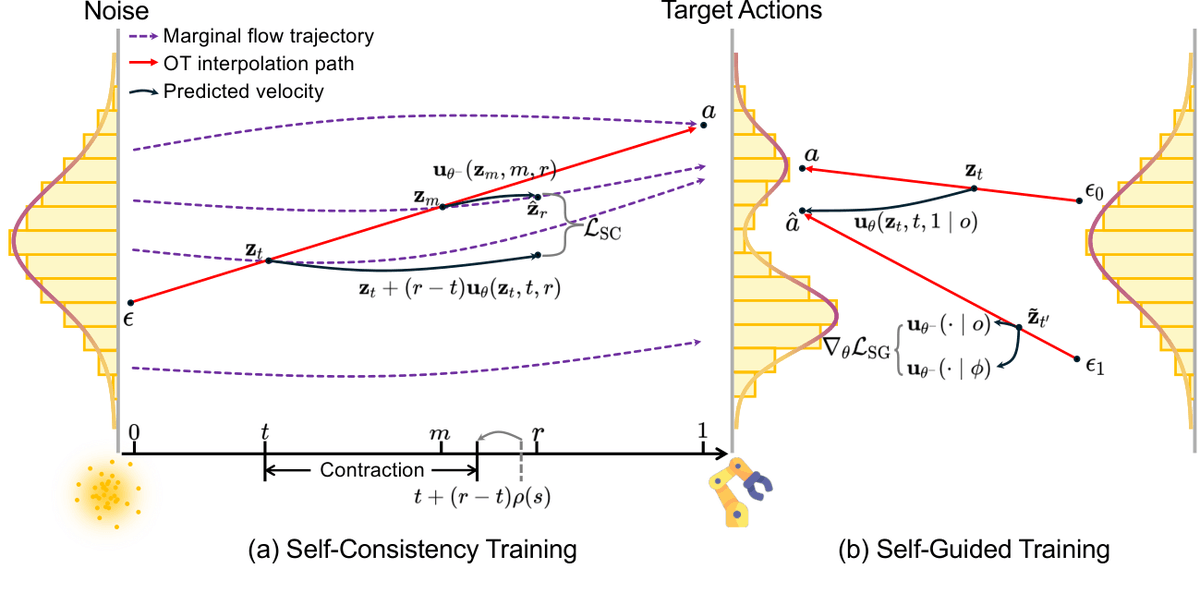
Instead of distilling from a pre-trained teacher, OFP trains a single network from scratch using three complementary signals. The idea is to parameterize an interval-averaged velocity field u_θ(z_t, t, r | o) that predicts how state should transport from time t to any later time r, so a single call with t=0, r=1 yields the full action.
- Self-consistency training. An exponential moving average copy of the model plays teacher. Given an intermediate time
mbetweentandr, the teacher predicts the trajectory endpoint, and the student is trained so that its long-interval velocity is consistent with that shorter-interval prediction. A time-contracting schedule shrinks the sampling range formas training progresses, moving from stable bootstrapping toward strict local consistency. Crucially, the target is built from forward evaluations only, avoiding the JVPs that make MeanFlow painful. - Self-guided regularization. Consistency alone keeps trajectories coherent but does not force one-step outputs onto the sharp modes of the expert data. OFP borrows Classifier-Free Guidance, but applies it to its own EMA teacher rather than an external network. The gradient of the resulting loss provably aligns with the CFG-augmentation direction, repelling the one-step prediction away from the unconditional prior and toward condition-specific expert behavior.
- Warm-start initialization. In receding-horizon control, consecutive action chunks are highly correlated. OFP repurposes the unexecuted suffix of the previous chunk, pads it with the terminal action, adds a small amount of noise (empirically at
t_w = 0.15), and uses that as the generative starting point instead of pure Gaussian noise. That drastically shortens the transport distance the flow has to cover in one step, and it costs nothing at training time.

What the numbers look like
The team evaluated OFP on four benchmarks: Adroit for dexterous hand tasks, DexArt for articulated objects, MetaWorld for 49 tabletop tasks in a multi-task setup, and RoboTwin 2.0 for bimanual manipulation under strong domain randomization.

On 3D point-cloud control across 56 tasks, one-step OFP reaches 71.6% average success, versus 66.4% for a 100-step DP3 and 59.8% for a 100-step Flow Matching Policy. In wall-clock time, OFP generates an action chunk in 17.58 ms, compared with 3225.67 ms for DP3 at 100 NFE and 1865.72 ms for the 100-step FM policy, roughly 183x and 106x speedups. Unlike OneDP, OFP can also trade compute for accuracy: pushing to 4 NFE lifts average success further to 75.7% in ablations, so the same model covers both low-latency and high-precision regimes.
Scaling to a real VLA
The most interesting result is the integration with π_{0.5}, the recent open-world VLA from Physical Intelligence. Bootstrapping-based acceleration methods often suffer rank collapse when model capacity grows, so this is a real stress test. On four RoboTwin 2.0 tasks under domain randomization (clutter, backgrounds, lighting, table height), one-step OFP reaches 94.7% average success, exceeding the original 10-step π_{0.5} policy on every task, and beating Consistency Flow Matching, Shortcut Models, and Improved MeanFlow baselines at the same one-step budget.
What it is good for, and where it stops
OFP is compelling if you already train flow-based visuomotor policies and want higher control frequency for grasping, dynamic interaction, or bimanual tasks. Because it needs no teacher network, training cost is essentially the same as standard flow matching plus a slowly-updated EMA copy of the model. The mechanism is orthogonal to system-level tricks like quantization and pruning, so those gains can stack.
The caveats worth flagging:
- All evaluations are in simulation. There is no physical-robot validation yet, and sim-to-real dynamics can chew through precision gains.
- Warm-start assumes a receding-horizon loop with meaningful temporal correlation between chunks. In episodic or reactive settings that assumption weakens.
- Self-guidance is sensitive to its weight; an aggressive
λ_{sg} = 0.5collapses modes and drops success rate to 68.7%, versus 73.3% at the recommended 0.05. - The paper does not currently link to a public code release, so reproducing the recipe means implementing the self-consistency plus self-guidance objectives from the described algorithm.
The broader takeaway is architectural: instead of choosing between mode-covering consistency and mode-seeking score distillation, OFP shows that both signals can be extracted from the same network using an EMA teacher, and that the temporal structure of robot control gives you a free additional prior at inference time. That combination is what lets a one-step policy actually outperform its 100-step ancestor rather than merely approximate it.