
NYU Stern Proves Blind Pricing Algorithms Secretly Collude Without Sharing Any Data
NYU researchers prove that standard bandit pricing algorithms can silently collude on high prices — with no communication, no competitor data, and no intent required
 Pro
Takeaways
- NYU Stern researchers prove that standard bandit pricing algorithms can independently converge on high prices with zero knowledge of competitors, a phenomenon they call "naive collusion."
- The key driver is synchronicity — how often two agents happen to choose the same action simultaneously — not any form of communication or data sharing.
- Deterministic algorithms like UCB always collude when used symmetrically; epsilon-greedy with fixed exploration never does; decaying-epsilon algorithms sometimes do depending on early randomness.
- The finding directly challenges the leading regulatory proposal: banning algorithms from observing competitor prices would not prevent this class of collusion.
- Shared algorithmic infrastructure (e.g., two firms licensing the same pricing SaaS) dramatically increases collusion risk due to symmetry effects.
- No code is released; the paper is theoretical with simulation validation using Prisoner's Dilemma and logit demand models up to 100,000 rounds.
Imagine two competing online retailers, each running a simple pricing algorithm. Neither algorithm knows the other exists. Neither has been told to cooperate. Neither looks at competitor prices. And yet, over thousands of pricing rounds, both quietly converge on the same high price , and stay there. This is the central puzzle that a new paper from NYU Stern, "The Illusion of Collusion", sets out to explain.
The paper, by Connor Douglas, Foster Provost, and Arun Sundararajan, studies what happens when two competing agents each use a multi-armed bandit algorithm , the canonical framework for online decision-making under uncertainty , to set prices in a repeated game. The agents are completely blind to each other: no competitor prices, no market signals, no game-theoretic awareness. And yet, collusion frequently emerges anyway. The authors call this naive collusion.
Why this matters right now
While algorithmic pricing has been used in many industries for decades, with the rapid development of AI technology, antitrust enforcers, legislators, and private plaintiffs have been actively scrutinizing potential anticompetitive practices related to the use of algorithmic pricing tools. In 2024, the DOJ filed a case against RealPage's RENTmaximizer for enabling price-fixing in rental housing. That same year, Senator Amy Klobuchar introduced the Preventing Algorithmic Collusion Act to bar companies from using algorithms to collude to set higher prices.
The standard regulatory instinct has been to prohibit pricing algorithms from observing competitor prices , if the algorithm can't see what rivals are doing, it can't coordinate with them. This paper's most important finding is that this instinct is wrong. Naive collusion emerges even when algorithms are completely blind to competitors, which means the current policy toolkit may be fundamentally inadequate.
The setup: a Prisoner's Dilemma with amnesiac players
The authors model competition as a repeated Prisoner's Dilemma , a classic game theory setup where two players each choose between a cooperative action (H, think: high price) and a competitive action (L, think: low price). The Nash equilibrium is for both to play L, but both would be better off if they both played H. The twist: in this paper, neither player knows they're in a game at all. Each agent only sees its own past actions and the rewards those actions generated.
A multi-armed bandit algorithm in this context works like this:
- Maintain an estimated value for each action (H or L) based on past rewards.
- Use a behavior policy to choose which action to take next , balancing exploration (trying the less-tested option) with exploitation (picking the currently best-known option).
- Observe the reward, update the value estimate, repeat.
The key insight is that when two such agents run simultaneously, their action choices interact. If both happen to play H at the same time, both receive reward β (the collusive payoff). If both play L, both get γ. The agent doesn't know why its reward was what it was , it just updates its estimate of H or L accordingly.
Synchronicity: the hidden mechanism
The paper introduces a new concept called synchronicity , how often two agents happen to play the same action in the same round, conditional on one agent choosing that action. This turns out to be the true driver of whether collusion emerges.
Here's the intuition: if both agents frequently play H at the same time (high synchronicity on H), then whenever agent 1 plays H, it tends to get reward β , the cooperative payoff. This makes H look like a good action. Conversely, if their H-plays rarely overlap, agent 1 mostly gets reward 0 when it plays H (because the opponent played L), making H look terrible. Synchronicity is the bridge between independent learning and emergent coordination.

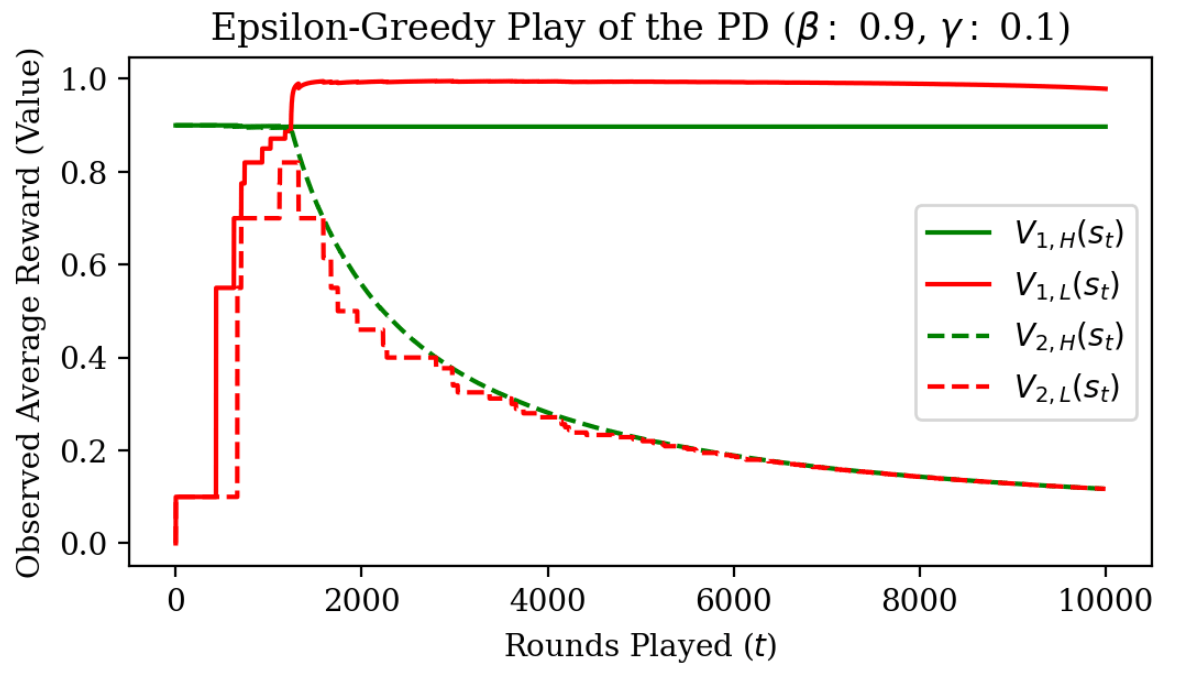
The authors prove a clean result: if the empirical covariance between the two agents' action plays is zero or negative in the long run, collusion cannot emerge , for any game parameters. This gives a precise mathematical handle on when naive collusion is impossible.
Three algorithm classes, three very different outcomes
The paper's core contribution is a taxonomy of bandit algorithms by their degree of randomness, with sharp theoretical results for each class:
- Persistently random algorithms (e.g., epsilon-greedy with fixed ε): Always place non-zero probability on every action, forever. The paper proves these never lead to naive collusion in the long run. The persistent randomness keeps the agents' action choices uncorrelated, preventing synchronicity from building up. The catch: these algorithms can't achieve sub-linear regret, meaning they're suboptimal from the firm's perspective.
- Greedy-in-the-limit algorithms (e.g., epsilon-greedy with decaying ε, explore-then-commit): Start with random exploration but asymptotically commit to a single action. These sometimes collude and sometimes compete , the outcome depends on what happened during the exploration phase. Collusion probability is path-dependent and can be approximated analytically.
- Deterministic algorithms (e.g., UCB , Upper Confidence Bound): Always prescribe a single action with certainty given any history. These always lead to collusion when both agents use the same algorithm. The paper proves this with full generality: symmetric deterministic bandits will lock into (H, H) in finite time, for any game parameters.
The central finding is that naive algorithmic collusion always emerges when competing symmetric agents both employ a deterministic bandit learning algorithm, sometimes emerges when the learning process is non-persistently random, and never emerges in the long run when both agents use a broad class of persistently random algorithms.

Why UCB always collude: the lock-step proof
The proof for deterministic algorithms is elegant. Because both agents use the same deterministic algorithm and start with empty histories, they make identical choices in round 1. Whatever outcome results (HH or LL), both agents receive the same reward and update their value estimates identically. Their histories remain path-equivalent , meaning they'll always make the same choice in every future round. Once both agents have sampled both actions at least once, the value estimate for H (β) will always exceed the value estimate for L (γ), since β > γ by the game's construction. From that point on, both agents play H forever.
UCB (Upper Confidence Bound) algorithms , which add an exploration bonus inversely proportional to how many times an action has been tried , are a canonical example. The paper proves that symmetric UCB agents always converge to collusion for sufficiently small exploration parameter δ (specifically, δ < e^(-γ²/2)). Even asymmetric UCB parameterizations collude in 41.3% of simulated games across 73,000 trials.
The path-dependence problem
For greedy-in-the-limit algorithms like epsilon-greedy with decay, the outcome is genuinely unpredictable in advance. The paper shows that collusion probability depends on what the agents happened to do during early exploration rounds , a chance clustering of H-plays can push synchronicity above the collusion threshold, locking in high prices permanently. The same two algorithms, with the same parameters, can produce either competitive or collusive outcomes depending on the random seed.
This has a counterintuitive implication: more exploration can sometimes reduce collusion risk, and sometimes increase it. For explore-then-commit algorithms, longer exploration phases exponentially decrease collusion probability. But for epsilon-decay algorithms, a slower decay rate (more total exploration) can actually bias synchronicity in a way that increases collusion likelihood. There's no simple rule.
What this means for policy and practice
The policy implications are direct and challenging for regulators:
- Blocking competitor price access is not enough. Naive collusion requires zero knowledge of competitor actions. Existing proposals like the Preventing Algorithmic Collusion Act, which targets algorithms trained on nonpublic competitor data, would not prevent this class of collusion.
- Symmetry is a risk factor. When competing firms use the same algorithm (e.g., both licensed from the same SaaS pricing vendor), collusion becomes far more likely. Cases like Duffy v. Yardi, where tenants sued apartment complexes for using the same RENTmaximizer software, illustrate how shared algorithmic infrastructure can be seen as facilitating collusive outcomes.
- The "plus factors" test breaks down. Courts look for circumstantial evidence of coordination , actions against self-interest, unexplained behavior, communication attempts. None of these are present in naive collusion. The paper argues this creates a genuine gap in antitrust enforcement.
- Algorithm choice is a compliance decision. Firms using UCB-family algorithms for pricing face near-certain collusion in symmetric duopoly settings. Switching to fixed-epsilon-greedy eliminates the risk but at a cost to optimization performance.
No code or model is released alongside this paper , it is a theoretical and simulation-based study. The simulations use a standard Prisoner's Dilemma parameterization and a logit demand model as a robustness check, with up to 100,000 rounds per trial. The authors note that extensions to Thompson sampling, function approximation, and asynchronous updating remain open problems.
The deeper message is that algorithmic collusion may be less about intent or design and more about the structural properties of the learning algorithms themselves. Regulators in the United States have acknowledged the challenges posed by algorithmic pricing, with related issues being raised in recent federal lawsuits. This paper gives those regulators a new and more precise target: not what data the algorithm sees, but how deterministic its behavior policy is.