
NYU's LangSCD Triples Street Change Detection Accuracy by Adding Language
Researchers pair vision-language models with SAM2 to turn scene change detection from noisy pixel differencing into object-level semantic reasoning.
 Pro
Takeaways
- NYU researchers introduce LangSCD, a vision-language framework for urban scene change detection.
- Uses GPT-4o captions fused with visual features via bidirectional cross-attention, then verified with SAM2 and Grounded SAM.
- RSCD + LangSCD jumps from 0.13 to 0.70 F1 on the new NYC-CD benchmark.
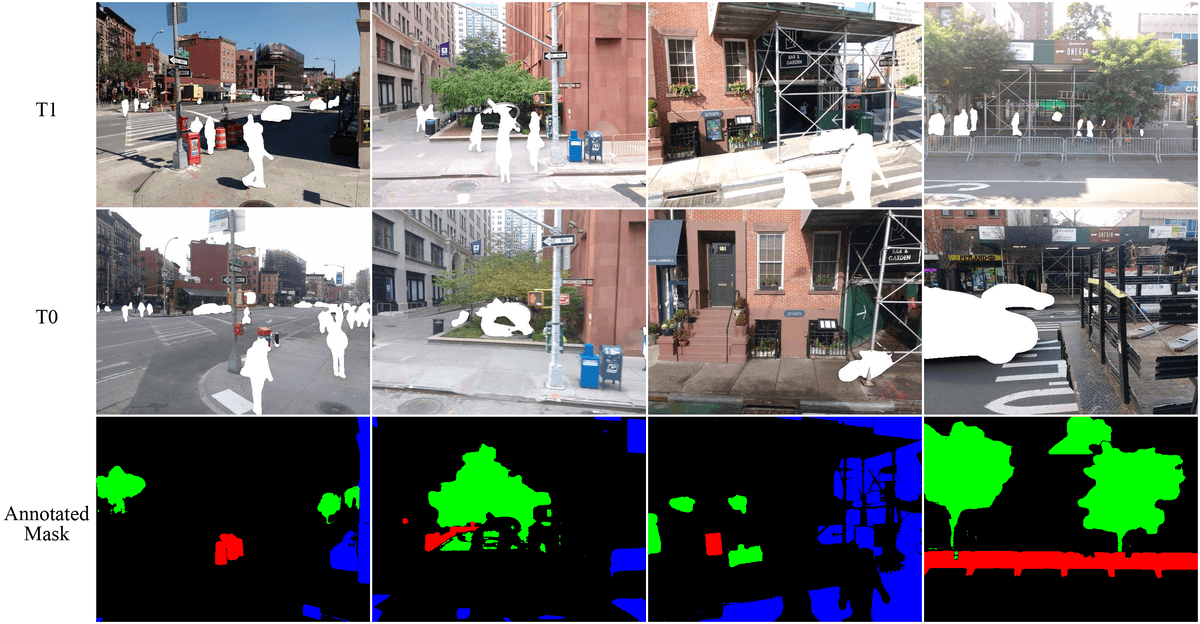
- New NYC-CD dataset: 8,122 Manhattan image pairs with object, vegetation, and viewpoint change classes.
- Modular design works as a plug-in for RSCD, C-3PO, and GeSCF backbones with consistent gains.
- Code, checkpoints, and captions available on GitHub; runs at 4.89s per pair, targeted at offline use.
A team of researchers at NYU's ai4ce lab has published a paper proposing a way to fix one of the more stubborn problems in computer vision: telling whether something meaningful has actually changed between two photos of the same street. Their framework, LangSCD, plugs a language model into existing scene change detection pipelines and delivers double-digit F1 improvements across four benchmarks. They also released NYC-CD, a new dataset of 8,122 image pairs captured across Manhattan, and open-sourced the code on GitHub.
Why pixel differencing keeps failing
Scene change detection (SCD) sounds simple: given two pictures of the same place taken months apart, produce a mask over what actually changed. In practice it is a mess. Urban environments introduce lighting variations, seasonal shifts, viewpoint differences, and complex layouts that all look like changes to a network trained on low-level visual features. Shadows shift. Trees bloom. The camera stands three meters to the left. Existing detectors happily flag all of it.
The authors frame this as a single-modal bottleneck. Because existing methods rely primarily on low-level visual features, they struggle to isolate genuinely changed objects amid the visual complexity of urban scenes. Transformer-based baselines like RSCD and CNN-based ones like C-3PO produce fragmented masks that miss semantically meaningful changes while lighting up on reflections and parallax.
Bolting language onto a visual backbone
LangSCD's core idea is to inject high-level semantic priors from a vision-language model into the visual pipeline, then verify them geometrically. The architecture is modular and works as a plug-in for existing SCD backbones.