
NYU's GraphVLM Benchmark Shows Fine-Tuned VLMs Crush GNNs on Multimodal Graphs
A new benchmark tests three ways to plug vision-language models into graph learning, and fine-tuned VLM predictors sweep six datasets.
 Pro
Takeaways
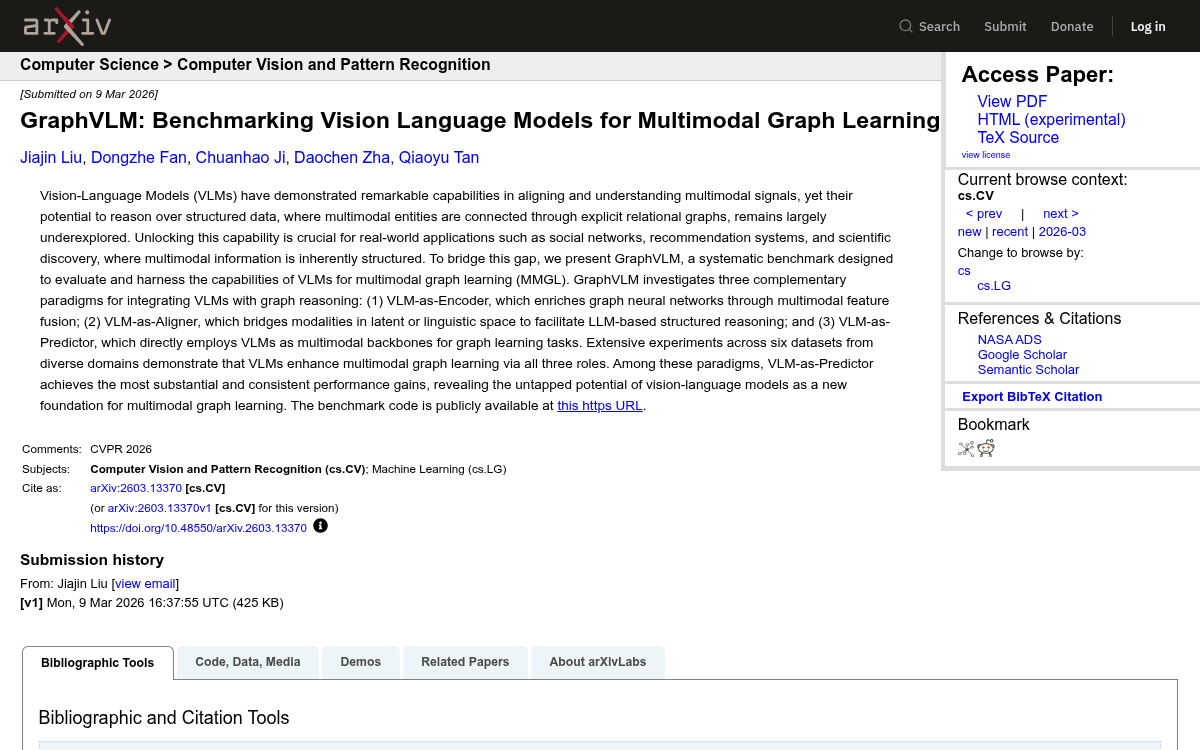
- GraphVLM benchmarks three ways of using VLMs on multimodal graphs: as encoder, aligner, or predictor. Paper
- Fine-tuning a VLM directly as the predictor wins across all six datasets tested.
- Qwen-VL-7B jumps from 12.56% to 54.18% on Movies after LoRA fine-tuning, a 4.3x gain.
- Latent-space fusion of structure beats prompt-level fusion in 15 of 18 cases.
- Six datasets from Amazon co-purchase graphs and Reddit, 16K to 100K nodes.
- Code and datasets released at GitHub; accepted at CVPR 2026.
Graphs full of images and text are everywhere: Amazon co-purchase networks, Reddit threads, drug interaction graphs, social feeds. But most graph learning research still treats nodes as bags of features, and most vision-language work still treats images and captions as isolated pairs. A new benchmark called GraphVLM, accepted to CVPR 2026, tries to answer a simple question: if you already have a capable VLM, what is the best way to point it at a graph?
The team from NYU Shanghai, NYU, and Rice tests three ways of wiring VLMs into multimodal graph learning (MMGL) pipelines, runs them across six datasets, and finds one clear winner. Among these paradigms, VLM-as-Predictor achieves the most substantial and consistent performance gains, revealing the untapped potential of vision-language models as a new foundation for multimodal graph learning.
The gap the benchmark tries to close
Multimodal graph learning has mostly split into two camps. GNN-based methods take pre-extracted image and text features (usually from CLIP) and pump them through message passing. LLM-based methods, sometimes called GraphLLMs, convert graph neighborhoods into text or projected embeddings so a language model can reason over them. VLMs themselves, despite being purpose-built for image-text alignment, have rarely been used as the actual reasoning backbone on graph tasks.
The authors argue that prior benchmarks like MM-Bench and MAGB compare a narrow slice of this space. Existing MMGL literature lacks a unified evaluation pipeline, making it difficult to compare GNN-, LLM-, and VLM-based models fairly. GraphVLM adds a third axis by turning "how you use the VLM" into a first-class design choice.
Three ways to plug a VLM into a graph
The benchmark organizes methods by the role the VLM plays:
- VLM-as-Encoder. The VLM produces node features that feed a GNN. GraphVLM tests three flavors: off-the-shelf CLIP, CLIP fine-tuned per dataset with a standard contrastive loss, and a structure-aware variant (CLIP-F-S) that randomly samples m nodes from the 1-hop neighborhood to capture contextual dependencies and applies a contrastive loss between an anchor and its neighbors.
- VLM-as-Aligner. The VLM bridges modalities for a GraphLLM. Two strategies: latent-space alignment (inject multimodal embeddings into the LLM input) and prompt-level alignment (use the VLM to turn each image into a text description, optionally including neighbor images too).
- VLM-as-Predictor. The VLM itself is the classifier, fine-tuned with LoRA. Structure is added either by explicitly listing the top-3 most similar 1-hop neighbors in the prompt, or by pooling neighbor patch embeddings and text tokens into structure-aware tokens injected in the latent space.

The datasets
Evaluation runs on six different datasets from the Amazon co-purchase networks and the social network Reddit platform, spanning from 16K nodes (Movies) up to nearly 100K (Reddit), with average degrees from 12 to 47. Each node has a text description and an image, and edges are co-purchase or co-comment relations. The split is 60/20/20.
What the numbers say
The encoder story is a bit muddy. Multimodal inputs beat unimodal ones almost everywhere, and for the MLP baseline they add roughly five points over text-only and thirteen points over image-only. But adding structure awareness to CLIP is not a free win. On most datasets, plain CLIP or fine-tuned CLIP outperforms the structure-aware variant when paired with GCN, GraphSAGE, or MMGCN. The authors read this as a sign that squeezing graph topology into a single embedding is a poor place to fuse structure and modality.
The aligner story is cleaner. For GraphLLMs like LLaGA and GraphPrompter, wiring in multimodal signals almost always helps, and latent-space alignment beats prompt-level alignment. LLaGA with latent-space fusion tops Movies (50.61%), Grocery (86.83%), and CDs (56.29%). The reason is intuitive: shoving image content into a text prompt hits a token budget wall and loses visual detail, while dropping raw image embeddings into the LLM keeps that signal intact.
Then comes the headline result. Fine-tuning a VLM directly as the predictor blows past both approaches. On the Movies dataset, Qwen-VL-7B jumps from 12.56% zero-shot to 54.18% after LoRA fine-tuning, a 4.3x improvement. LLaVA-1.5-7B shows a 3.5x gain. Across all six datasets, Qwen-VL sees absolute gains between 21 and 44 percentage points from fine-tuning alone.

Adding structure on top helps further. Latent-space fusion surpasses prompt-level fusion in 15 out of 18 cases, yielding more stable convergence and higher accuracy by embedding structural cues directly within the model's representation space. The story rhymes with the aligner result: text prompts are a bad container for graph structure because tokens compete for context space, but latent tokens sit alongside the model's own representations.
Where structure actually helps
One of the more interesting findings sits in the appendix-level analysis. Structural cues help across all three paradigms, but the effect is not uniform. Dense graphs benefit most: CDs, with an average degree of 47, gains the most from structure-awareness, while sparser graphs like Toys and Grocery sometimes see negative gains. These findings highlight the complexity of structure-modality interactions and suggest that future multimodal graph learning should build on strong VLM backbones, selectively injecting structural cues to enhance relational reasoning.

The trade-offs to keep in mind
The VLM-as-Predictor wins are real, but they are not free:
- Compute. Training Qwen-VL or Qwen2.5-VL on the Movies dataset takes about 5 hours; inference on the test set takes 20 minutes. A GCN trains in roughly 2 minutes and finishes inference in 10 seconds.
- Zero-shot is weak. Without fine-tuning, the VLMs are actually the worst backbones. Qwen-VL scores 12.56% on Movies before SFT, versus 45.90% for MMGCN with CLIP features. The gains only appear once you spend the LoRA budget.
- Structural gains are dataset-dependent. If your graph is sparse, adding neighbor tokens can hurt.
- Prompt-level structure has diminishing returns. Text descriptions of neighbors bloat the context window and inject noise.
What to grab
The full benchmark is on GitHub and datasets are hosted on Hugging Face. It ships three separate pipelines for Encoder, Aligner, and Predictor experiments, and integrates existing baselines like LLaGA, GraphPrompter, LLaVA, and Qwen-VL. If you are working on recommendation, knowledge graphs, or any problem where nodes carry both pictures and text, this is the first standardized way to compare a fine-tuned VLM head-on with GNN and GraphLLM baselines under identical splits.