
NYU's FINN Beats Heston by 60% Pricing Options Without Any Labels
A new neural network for option pricing skips labeled prices entirely, learning from replication error and recovering no-arbitrage rules on its own.
 Pro
Takeaways
- FINN learns option prices via self-supervised replication error, not labeled option data. Paper
- Minimizing replication residual is provably equivalent to solving the Black-Scholes PDE in the limit.
- Recovers Black-Scholes and Heston prices; put-call parity emerges without being enforced.
- Reconstructs SPY implied volatility surfaces with 60.5% lower MAE than a hybrid Heston calibration.
- FINN delta cuts tail losses versus Black-Scholes delta in stressed years with transaction costs.
- Can price options on assets with no listed derivatives by training on spot price history alone.
Option pricing has always lived in an uncomfortable split. On one side, textbook models like Black-Scholes are grounded in no-arbitrage theory and give traders auditable, interpretable prices, but they lean on assumptions that markets routinely violate. On the other, neural networks can fit market data beautifully yet often produce prices and hedge ratios that quietly break basic economic rules. A team from NYU, Toronto, and Princeton is proposing a way out with the Finance-Informed Neural Network (FINN), a framework that trains without labeled option prices and instead learns by trying to hedge itself.
Learning to hedge, not to fit
The core move in FINN is switching what the network is being asked to do. Instead of supervising the model with observed option prices, the network is trained to minimize the replication error of a dynamically hedged portfolio, embedding no-arbitrage conditions derived from hedging arguments directly into the loss function. The economic intuition is the one every derivatives desk uses: if you can build a portfolio out of the underlying stock and cash that mirrors an option's payoff, that portfolio should grow at the risk-free rate. If it doesn't, the price you assumed for the option was wrong.
Concretely, the network g^θ(t, S) takes market state as input and outputs an option value. The hedge ratios (Delta and, optionally, Gamma) come straight out of automatic differentiation of that same network. FINN then simulates or samples price paths, builds a self-financing portfolio using those learned Greeks, and penalizes any deviation of the portfolio's value from risk-free growth step by step. There are no option price labels anywhere in the loop.

The authors also prove that this isn't just a clever heuristic. In the continuous-time limit, forcing the replication residual to vanish is mathematically equivalent to solving the Black-Scholes PDE (and its stochastic-volatility generalizations). So the training loss is a direct implementation of the no-arbitrage condition, not a proxy for it.
What the numbers show
The paper runs FINN through a gauntlet of increasingly nasty settings. Under geometric Brownian motion, where Black-Scholes gives an exact answer, FINN recovers prices with relative deviations mostly under 4% and delta errors in the 2 to 3% range, with errors that grow smoothly and predictably with volatility and maturity rather than randomly. Under the Heston stochastic volatility model, where closed-form Greeks don't exist and Monte Carlo is the reference, the errors stay in the same ballpark.

A more interesting test: FINN trains calls and puts independently, with no put-call parity constraint anywhere in the loss. Yet the parity relationship C - P = S - K*exp(-r*τ) emerges anyway, with mean absolute deviations staying below about 0.13 across all tested regimes. That's the kind of behavior you get when a model has internalized the economics rather than memorized surface patterns.
Where FINN actually beats the classics
The most striking result comes from reconstructing implied volatility surfaces on real SPY option data. The authors compare FINN against a hybrid Heston calibration where structural parameters are frozen and only the instantaneous variance updates daily. Across the out-of-sample period:
- Mean absolute error drops from 0.1153 (Heston) to 0.0456 (FINN), a 60.5% improvement
- RMSE drops from 0.1218 to 0.0562, a 53.9% improvement
- MAPE falls from 59.08% to 26.95%
The Heston surface systematically sits below the market surface across most strikes and maturities, revealing that its calibrated structural parameters (mean reversion speed, vol-of-vol) impose curvature that no longer matches the market. FINN's errors, by contrast, are centered near zero and lack that systematic bias.
The stress tests are equally interesting. When you compute hedge ratios using volatility from a training window and then simulate hedging through a crisis year like 2008 or 2020, FINN's delta produces smaller losses and tighter tails than Black-Scholes delta once transaction costs enter the picture. In 2008 with 2% transaction costs, the 95% conditional value-at-risk improves from -7.12 under Black-Scholes to -5.91 under FINN. The intuition is that FINN's hedge ratios are smoother, so they rebalance less aggressively in adverse scenarios and rack up fewer trading costs.
Pricing options that don't exist
The most unusual application shows up at the end. FINN can be trained directly on historical spot prices of an asset that has no listed options at all. The authors demonstrate this on three recently issued tickers (TACO, GTEN, COPL) with roughly 120 days of price history each. There's no implied volatility to extract, no parametric SDE to calibrate. FINN just samples one-step transitions from the observed path, generates hypothetical contracts with random strikes and maturities, and runs its replication loss.

The resulting price and delta surfaces satisfy the qualitative properties you'd expect from no-arbitrage. Call prices are increasing and convex in the spot with deltas in [0,1]; put prices are decreasing with deltas in [-1,0]. These shape properties come out of the hedging loss and payoff behavior at maturity, not from explicit constraints. That opens a door for pricing newly issued ETFs, OTC instruments, or bespoke structured products where classical calibration simply isn't possible.
The rough edges
FINN isn't a silver bullet. A few real limitations show up in the paper itself:
- Incomplete markets lose uniqueness. The theoretical guarantees rely on a complete market where a unique equivalent martingale measure exists. In incomplete markets, FINN picks one particular economically admissible pricing functional rather than recovering a unique price.
- At-the-money errors persist. Residual errors concentrate near the at-the-money region where curvature (Gamma) is highest, and they get worse with longer maturities.
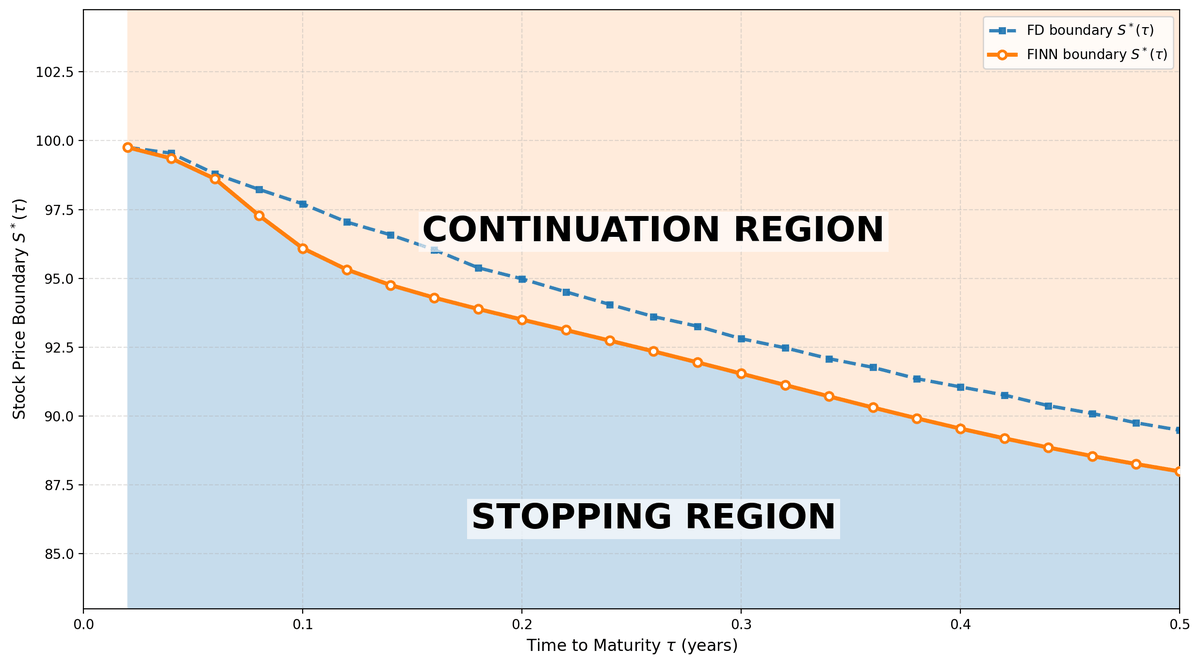
- American options are harder. The free-boundary extension using a sigmoid gate and payoff-violation penalty works, but performance degrades relative to European cases due to the exercise decision.
- No public code is mentioned in the paper. The authors provide detailed pseudocode and a worked forward-pass example in the appendix, but no accompanying repository or trained weights are cited.
Why this matters
The real breakthrough here isn't a better fit on option data; it's a reframing of what the network is supposed to learn. FINN treats option pricing as learning a pricing operator whose economic consistency is baked into the objective, rather than fitting individual prices. That shifts machine learning in derivatives from a black-box prediction task toward something closer to a differentiable, self-consistent replacement for calibration pipelines. For anyone building risk systems, valuation engines for illiquid instruments, or online pricing for freshly listed assets, that's a very different tool than the usual supervised regression on option chains.