
NYU Researchers Prove LLaMA 3.2 Works Even When Prompt Embeddings Start Anywhere
NYU researchers show prompt-tuning embeddings can live anywhere in activation space — and still work just as well, upending assumptions about embedding collapse
 Pro
Takeaways
- Embedding collapse isn't necessary: Prompt-tuning embeddings initialized far outside familiar activation regions still reach the same final performance.
- Priors control position, not quality: Different initialization strategies (Gaussian, exclusion, interpolation) strongly affect where embeddings land, but not the performance ceiling.
- Task clusters are real: Arithmetic and NLP tasks form distinct activation clusters; different NLP tasks (QA, MLM) share the same cluster.
- CoT distillation opportunity: Controlled posteriors could serve as better initialization priors for chain-of-thought distillation tasks bridging domain gaps.
- VAE approach failed: A VAE-based prior collapsed despite multiple regularization strategies, leaving structured sampling unsolved.
- No code released: The paper is a pure empirical study on LLaMA 3.2 1B; experiments on larger models remain future work. arXiv
A persistent assumption in the prompt-tuning world is that embedding collapse , the tendency for learned soft-prompt tokens to cluster tightly around pre-existing token embeddings , is a core feature of how these methods work. A new paper from NYU researchers challenges that assumption head-on, and the findings raise deeper questions about how large language models generalize at all.
The paper, titled Exploring Embedding Priors in Prompt-Tuning for Improved Interpretability and Control, shows that you can initialize prompt embeddings almost anywhere in a model's activation space , including completely uncharted regions the model has never seen during pretraining , and still converge to the same final performance. The location of the embeddings turns out to matter far less than previously assumed.
Why prompt-tuning, and why does collapse matter?
Prompt-tuning is one of the most compute-efficient ways to adapt a frozen LLM to a new task. Soft prompt tuning introduces a small set of trainable continuous prompt vectors prepended to the input sequence while keeping all model parameters frozen. Research from Google demonstrated that this approach can achieve performance comparable to full fine-tuning while updating less than 0.1% of the parameters.
There are two main flavors covered in this paper:
- Soft Prompt-Tuning: Trainable token embeddings are prepended to the input. Only those embeddings are updated; the rest of the model stays frozen.
- Deep Prompt-Tuning (DPT): Deep prompt tuning achieves comparable performance to fine-tuning across several tasks by inserting tunable parameters into every LLM layer.
A critical issue with prompt-tuning is the phenomenon of embedding collapse, where the embeddings of newly tuned tokens tend to converge toward specific, pre-existing token embeddings. This clustering reduces the diversity of embeddings, limiting the model's ability to generalize across different language domains and leading to overfitting on task-specific features. The standard interpretation has been that this collapse is somehow necessary , that the model needs its prompt tokens to live near familiar vocabulary embeddings to function well.
The experiment: priors as a scalpel
The team's approach is conceptually elegant. Rather than letting the optimizer decide where embeddings end up, they designed explicit initialization priors , Bayesian starting distributions , that force the prompt tokens to begin in specific regions of the embedding space. They then trained the model and observed where the embeddings ended up (the posterior), and whether performance changed.
They tested four types of priors on a LLaMA 3.2 1B model, using SQuAD (question answering) and the DeepMind MATH dataset (arithmetic):
- Isotropic Gaussian: A simple baseline , embeddings initialized from a zero-mean Gaussian with no structure.
- Fitted Gaussian: A Gaussian fitted to the actual distribution of pre-trained token embeddings, capturing their mean and covariance.
- Gaussian Exclusion: Samples are drawn from a wider distribution and then filtered to exclude the high-density region around existing token embeddings , forcing initialization into sparse, uncharted territory.
- Gaussian Interpolation: Embeddings are initialized as a linear blend between two Gaussians fitted on different task domains (e.g., C4 pretraining data and MATH), with a random interpolation weight.
They also experimented with a VAE-based prior, training a variational autoencoder on dataset activations to try to smooth the distribution between domains.

The surprising result: location doesn't determine performance
The findings suggest that priors strongly affect the position of the tuned embeddings, and models can effectively work with embeddings from different parts of activation spaces, including completely new regions. In every configuration tested , even when the initialized embeddings started far outside the model's familiar activation clusters , the final validation performance matched the baseline. The model found a way to use those distant embeddings just as effectively.
There is a catch: it takes more time to converge to the same validation loss level, so the search for optimal embeddings in distant regions takes longer. But the ceiling is the same. This means embedding collapse is not a prerequisite for prompt-tuning to work , it's just the path of least resistance the optimizer tends to take.
What the activation space actually looks like
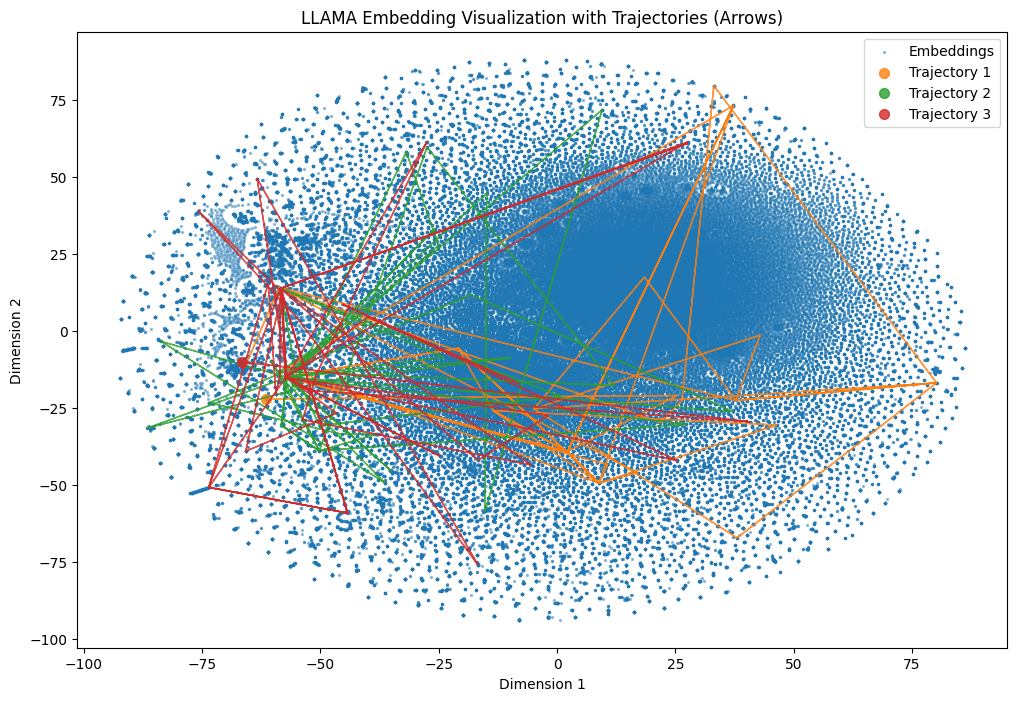
Beyond the prior experiments, the team ran a parallel investigation into how LLM activations are structured across tasks. They visualized token trajectories and layer-wise activations using PCA and t-SNE, and found two key things:
- Generated trajectories are not localized in the activation space of the models. Sentence-level paths through the embedding space are highly non-local , more like random walks than tight paths.
- Task domain matters for clustering. There are distinct clusters of activations for distant tasks (e.g., NLP and arithmetic), while activations between NLP tasks (e.g., Question-Answering and MLM) lie in the same cluster.

The T5-base model experiments were particularly striking: arithmetic subtasks from the DeepMind MATH dataset formed clusters far away from general NLP activations , and different arithmetic subtasks were far apart from each other too. The authors interpret this as evidence that the model has not fully integrated mathematical reasoning into its broader representation space.
The real breakthrough: a new lens on generalization
The deeper implication here is about what makes LLMs generalize. If a model can use prompt embeddings placed in completely novel regions of its activation space, then the geometry of that space is more flexible than the embedding-collapse narrative suggests. The model isn't rigidly tied to its pretraining distribution at the embedding level.
This opens a practical question the paper raises explicitly: as final Prompt-Tuning capabilities are limited, controllable Prompt-Tuning posteriors may serve as a good starting point in such tasks as COT distillation. Chain-of-thought distillation is a powerful technique for transferring reasoning abilities from large language models to smaller student models. The idea is that if you can steer where prompt embeddings land , placing them in an interpolated region between, say, a general NLP cluster and a math cluster , you might be able to bootstrap better initialization for tasks that require bridging those domains.
Limitations and what didn't work
The paper is honest about where things fell short:
- No performance improvement: Despite the flexibility, no prior design actually beat the baseline prompt-tuning performance. The ceiling is the same regardless of initialization.
- VAE collapse: The VAE-based prior failed to maintain a structured spread of activations. Despite multiple regularization strategies including KL divergence constraints, the VAE kept collapsing the activation distribution into a tight cluster.
- Slower convergence: Distant initializations consistently took longer to converge, which matters in practice for training budgets.
- Scale: All experiments used LLaMA 3.2 1B. Whether these findings hold at 7B, 70B, or beyond is an open question.

Who should care about this
If you're working on parameter-efficient fine-tuning, this paper is a useful sanity check: don't over-index on where your prompt embeddings end up geometrically. The model is more robust to initialization than the embedding-collapse literature implies. If you're working on multi-modal adaptation or cross-domain transfer , bridging a language model into a new domain like code, math, or vision , the activation clustering findings are directly relevant. The gap between NLP and arithmetic clusters in activation space is a concrete, visualizable signal of where a model's generalization breaks down.
No code or pretrained models have been released alongside the paper. The work is primarily an empirical investigation, and the authors frame it as groundwork for future research into CoT distillation and multi-modal embedding initialization. The full paper is available on arXiv.