
NYU Releases GUIDE, an Open Courseware Teaching AI-Assisted Chip Design
NYU and partners release an open-source repository of modular Colab-based teaching units for LLM-assisted RTL design, verification, and hardware security.
 Pro
Takeaways
- GUIDE is an open courseware repository for teaching LLM-assisted RTL design, verification, and hardware security.
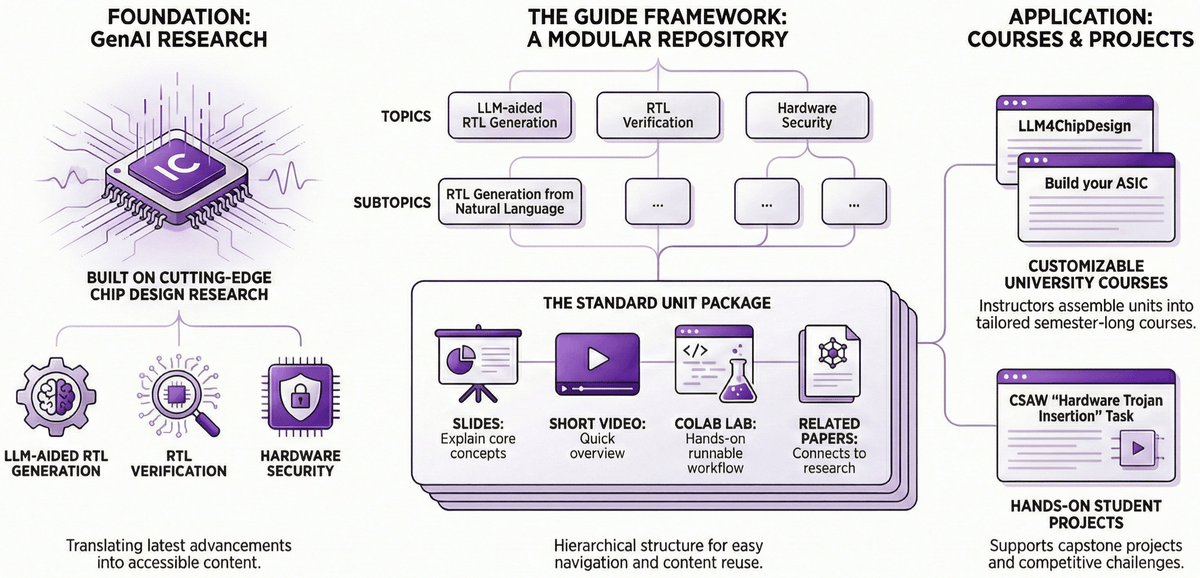
- Each unit bundles slides, a short video, a runnable Google Colab lab, and the source research paper.
- Three flagship units: VeriThoughts (formal-verification-backed RTL), enhanced testbench generation with Python golden models, and LLMPirate for IP piracy attacks.
- Four full course instances already run on it, including a hardware-security capstone deployed at the CSAW competition.
- An NYU Cognichip Hackathon engaged 72 students across 24 international teams in AI-assisted RTL workflows.
- Roadmap adds units for high-level synthesis, physical design, and analog SPICE netlist generation.
Teaching students how to use large language models for chip design is a moving target. Prompting workflows shift every few months, EDA tools sit behind licenses, and a Verilog file that looks correct can still miss a reset or truncate a bus width in ways that silently break silicon. A group from NYU Tandon, NYU Abu Dhabi, RPI, and Texas A&M has released GUIDE, an open courseware repository that tries to make this teachable without every instructor rebuilding the wheel.
The paper describing GUIDE lays out an architecture where each teaching unit is a self-contained bundle of slides, a short video, a runnable Google Colab lab, and the underlying research paper. A professor can pull a unit off the shelf, drop it into a syllabus, and grade student submissions against a predictable set of artifacts.
Why chip design breaks the usual GenAI courseware mold
RTL must follow precise interfaces, clock and reset behavior, and synthesis constraints, and even small issues can lead to incorrect hardware. That makes the usual "generate code, run it, ship it" loop from software courses dangerous when applied to silicon. The authors flag three teaching-specific headaches: rapid tool evolution that outdates material within months, wildly varying student backgrounds across EE, CE, and CS tracks, and the need to wire LLM outputs into an EDA toolchain for compilation, simulation, and formal checks.
GUIDE's answer is modularity. The repository is organized into three topics: LLM-aided RTL generation (natural-language and finetuned variants), LLM-aided RTL verification (simulation-based and formal), and LLM-aided hardware security (attacks and defenses). A unit is the smallest teaching-ready element, corresponding to one concrete teaching objective.