
NVIDIA's MD-Audio Benchmark Exposes How Poorly AI Actually Understands Sound
NVIDIA and UMD researchers release MD-Audio, a multi-domain Audio QA benchmark that exposes major gaps in today's best audio-language models
 Pro
Takeaways
- New benchmark: MD-Audio (DCASE 2025 Task 5) tests audio-language models on multi-domain question answering across bioacoustics, temporal soundscapes, and complex real-world audio.
- Hard for current models: Best zero-shot accuracy is 48.3% (Gemini 2.0 Flash); random chance is 25%, showing significant room for improvement.
- Three distinct subsets: Bioacoustics QA (marine mammals, 31 species), Temporal Soundscapes QA (event timing/ordering), and Complex QA (8K+ pairs from AudioSet and Mira).
- Key failure modes: Models hallucinate non-existent sounds and fail at temporal localization; some answer correctly even without listening to the audio.
- Open resource: Dataset on Hugging Face with baselines; open for ongoing research post-challenge.
- Robustness metric: Answer-shuffling is used to detect models gaming positional biases rather than genuinely reasoning from audio.
Audio AI has come a long way from classifying a dog bark or tagging a car horn. The next frontier is getting models to reason about what they hear, the same way a person can answer "what's making that man sound so happy?" by noticing the crowd noise and the music in the background. A new benchmark from researchers at NVIDIA, the University of Maryland, USTC, Seoul National University, and Adobe is designed to stress-test exactly that capability, and the early results suggest today's best models still have a long way to go.
The gap between hearing and understanding
Most existing audio evaluation frameworks treat the problem like a classification task: given a clip, pick the right label. Audio Question Answering (AQA) goes further, requiring systems to interpret a question, incorporate relevant external knowledge, and link it to the audio information to select the correct answer. The causal chain is fundamentally more complex. In AQA, reasoning depends not only on the audio and the question but on latent confounding factors such as audio information, interactive events, and external knowledge.
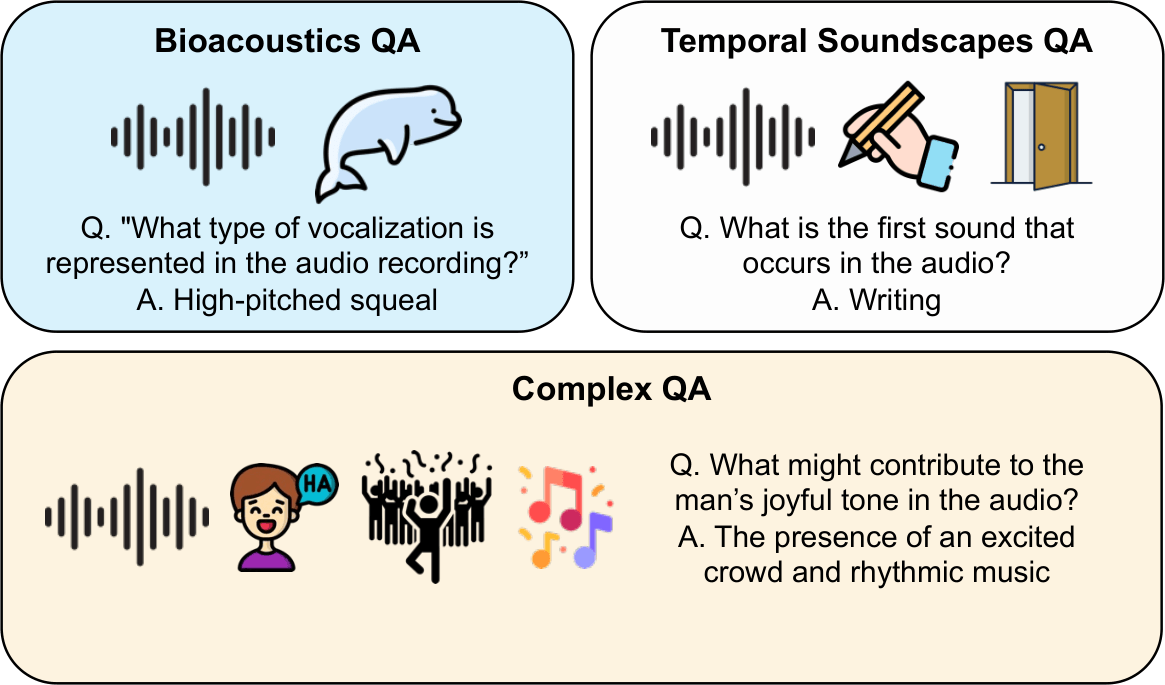
To illustrate the gap: when asked "What might contribute to the man's joyful tone?", a model cannot just detect a voice. It must also pick up on the excited crowd and rhythmic music in the background, then infer that those elements are likely causing the joy. That kind of layered, contextual reasoning is what the new MD-Audio benchmark is built to probe.
Three very different tests under one roof
The AQA dataset comprises three distinct QA subsets: Bioacoustics QA (BQA), Temporal Soundscapes QA (TSQA), and Complex QA (CQA), each designed to assess a different aspect of audio understanding and reasoning. Each subset is a multiple-choice format with one correct answer, but the skills they demand are deliberately non-overlapping.
- Bioacoustics QA (BQA): Features questions about 31 marine mammal species that vary significantly in vocalization frequency ranges, durations, and ecological habitats. It challenges models to identify the species, vocalization types, or both from audio, and reason about perceived events by recalling factual information about the species. The subset contains 0.7K training and 0.2K development question-answer pairs, all sourced from the Watkins Marine Mammal Sound Database. The recordings span sample rates from 600 Hz to 160 kHz and durations ranging from 0.4 seconds to over 10 minutes.
- Temporal Soundscapes QA (TSQA): Designed to evaluate models' ability to perceive and reason about temporal interactions across 26 sound classes. It challenges models to identify the active sound, classify its type, and infer temporal relationships between events, including their order, onsets, offsets, and durations. The dataset comprises 1K training and 0.6K development QA pairs, with all audio clips at 10 seconds in duration.
- Complex QA (CQA): Focuses on complex question answering grounded in audio understanding, where each instance consists of a natural audio clip paired with a multi-faceted question that requires reasoning over temporal, acoustic, and contextual cues. Questions may involve identifying overlapping sound events, interpreting sequences of auditory phenomena, or discerning abstract relationships implied by the soundscape. This subset comprises 6.4K training and 1.6K development QA pairs, making it the largest among the three.
How the evaluation works
The primary evaluation metric is top-1 accuracy, defined as the proportion of questions for which the model's predicted answer matches the ground truth. Leaderboard rankings are determined by top-1 accuracy averaged across the three domains. There is also a robustness criterion built in: answer choices are shuffled to prevent models from gaming positional biases, a known failure mode in multiple-choice LLM evaluations.
Three state-of-the-art audio-language models serve as baselines:
- Qwen2-Audio-7B: A 7-billion-parameter audio-language model that combines the Whisper-large-v3 audio encoder with the Qwen language model. When the model produces free-form text, a post-processing step maps the output to the most semantically similar option using a pretrained Sentence-BERT model with pairwise cosine similarities.
- AudioFlamingo 2: A 3-billion-parameter audio-centric large language model built upon a Flamingo-style cross-attention architecture, integrating an enhanced CLAP audio encoder with a language decoder. CLAP (Contrastive Language-Audio Pretraining) is the audio equivalent of CLIP, learning joint embeddings between sounds and text. AF2 achieves state-of-the-art performance with only a 3B parameter model, surpassing large open-source and proprietary models across over 20 benchmarks.
- Gemini 2.0 Flash: Google DeepMind's proprietary multimodal model, which accepts long-context audio inputs and was prompted with both the audio clip and a unified instruction including the question and answer choices.
The numbers tell a humbling story
Despite being evaluated in a zero-shot setting, overall performance remains low, typically ranging from 30% to 50%. This suggests that the proposed AQA dataset probes essential aspects of audio understanding and reasoning that are not effectively addressed by naïve transfer from large-scale pretraining of audio-language models.
| Model | Domain Avg | BQA (Bioacoustics) | TSQA (Temporal) | CQA (Complex) |
|---|---|---|---|---|
| Qwen2-Audio-7B | 39.6% | 30.0% | 39.2% | 49.6% |
| AudioFlamingo 2 | 45.0% | 53.9% | 31.7% | 49.5% |
| Gemini 2.0 Flash | 48.3% | 42.0% | 46.3% | 56.6% |
Random chance on a four-choice question is 25%, so these models are doing better than guessing, but not by a dramatic margin. Performance varies significantly across models and subsets, underscoring the importance of multi-domain AQA benchmarks in revealing differences in the capabilities of audio-language models. The divergence is particularly striking: Qwen2-Audio-7B performs notably poorly on Part 1, which requires fine-grained perception and understanding of acoustic details. In contrast, AudioFlamingo 2 excels in Part 1 but struggles with Part 2, which emphasizes temporal reasoning.
Where models break down
The qualitative analysis reveals two distinct failure modes. The first is hallucination: models generate outputs grounded in non-existent acoustic evidence, inventing events or sounds not supported by the input waveform. In one documented case, Qwen2-Audio-7B identifies sounds like "mechanical fan" and "ticking clock" that are not present in the clip and do not match any of the provided answer choices. This suggests the model is either over-relying on statistical priors or misinterpreting background textures as discrete sound events.
The second failure mode is temporal misalignment: models can recognize what a sound is, but cannot reliably pin down when it happens. In one example from the paper, the model correctly identifies a sound category but places its start time at 8.1 seconds when the correct answer is 6.5 seconds. This is a fundamentally different skill from recognition, and current architectures are not built for it.
Why this benchmark matters beyond the leaderboard
The audio AI landscape has been moving fast. MMAU and its successors have become the de facto standard for benchmarking large audio-language models. But MMAU and most prior benchmarks focus on relatively short, isolated clips with single-domain questions. MD-Audio deliberately crosses domains and forces models to bring in external knowledge, something that matters enormously for real-world applications.
The practical use-cases are broad:
- Wildlife monitoring: Automated systems that can not only detect marine mammal calls but answer questions about species, behavior, and ecological context from passive acoustic recordings.
- Surveillance and security: Systems that reason about sequences of sound events, their timing, and their relationships, rather than just flagging individual sounds.
- Accessibility tools: Audio agents that can describe complex acoustic scenes to visually impaired users, including temporal context and causal relationships.
- Media and content analysis: Automatically answering questions about audio tracks in video content for indexing, search, and moderation.
The task differs from generic audio captioning because the model must answer a specific question from the audio, while many choices remain plausible from language priors alone. In preliminary experiments, strong open audio-language models often answer a large fraction of samples correctly even when the audio is removed. That last point is the real diagnostic insight: if a model can get the right answer without listening, it is not actually doing audio reasoning. MD-Audio's answer-shuffling robustness criterion is specifically designed to catch this.
Getting started
The dataset is available on Hugging Face under the PeacefulData/2025_DCASE_AudioQA_Official repository.
While the DCASE 2025 Challenge has concluded its official submission phase, this repository remains open for ongoing research, and researchers are encouraged to continue evaluating their models and reporting results on the Development Set.
Baseline code is available at the AudioQA Baselines repository.
# Clone the dataset and download audio
git clone https://huggingface.co/datasets/PeacefulData/2025_DCASE_AudioQA_Official
cd 2025_DCASE_AudioQA_Official
bash download_dcase_25_task5_challenge_audio.sh
The benchmark is non-archival and open-source, meaning teams can keep submitting results even after the challenge closes. With the best model topping out at 48.3% average accuracy, there is substantial headroom for new approaches, whether that means better temporal encoders, retrieval-augmented audio reasoning, or fine-tuning strategies that force genuine audio dependency rather than relying on language priors.