
NVIDIA's LESS Framework Uses LLMs to Fix Messy Real-World Speech Training Data
NVIDIA researchers use LLMs to clean up noisy ASR and translation pseudo-labels, cutting WER by 3.8 points on WenetSpeech and pushing BLEU to new highs.
 Pro
Takeaways
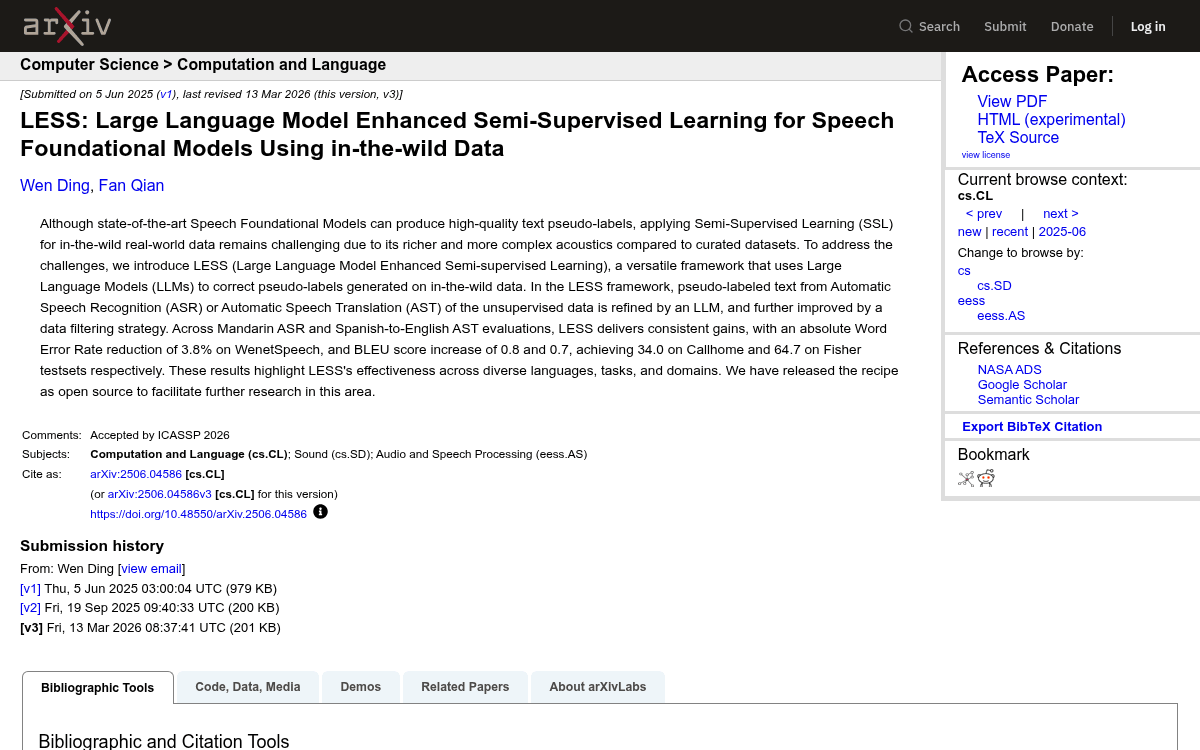
- NVIDIA researchers introduce LESS, an LLM-in-the-loop framework for semi-supervised speech training on noisy in-the-wild audio.
- Achieves 3.8% absolute WER reduction on WenetSpeech meeting test set over the supervised Whisper baseline.
- Pushes Spanish-to-English AST to BLEU 34.0 on Callhome and 64.7 on Fisher, beating standard Noisy Student Training.
- Uses a WER-based filter with threshold 0.1 to discard aggressive LLM rewrites before fine-tuning.
- Yi-Large outperformed Qwen2.5-coder for Mandarin correction; general-purpose LLMs beat code-tuned ones here.
- Full recipe is open-sourced, built on Whisper Large-v3, Silero VAD, and K2 Icefall.
Training speech models on messy, real-world audio is one of those problems that sounds solved until you actually try it. Curated datasets like AISHELL or LibriSpeech let semi-supervised learning shine, but throw a random pile of YouTube clips at the same pipeline and gains often evaporate. A pair of NVIDIA researchers just published LESS, a framework that plugs a large language model into the pseudo-labeling loop to fix that specific pain point, and released the full recipe on GitHub.
The pseudo-label problem
Speech Foundational Models (SFMs) like Whisper can transcribe or translate audio well enough to generate pseudo-labels for unlabeled data, which is the core trick behind semi-supervised learning (SSL). Speech processing tasks require high-quality labeled speech data, which is less abundant compared to text-only data, so SSL is often the only way to scale. The trouble is that existing SSL methods typically use relatively small student models and do not evaluate on large-scale models or SFMs, and curated datasets used in an unsupervised manner fail to reflect the complexity and diversity in real-world audios.
Once you swap in genuinely in-the-wild audio, the pseudo-labels get noisier, and retraining on them can actually hurt performance. The NVIDIA team confirms this: adding raw YouTube pseudo-labels to standard Noisy Student Training slightly degraded BLEU on Callhome and Fisher before any LLM correction was applied.
How LESS works
LESS (LLM Enhanced Semi-Supervised Learning) sits inside a standard Noisy Student Training loop, but adds two steps between the SFM's output and the next round of fine-tuning:

- Raw YouTube audio is chunked with Silero VAD into segments up to 20 seconds.
- A fine-tuned Whisper Large-v3 produces an initial ASR transcript or AST translation.
- An LLM (Yi-Large for Mandarin ASR, LLaMA-3 for Spanish-to-English AST, both served through NVIDIA NIM) rewrites the hypothesis to fix likely errors.
- A filter compares the WER between the greedy hypothesis and the LLM-corrected version, and only keeps pairs whose distance is below 0.1.
- Filtered corrected pseudo-labels are mixed with the supervised data to fine-tune the next student model, and the loop repeats.
One quirky design choice: the prompt asks the LLM to both perform the correction and calculate the WER between the original input hypothesis and the corrected version during generation, which is referred to as WER Prompting. The generated WER numbers are ignored, but forcing the model to think about them measurably improves the corrections it produces.
What the numbers actually say
On Mandarin ASR, the supervised baseline (Whisper fine-tuned on AISHELL-1's 180 hours) hits 17.7% WER on the out-of-domain WenetSpeech meeting test set. After three rounds of NST using LESS, WER on wenet_meeting drops from 15.0% to 13.9%, an absolute reduction of 3.8% compared to the supervised baseline. On the in-domain AISHELL-1 and AISHELL-2 tests, gains are marginal, which is honest reporting: LESS mainly helps when the evaluation audio actually looks like the noisy, diverse in-the-wild data.
For Spanish-to-English translation, the improvements are smaller in absolute terms but land at strong overall levels:
| Model | Callhome BLEU | Fisher BLEU | Common Voice BLEU |
|---|---|---|---|
| ESPnet reference | 21.7 | 50.5 | - |
| Supervised baseline | 33.5 | 64.2 | 36.7 |
| NST without LESS | 33.2 | 64.0 | 36.9 |
| NST with LESS | 34.0 | 64.7 | 37.3 |
The takeaway: standard NST on raw YouTube data slightly hurt BLEU, and LESS reversed that and pushed past the supervised baseline in a single iteration.
Details worth knowing before you try it
A few ablations in the paper are useful if you plan to adapt this to another language pair:
- LLM choice matters. Yi-Large outperformed Qwen2.5-coder-32b-instruct on wenet_meeting, likely because Qwen has been post-trained primarily for coding tasks, while Yi-Large is a more general-purpose LLM better suited for this task.
- Filtering threshold is critical. A strict 0.1 WER threshold between the raw and corrected hypothesis clearly beat a permissive 1.0 (no filtering). LLM rewrites are not always right, so throwing away the aggressive edits is the safer default.
- Weakness on in-domain data. The authors are upfront that there are limited improvements on AISHELL-1 and AISHELL-2 due to domain mismatch. If your target domain already matches your supervised data, LESS is unlikely to move the needle much.
- LLMs aren't post-trained for speech. A slight regression appeared in one configuration because open-source LLMs haven't seen spoken-language artifacts, hesitations, or ASR-style errors during their training.
Why this matters
The bigger idea here is treating the LLM as a domain-aware denoiser sitting between an SFM and its own training data. For ASR that mostly means catching plausible transcription slips; for AST it means something more interesting, since a good translation is not unique. The authors argue LLMs can generate diverse pseudo-labels representing multiple valid translation possibilities, leading to more flexible and robust models across different languages and domains, which lines up with the out-of-domain BLEU gains on Common Voice.
The recipe is open source and built on off-the-shelf components (Whisper Large-v3, Silero VAD, LLaMA-3, Yi-Large, K2 Icefall), so reproducing or porting it to another language pair should be a matter of swapping the SFM prompts and the source audio, not rewriting the pipeline.