
NVIDIA's LCDrive Ditches English Reasoning and Drives 1.8x Faster
NVIDIA researchers swap English chain-of-thought for vector reasoning tokens grounded in a world model, cutting driving VLA latency 1.8x and improving trajectory accuracy.
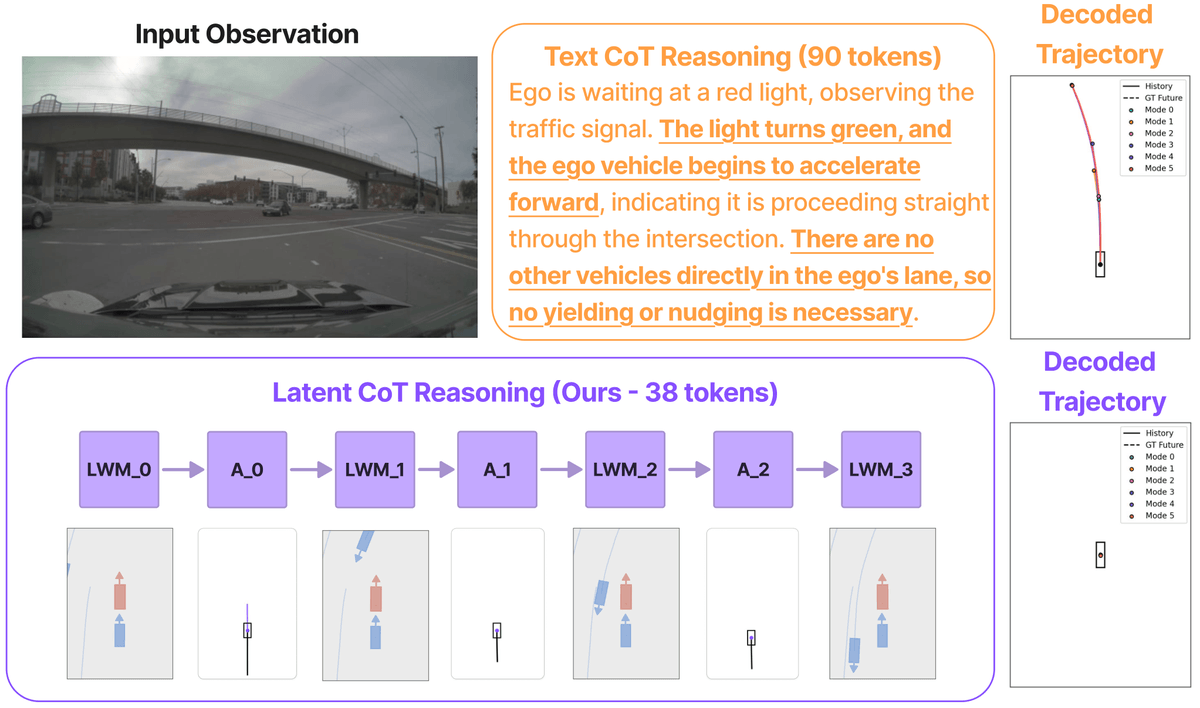
Takeaways
- NVIDIA-led team replaces text chain-of-thought in driving VLAs with latent reasoning tokens grounded in a learned world model.
- LCDrive interleaves action-proposal tokens (same vocab as output) with latent world-model tokens simulating counterfactual futures.
- Achieves 1.626 ADE vs 1.650 for text CoT and 1.762 for no-CoT on PhysicalAI-AV.
- 1.8x faster reasoning than text CoT baseline; 3.2x with lighter configuration on an RTX A5000.
- Trained via three stages: non-reasoning pretraining, CoT cold start, then GRPO reinforcement learning without KL regularization.
- RL yields large gains on latent CoT but no gain on non-reasoning baseline, showing latent format enables better optimization.
Reasoning language models have taken over the frontier of AI, but there is a growing suspicion that natural language is a lousy medium for many of the problems we point them at. A new paper from NVIDIA, UT Austin and Stanford, Latent Chain-of-Thought World Modeling for End-to-End Autonomous Driving, makes that case concretely for self-driving. The team's model, LCDrive, replaces the English rationales that current driving Vision-Language-Action (VLA) models generate before choosing a trajectory with a compact latent reasoning trace grounded in a learned world model. It runs faster, drives more accurately, and squeezes more out of reinforcement learning than either non-reasoning or text-CoT baselines.
Why English is a bad language for driving
Recent driving VLAs like EMMA, DriveCoT, AutoVLA and Alpamayo-R1 all follow the same recipe: read the cameras, produce a paragraph of natural language reasoning ("there is a pedestrian on the right, so I will slow down"), then emit a trajectory. The authors argue this is doubly broken. Words are ill-suited for representing spatiotemporal geometry and multi-agent interactions, autoregressively decoding long chains of text introduces nontrivial latency that makes real-time deployment challenging, and the generated actions can diverge from the preceding rationales due to weak action-text alignment.
Text CoT also bloats the token budget. The paper reports that the text-CoT baseline uses on average 71.8 tokens per clip, with a 75th percentile of 80 tokens and a long tail up to 252 tokens per clip. That's a lot of decode steps for something that has to run at 10 Hz on a car.
Reasoning in the same vocabulary as actions
LCDrive's core move is to make the model "think" in two token types that are structurally aligned with driving:
- Action-proposal tokens: drawn from the exact same 1024-code motion-primitive vocabulary the model uses for its final trajectory. Each block covers 1.0 seconds at 10 Hz.