
NVIDIA's AutoGaze Cuts Video AI Token Costs by 100x Before ViT Runs
A 3M-parameter module trims video patches before the ViT even sees them, letting MLLMs process 1K-frame 4K videos with 19x speedups.
 Pro
Takeaways
- AutoGaze is a 3M-parameter module that removes redundant video patches before the ViT, cutting tokens 4x-100x. Paper
- Delivers up to 19x ViT and 10x MLLM speedup, enabling 1024-frame 4K-resolution video understanding.
- Trained with next-token prediction on greedy-search gazing sequences, then GRPO reinforcement learning with reconstruction reward.
- NVILA-8B with AutoGaze hits 67.0 on VideoMME and gains 10.1 points on the new HLVid benchmark.
- New HLVid benchmark ships 268 QA pairs over 5-minute 4K videos requiring 1K-2K perception. Dataset
- Code, weights, benchmark, and demo released by NVlabs. GitHub
Video-understanding models spend most of their compute staring at pixels that never change. A static background gets tokenized frame after frame, the vision transformer processes every one, and the LLM chokes on the resulting token flood. A team from UC Berkeley, NVIDIA, MIT, and Clarifai has released AutoGaze, a tiny 3M-parameter module that decides which patches are worth encoding before the ViT ever sees them, and the numbers are striking: up to 19x speedup for ViTs and 10x for MLLMs, with visual tokens reduced by 4x to 100x.
Why current MLLMs choke on long, high-res video
The core problem is that modern multi-modal LLMs process every pixel in every frame equally, wasting computation due to spatiotemporal redundancy in videos. Recent efficiency work has tried to prune tokens, but the pruning usually happens inside the LLM after the ViT has already done all the heavy lifting. The vision transformer still processes all pixels, creating a huge efficiency bottleneck that prevents scaling to longer, higher-resolution videos.
That bottleneck matters because a lot of real-world footage is exactly the thing today's video MLLMs cannot handle: minutes-long clips at 4K where the answer to a question might depend on a small detail somewhere in the frame. Existing benchmarks either test length or resolution, rarely both.
Attend before attention
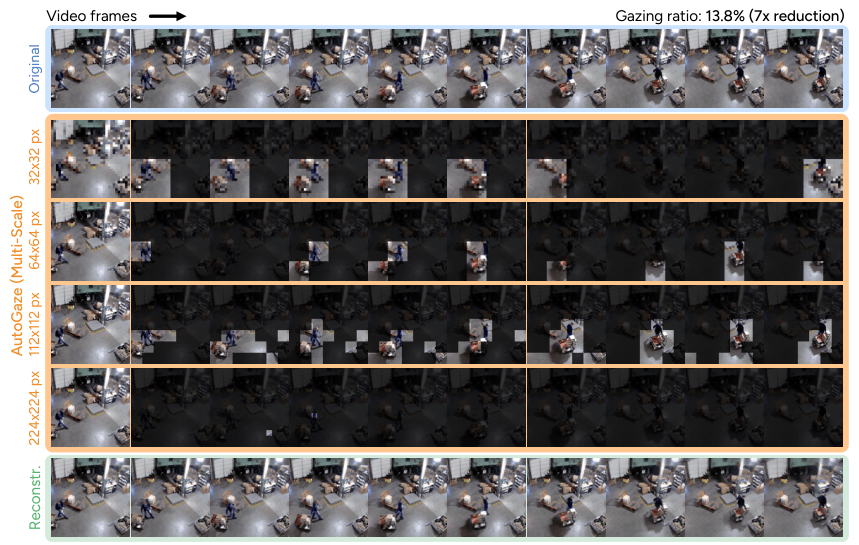
AutoGaze reframes token reduction as an autoregressive sequence problem. Given a video, it selects a minimal set of patches, called gazing, that can reconstruct the video within a reconstruction loss threshold. The design borrows directly from LLMs: the decoding process mirrors LLMs except the vocabulary contains only patch indices instead of words.

The full model is a convolutional encoder plus a four-layer transformer decoder styled after LLaMA 3, totaling 3M parameters. It processes a video frame by frame. For each new frame, it looks at what has already been seen and what has already been selected, then emits patch indices one at a time. When it thinks the patches it has picked so far are enough to reconstruct the current frame under the target error, it stops and moves on.
A few design choices make this practical:
- Multi-scale vocabulary. The decoder can pick patches at four resolutions (32, 64, 112, and 224 pixels). Solid backgrounds get one coarse patch; textured or text-heavy regions get many fine ones. Multi-scale gazing reduces the gazing ratio and improves efficiency by 2.3x compared to single-scale.
- Automatic stopping. A separate head predicts, at every step, the reconstruction loss the model would achieve if it stopped now. Once that predicted loss drops below the user's threshold, gazing halts for that frame.
- Multi-token prediction. Multiple heads emit several patch indices in parallel, trading a slightly higher gazing ratio for much lower latency. Ten tokens per step is the sweet spot the authors report.
Training: greedy search, then reinforcement learning
AutoGaze is trained in two LLM-style stages. First, pre-training with next-token prediction on videos paired with ground-truth gazing sequences that are collected via greedy search to approximately minimize reconstruction loss. Next, since the pre-trained gazing quality is bounded by the sub-optimal gazing data, post-training with RL uses reconstruction reward to discover gazing sequences with lower reconstruction loss.
The reward signal comes from a custom VideoMAE with block-causal attention that reconstructs each frame from only the patches gazed so far. The RL algorithm is a simplified on-policy GRPO variant, the same family used in DeepSeek-R1. Training data spans roughly 800K videos from Ego4D, 100DoH, and InternVid, plus synthetic panning videos generated from SA-1B and IDL images to cover text-rich content.
Ablations show both stages matter. With only pre-training or post-training, efficiency improves over no training, while pre-training contributes more. With both stages, we obtain the lowest gazing ratio, achieving around 10% improvement over pre-training only.
What it actually looks at

The behavioral analysis is where the paper gets interesting. Tested against optical flow ground truth from FlyingChairs, AutoGaze more frequently selects patches with higher optical flow across all scales, meaning it learned to chase motion without ever being told to. It also learned to pick finer scales for busier textures, measured by Laplacian variance over image patches.
Generalization holds up in scenarios well outside the training distribution: CCTV footage, robot grasping demos, fisheye lenses, black-and-white films, and even videos where the foreground object is swapped mid-clip using Luma's Ray2. Style transfer via TokenFlow does not throw it off either. The model tracks the falling subject across radically different textures and lighting.
The efficiency numbers
The authors settle on a reconstruction loss threshold of 0.7 as the sweet spot where downstream MLLM accuracy barely moves. At that threshold:
- Typical videos need 4x to 100x fewer patches.
- 30-FPS 4K videos need roughly 1% of their patches.
- ViT latency drops up to 19x, MLLM latency up to 10x.
- On streaming videos processed frame by frame, throughput improves by up to ~16x, unlocking real-time MLLM processing at 3 FPS and 1K resolution.
Compared against a wide range of token-reduction baselines (ToMe, VisionZip, FastV, LongVU, PruneVID, STORM, FastVID, VideoChat-Flash), AutoGaze is the only method that also cuts ViT latency, roughly 4x, because everyone else prunes after the ViT has already run.
Scaling NVILA and the new HLVid benchmark
Plugging AutoGaze into NVILA-8B-Video lets the model run at 1024 frames and 3584 resolution, a 4x frame count and 8x resolution jump over the base configuration. On VideoMME it hits 67.0 without subtitles, beating Qwen2.5-VL-7B and GPT-4o on that particular benchmark.
The bigger story is HLVid, a new benchmark the team built specifically to stress high-resolution long video. It consists of 268 QAs about details in up to 5-minute, 4K-resolution videos, requiring visual perception at 1K to 2K resolution to solve. On HLVid, NVILA plus AutoGaze jumps from 42.5 to 52.6, a 10.1-point gain, edging out Gemini 2.5 Flash-Lite (52.2) and beating GPT-4o (49.3).
Where it falls short
Two honest limitations. First, camera motion is not handled well: when the scene pans, AutoGaze subsamples patches but does not recognize that a shifted region is essentially the same content it saw a frame ago. Second, the VideoMAE used for reconstruction has no intuitive physics; it cannot anticipate that a falling ball will continue falling, so the model does not exploit predictability to skip patches.
Availability
The team released code, weights, the HLVid benchmark, and a demo. The AutoGaze repository is under NVlabs, model checkpoints are on Hugging Face, and a hosted demo is available. The Python interface is minimal: load the processor and model from Hugging Face, pass a video tensor with a target gazing_ratio and task_loss_requirement, and get back the selected patches ready to feed into a downstream ViT. For anyone hitting memory walls on long video MLLM inference, this is one of the few token-reduction methods that actually attacks the vision encoder, not just the LLM.