
NVIDIA Proves Wider Beam Search Makes AI Reasoning Worse by 6 Points
New NVIDIA research proves that wider beam search hurts LLM reasoning when the scorer is noisy, and provides a formula for the safe beam width.
 Pro
Takeaways
- NVIDIA researchers prove wider beam search can degrade LLM reasoning when the scorer is noisy.
- Extreme Value Theory gives an explicit safe beam width: k̂ = floor(sqrt(1 + exp(Δ²/2σ²))).
- Perplexity-guided search yields k̂ = 1, providing zero benefit and dropping Llama accuracy by 5.4 points at k=4.
- PRM-guided search using Math-Shepherd lifts Mistral by 8.9 points on MR-BEN's 5,975 questions.
- 44% of perplexity beam selections have margins below 0.1, effectively random choices between candidates.
- Code available as a fork of LLM Reasoners; invest in scorer quality rather than beam width.
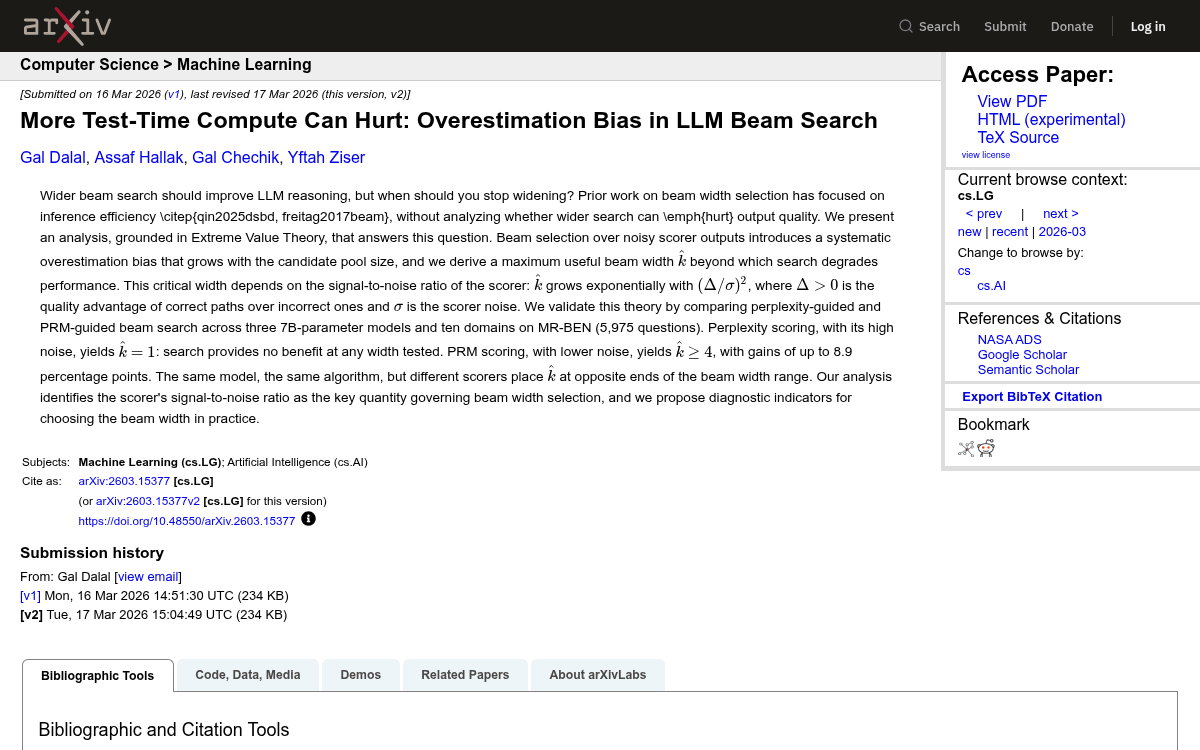
Throwing more compute at inference is supposed to make language models reason better. A new paper from NVIDIA Research shows that when the scoring signal is noisy, the opposite happens: widening the beam can drop accuracy by nearly six percentage points. The authors derive an exact formula for the maximum useful beam width and validate it across three 7B models and ten reasoning domains.
The bias hiding inside every beam search
Beam search over chains of thought works by generating several candidate reasoning steps, scoring them, and keeping the top k. The implicit assumption is that any reasonable scorer, plus more candidates, equals better answers. This assumption has not been rigorously examined.
The problem is a classic statistical artifact called overestimation bias. When you take the maximum over many noisy estimates, that maximum is systematically inflated. Single-sample decoding returns one draw from the scorer and incurs no selection bias, while beam search selects from a pool of n noisy draws, introducing a systematic upward bias in estimated quality that grows with both n and the scorer noise. The wrong candidates get a free bonus from the maximization that the single correct candidate does not.
A formula for when to stop widening
Using Extreme Value Theory, which describes the behavior of maxima of random variables, the authors derive a closed-form expression for the maximum useful candidate pool size:
n̂ = 1 + exp(Δ² / 2σ²)
k̂ = floor(sqrt(n̂))
Here Δ is the quality gap between correct and incorrect paths, and σ is the scorer's noise. When the signal-to-noise ratio is poor as with perplexity, n̂ collapses to approximately 2, giving k̂ = 1: no beam width helps. When the SNR is moderate as may be the case with a trained PRM, n̂ reaches 16 or higher, giving k̂ ≥ 4. The dependence is exponential in the squared SNR, meaning tiny improvements in scorer quality massively expand the useful search range.
Perplexity is not a scorer
The empirical validation is where things get brutal for a common practice. The team ran beam search with widths of 1 through 4 on MR-BEN, a benchmark of 5,975 questions across math, science, medicine, and logic, using Qwen2.5-7B, Llama-3.1-8B, and Mistral-7B. They compared two scorers:
- Perplexity: the model's own confidence in its output, free to compute.
- PRM: Math-Shepherd, a trained process reward model that scores each reasoning step.
Perplexity-scored beam search provides no benefit: Qwen is flat, while Llama and Mistral degrade at wider beams, at -5.4 and -3.9 points at k=4, consistent with the overestimation bias. Swap in the PRM without changing anything else and the picture flips completely. All three models benefit at k=4: Mistral gains +8.9 points from 42.3% to 51.2%, Llama gains +6.2 points from 59.2% to 65.4%, and Qwen gains +3.4 points from 71.7% to 75.1%. The largest gain goes to the weakest model, suggesting search is most valuable when the base policy struggles.
Reward inversion caught in the act
The case studies show the mechanism concretely. On one biology problem, the correct answer was rejected in favor of an incorrect one by a perplexity margin of just 0.009 out of 12 candidates. In 25 disagreement cases where k=1 was correct but k=4 was wrong, the k=4 path consistently had a higher reward, i.e. lower perplexity. Beam search reliably selects paths that look better to the scorer but are actually worse, the reward inversion predicted by the theory.
A companion diagnostic emerges from the score margins themselves. Across 2,770 beam selections in this domain, 44.3% had a reward margin less than 0.1 between the top two candidates, indicating near-random selection. When margins are that tight, beam selection is a coin flip.
What to do about it
The paper proposes practical guidance instead of exact bias calculations, since Δ and σ are not directly observable:
- Check score margins on a small pilot run. Consistently tiny gaps between the top candidates mean the scorer cannot support wider search.
- Run k=2 vs k=1 on a validation set. If k=2 does not beat k=1, no wider beam will either.
- Spend on scorer quality, not beam width. Because n̂ grows exponentially with (Δ/σ)², halving scorer noise buys far more search headroom than doubling the beam.
There is also a hint at a fix: subtract the estimated overestimation bias B(σ̂, n-1) from each maximum score, where σ̂ comes from the observed score variance at each step. That correction would raise k̂ without touching the scorer, though the authors leave empirical validation to future work.
Caveats worth knowing
The experiments stop at k=4 because a single subject-seed combination requires approximately one week of GPU time on a single A100, making beam widths beyond 4 computationally prohibitive. Only 7B-parameter policies were tested, temperature was fixed at 0.7, and perplexity was the sole training-free signal evaluated. Other intrinsic signals like entropy-based self-certainty may sit somewhere between perplexity and a trained PRM on the SNR spectrum. The LLM Reasoners fork used for the experiments is publicly available.
The takeaway is that beam width belongs in the same category as learning rate: a hyperparameter with a theoretically grounded optimum, not a knob to crank up. If the scorer is noisy, more search is not more compute well spent, it is a way to buy worse answers at 16x the cost.