
NVIDIA FLARE Lets Rival Banks Fight Fraud Without Sharing a Single Transaction
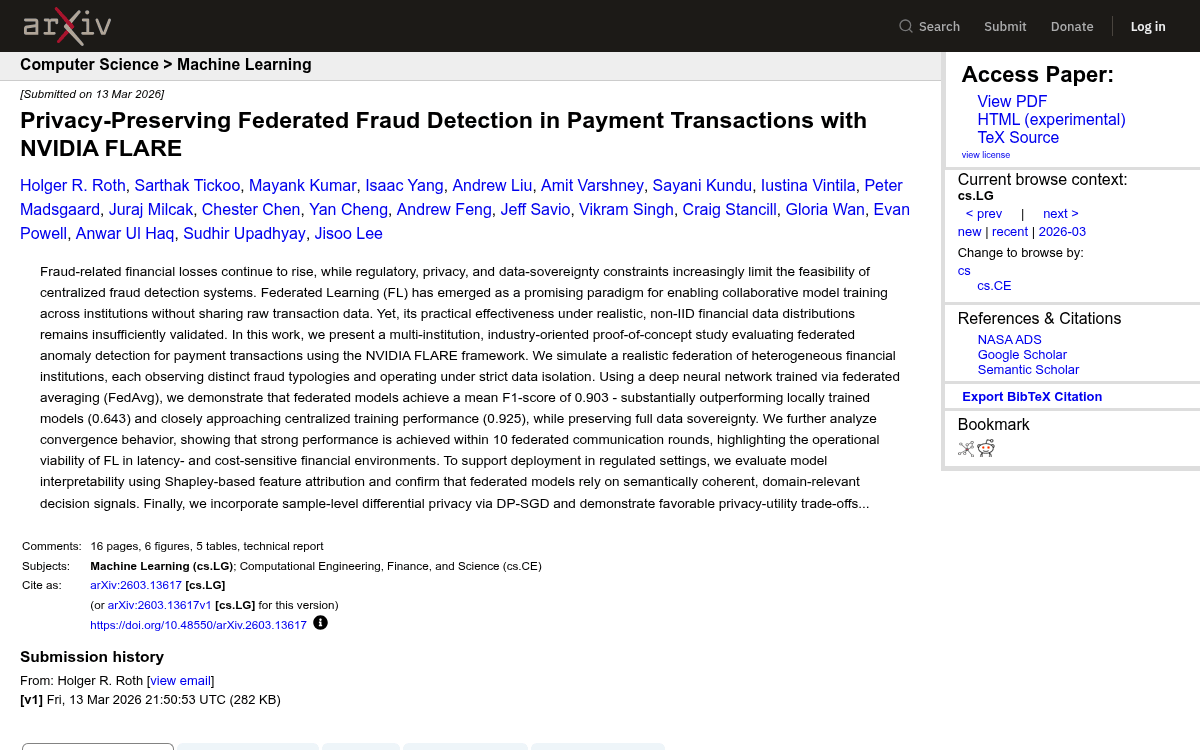
Researchers from NVIDIA, J.P. Morgan, RBC, BNY, and DeepTempo tested federated fraud detection across five simulated banks, closing the gap to centralized training.
 Pro
Takeaways
- Research team from NVIDIA, J.P. Morgan, RBC, BNY, and DeepTempo tests federated fraud detection across five simulated banks.
- FedAvg reaches 0.903 F1 versus 0.925 centralized and 0.643 local-only training, a 40% gain over solo training.
- Models converge in 3-5 federated rounds with marginal gains beyond round 10, limiting communication overhead.
- Cross-domain transfer lets clients hit >0.94 F1 on fraud types absent from their local training data.
- DP-SGD via Opacus drops F1 to 0.879 at ε=10.0 and 0.791 at ε=1.0, showing clean privacy-utility trade-off.
- Code available in NVFlare research examples; study uses synthetic data, real-transaction validation still pending.
A team of researchers from NVIDIA and several major banks has published a proof-of-concept study showing that federated learning can detect payment fraud almost as accurately as pooling every bank's data in one place, without any institution sharing raw transactions. The experiment simulated five financial institutions using NVIDIA FLARE, and the resulting collaborative model landed within 0.022 F1 points of a centralized baseline while dramatically outperforming any bank training alone.
Why centralized fraud models keep hitting a wall
Fraud losses continue to climb, but the standard playbook of pooling transaction data into one big training set is getting harder to execute. Regulatory boundaries, data sovereignty rules, and organizational risk tolerance routinely prevent centralized aggregation, and even permitted transfers are slow and fragile at scale. That fragmentation hurts detection quality, because any single bank only sees a narrow slice of the fraud typologies actually circulating.
Federated learning (FL) offers an alternative: a central server sends an initial model to clients, each client trains locally on its own data, and only the model updates go back to the server for aggregation. The raw data never leaves the institution. The open question this paper set out to answer was whether FL actually works well when banks have very different fraud distributions, not just in theory but under realistic non-IID conditions.

The setup: five simulated banks, four fraud types
Because real transaction data cannot be shared across institutions, the team built a synthetic transaction generator producing 200,000 records per site with distinct fraud rates and amount distributions. Each site was exposed to a different mix of four anomaly families:
- Type 1 - Location mismatch: cell tower coordinates far from the account's expected geography.
- Type 2 - Immature account with anomalous amount: large transactions minutes after account creation.
- Type 3 - Dormant account reactivation: sudden activity after 3-6 months of silence.
- Type 4 - Unusual frequency: transaction volume far above what an account type normally sees.
The classifier is deliberately small: a three-layer fully connected network with 64, 32, and 16 neurons, trained with FocalLoss to counter the roughly 0.5% fraud rate. The authors picked a deep network over gradient-boosted trees for a specific reason: tree ensembles do not have a continuous parameter space that plays nicely with FedAvg-style weight averaging, whereas neural network gradients do.
The numbers
Across 20 federation rounds, FedAvg reached a mean binary F1 of 0.903, compared to 0.925 for a centralized model trained on pooled data and 0.643 for banks training only on their own local data - a 40% jump from local-only. Fancier aggregation algorithms barely moved the needle: FedOpt hit 0.905 and FedProx matched FedAvg at 0.903, suggesting the extra machinery is unnecessary at moderate heterogeneity.
The most operationally interesting result is cross-domain transfer. Sites that never saw a particular fraud type during local training still achieved F1 scores above 0.94 on that unseen type after federation. In other words, the primary value of FL here is not a marginal accuracy bump; it is the ability to catch fraud typologies your own institution has never encountered.

Convergence was also quick. Models stabilized within 3-5 rounds with marginal gains after round 10, which matters because communication rounds are the expensive part of any real FL deployment.
Privacy budget versus fraud caught
The team also layered differentially private SGD on top of FedAvg using Opacus, clipping per-sample gradients and adding calibrated Gaussian noise. The trade-off curve is clean and monotonic:
| Privacy budget | Mean F1 |
|---|---|
| No DP | 0.920 |
| ε = 50.0 | 0.889 |
| ε = 10.0 | 0.879 |
| ε = 1.0 | 0.791 |
At high transaction volumes, even a 0.04 F1 drop translates to a meaningful shift in the balance between fraud caught and false alarms, so the acceptable operating point depends on each institution's risk tolerance. The authors also make a useful distinction: FL's architectural guarantee (raw data never leaves) and DP-SGD's sample-level guarantee address different threat surfaces, and combining both gives a stronger privacy posture than either alone.
What is missing before this ships
The authors are candid about the limitations. The whole study runs on synthetic data with rule-based anomalies, which does not capture adversarial adaptation, concept drift, or ambiguous ground truth. The federation is also five equally sized sites with clean fraud-type partitions, whereas real deployments involve messy overlaps and asymmetric data volumes. And the protocol assumes honest participants - no evaluation of model poisoning or malicious gradient updates.
Interpretability holds up though. Shapley-based feature attribution via Captum's GradientShap confirmed the federated model relies on the same signals a human analyst would expect: geographic features dominate Type 1 detection, while account age and transaction amount drive Type 2. Code for the data generator and the FL pipeline is available in the NVFlare research examples, and the underlying framework itself is open source.