
NVIDIA and Brazilian Universities Drop TAGARELA, a 9,000-Hour Portuguese Speech Dataset
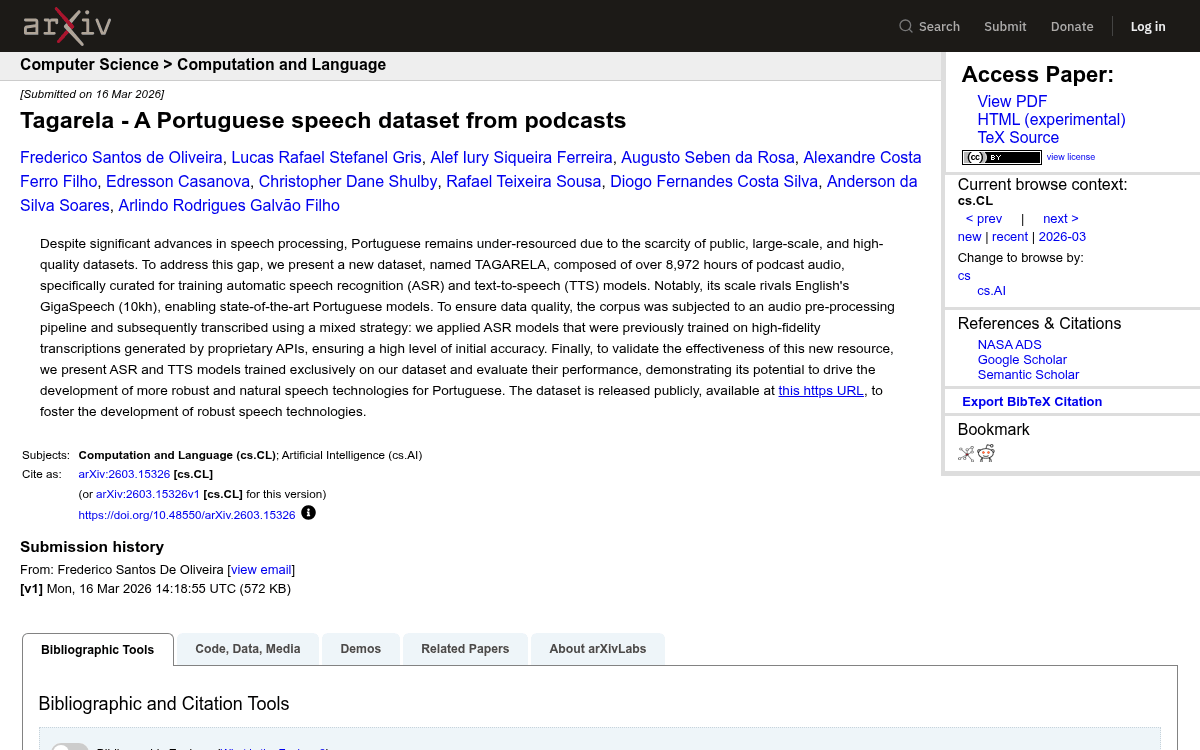
Researchers curated 8,972 hours of Portuguese podcast audio into a clean corpus that finally rivals English datasets for training ASR and TTS models.
 Pro
Takeaways
- TAGARELA releases 8,972 hours of curated Portuguese podcast audio for ASR and TTS training.
- Scale rivals English's GigaSpeech, closing a long-standing resource gap for the language.
- Built from the raw 76k-hour Cem Mil Podcasts corpus using diarization, denoising, and overlap filtering.
- Bootstrap transcription: ElevenLabs Scribe seeded Whisper large-v3, cross-checked against Wav2vec2-XLS-R.
- Fine-tuned Parakeet v2 hit 15.18% WER; Orpheus-TTS reached 9.5% WER with MOS 4.155.
- Includes 2,800-hour clean subset for TTS, dialect labels, and ~13,368 clustered speaker IDs.
Portuguese has hundreds of millions of speakers, but if you have ever tried to train a speech model on it, you know the data situation is bleak compared to English. A team from Brazilian universities, NVIDIA, and Elsa Speak just dropped TAGARELA, a curated podcast corpus that finally puts Portuguese in the same weight class as English resources like GigaSpeech.
The data gap that nobody wanted to fix
High-resource languages like English benefit from extensive corpora such as LibriSpeech (1000 hours), GigaSpeech (10k hours) and Emilia (139k hours). Portuguese, meanwhile, has been stuck with much smaller sets. Landmark initiatives include CORAA (290h), NURC-SP (239h), MuPe (365h), and VoxCeleb-PT (18h), and most of them are spontaneous speech recordings full of disfluencies, background noise, and interruptions, which makes them useless for training text-to-speech systems that need clean audio.
A significant opportunity to bridge this data gap emerged with the release of the "Cem Mil Podcasts" collection, a massive corpus offering over 76,000 hours of diverse, multi-dialect Portuguese audio. However, the dataset was provided as raw, unprocessed audio with automatically generated transcripts of varying quality. Without diarization, denoising, or overlap removal, it was essentially unusable for serious model training. TAGARELA is the cleaned-up, transcribed distillation of that raw pile.
What is actually in the box
The final corpus contains roughly 16,806 episodes from 2,094 shows, totaling over 8,972 hours of audio, including both Brazilian (8,130 hours) and European Portuguese (842 hours) dialects. 70% of the audio is attributed to male speakers and 30% to female speakers, with segments averaging 9.30 seconds and 27.69 words. There are two subsets: the full 8,972-hour set with disfluencies intended for ASR, and a 2,800-hour clean-speech subset carved out for speech generation.

The pipeline that made it usable
The team built a multi-stage processing chain to turn messy podcast audio into training-grade data:
- Standardization: All audio files were converted to FLAC, 16kHz, 16-bit, mono, then segmented into 5 to 20 second clips at natural silences.
- Diarization: Using the pyannote framework, they identified and labeled speech segments per speaker so each final sample contains only one voice, which matters a lot for TTS.
- Overlap detection: A dedicated classifier based on Wav2vec2-XLS-R was trained to flag segments where multiple speakers talk simultaneously, and those clips were discarded.
- Denoising: A Vocos vocoder was repurposed as a denoiser to remove background noise, hiss, and light reverberation.
- Speaker clustering: RedimNet B6 embeddings plus HDBSCAN clustering per podcast produced approximately 13,368 distinct speaker labels.
The bootstrap trick for transcription
Transcribing nearly 9,000 hours with a commercial API would be expensive, so they used a two-stage trick. A 1,000-hour seed corpus was transcribed with ElevenLabs Scribe v1 and used to fine-tune Whisper large-v3, which then generated pseudolabels for the rest of the data. To keep Whisper from hallucinating on the pseudolabels, they also trained a Wav2vec2-XLS-R model on the same seed data and calculated Word and Character Error Rates between both models, keeping only samples with high agreement. Cheap where it can be, expensive only where it must be.
Does it actually train good models?
For ASR, the team fine-tuned several architectures on the full corpus and evaluated them on a manually transcribed test set. The fine-tuned Parakeet v2 achieved a WER of 15.18% and CER of 7.09%, outperforming Wav2Vec Large, Distil-Whisper, and Whisper Large V3, with Whisper Large V3 landing at 20.91% WER as a zero-shot baseline.
For TTS, they trained Orpheus-TTS and Chatterbox on the 2,800-hour clean subset. Orpheus-TTS achieved superior intelligibility with 9.5% WER, while Chatterbox attained slightly higher naturalness at MOS 4.176 despite significant errors, revealing a trade-off between linguistic precision and prosody. Ground truth landed at MOS 4.231 for reference, so both models are close to human-level naturalness on the perceptual score.

Where it fits, and where it does not
TAGARELA is released for research and is available through the project page, along with the trained overlap-detection classifier and a public-dataset version of the denoiser for reproducibility. It is a strong fit if you are building Portuguese ASR for podcast, interview, or long-form conversational audio, or a Portuguese TTS system where you need dialect labels (Brazilian vs European) baked into the metadata.
The caveats are worth flagging. The gender split leans heavily male (70/30), and Brazilian Portuguese dominates European Portuguese by roughly ten to one, so downstream models will inherit that skew. The authors themselves note imperfect text-audio alignment as a known weakness, meaning the corpus is not a drop-in replacement for meticulously aligned datasets like LibriSpeech when frame-level alignment matters. And because transcriptions come from a Whisper-derived pipeline rather than human annotators, some noise in the labels is baked in by design.