
NUS Unifies All Dataset Distillation Methods With UniDD's Spectral Filter View
A new spectral filtering framework unifies fragmented dataset distillation methods and produces a curriculum-based technique that beats existing baselines on ImageNet-1K.
 Pro
Takeaways
- UniDD unifies dataset distillation methods as spectral filters on feature correlation matrices.
- DM and DC act as low-pass filters producing blurry synthetic images with high intra-class similarity.
- MTT and FrePo act as high-pass filters emphasizing textures and diversity but adding noise.
- Curriculum Frequency Matching schedules the filter parameter to cover both frequency ranges.
- CFM hits 82.3% on CIFAR-10 and 66.9% on ImageNet-1K at IPC=100, beating baselines.
- Only linear-kernel methods fit the framework; nonlinear kernels and very-low IPC budgets remain open.
Dataset distillation has quietly become one of the more practical tricks for training large models cheaply: shrink a giant dataset down to a handful of synthetic images per class, then train on the tiny surrogate. The catch is that the field is a patchwork of methods, statistical matching, gradient matching, trajectory matching, kernel ridge regression, each with its own loss function and no clear story about why one works better than another. A new paper from researchers at the National University of Singapore and Shanghai Jiao Tong University argues that all of them are secretly doing the same thing: filtering frequencies.
Their framework, UniDD, reinterprets every major distillation objective as a spectral filter applied to a feature correlation matrix. That reframing exposes what each method is actually optimizing and points to a new algorithm, Curriculum Frequency Matching (CFM), that consistently outperforms prior work across CIFAR-10/100, Tiny-ImageNet, and ImageNet-1K.
The fragmentation problem
Existing distillation methods are usually justified by intuition rather than theory. Statistical matching aligns key statistics, such as mean and variance, between real and synthetic datasets. Gradient matching minimizes the direction of model gradients across real and synthetic data during training. Trajectory matching enforces the synthetic data to emulate the update trajectories of real model parameters. Kernel-based approaches employ a closed-form solution to bypass the inner optimization and improve distillation efficiency. Each camp reports strong numbers on its favored benchmark, but no one had a principled way to say why.
The authors' key move is to look at two matrices built from the features that a pretrained backbone produces on the data:
- The feature-feature correlation (FFC) matrix, which captures how channels co-vary.
- The feature-label correlation (FLC) matrix, which captures how channels align with class labels.
All of the methods analyzed turn out to match the FFC and FLC matrices between real and synthetic datasets. Their difference lies in the filter function applied to the FFC matrix, which changes the eigenvalues of the FFC matrix to extract certain frequency components of the FLC matrix.
Low-pass versus high-pass, in disguise
Once you view methods as filters on the eigenvalues of FFC, a clean split appears. Eigenvectors with large eigenvalues carry low-frequency information (coarse shape, average color), while small eigenvalues carry high-frequency detail (textures, edges).
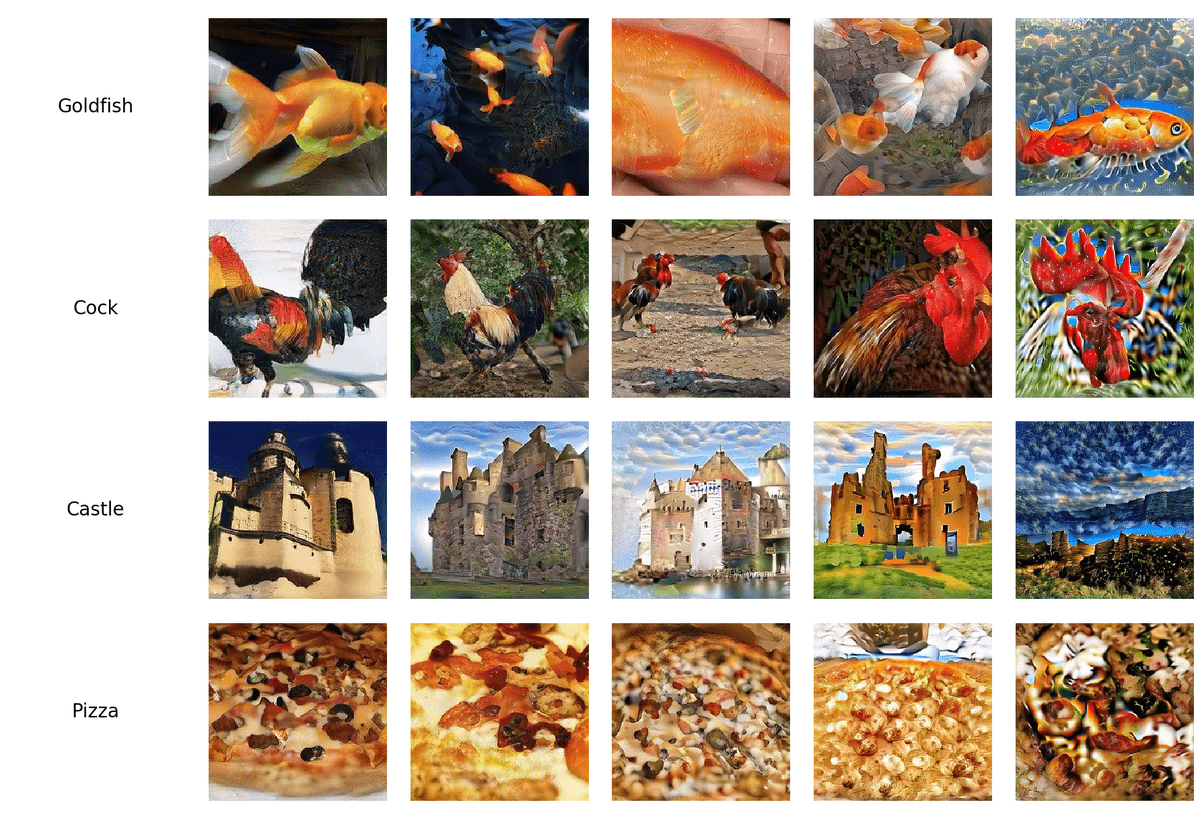
The authors show that low-frequency methods like DM and DC tend to learn coarse-grained colors and blur the synthetic images, while high-frequency methods like MTT and FrePo focus on fine-grained textures and have better diversity. They back this with power spectral density plots of synthesized images and intra-class similarity measurements: the low-pass filter increases intra-class similarity and preserves consistency, while the high-pass filter improves data diversity by reducing intra-class similarity.
The filter view also produces a compact table of equivalences. DM corresponds to f(λ) = 1, DC to f(λ) = {1, λ}, MTT to f(λ) = (1 - αλ)^p, and FrePo to f(λ) = (λ + β)^-1. Same theoretical skeleton, four different filter shapes.
Curriculum Frequency Matching
The theoretical unification exposes a shared weakness: existing methods use fixed filter functions during distillation and can only learn a single frequency component, which limits their adaptability. High-frequency-only synthetic data captures diversity but adds noise; low-frequency-only data is consistent but blurry.
CFM addresses this with a scheduled filter parameter. It uses f(λ) = (λ + β_b)^-1 and varies β_b across batches with a cosine schedule, effectively sweeping from low-frequency matching at the start toward high-frequency matching at the end. The loss combines a filter-matching term, a signal-matching term, and a standard classification loss.
Two implementation details are worth flagging:
- FFC and FLC are computed per convolutional layer using covariance matrices and mean features, avoiding numerical overflow from the naive reshape.
- An exponential moving update caches per-batch FFC statistics so that mini-batch training approximates the full-batch theoretical assumption.
Numbers that matter
On ResNet-18, CFM reaches 82.3% on CIFAR-10 and 71.4% on CIFAR-100 at 50 images per class, both substantial improvements over methods like SRe2L, G-VBSM, and DWA. On ImageNet-1K with ResNet-101 and 100 images per class, it hits 66.9%. Cross-architecture transfer is also strong: distilling with ResNet-18 and evaluating on ResNet-50, DenseNet-121, RegNet-Y-8GF, and ConvNeXt-Tiny, CFM leads all baselines.
Efficiency is competitive rather than exceptional. Per-step time on ImageNet-1K is 0.31 seconds versus 0.26 for SRe2L and 0.35 for G-VBSM, and CFM uses the lowest memory of the three at 21.4 GB, since it operates on convolutional layers rather than batch-norm layers.
Where it helps, where it does not
CFM is useful when you want a small synthetic training set that generalizes across architectures, for example to run rapid neural architecture search, continual learning experiments, or privacy-preserving surrogates without repeatedly loading ImageNet. Ablations show that high-frequency information is more important for DD, but extremely high frequency also leads to performance degradation, so the curriculum is doing real work.
The main limitation shows up at very tight budgets. On ImageNet-1K with only 10 images per class, RDED beats CFM, and the authors suspect that the synthetic data cannot effectively cover the useful frequency features under the limited memory budget. The framework also only unifies linear-kernel KRR variants; nonlinear kernels like Gaussian remain out of scope.
The authors state they will release the code publicly on acceptance, and the full derivations and pseudocode are available in the paper's appendix. The bigger contribution may not be CFM itself but the change of perspective: instead of proposing yet another matching loss, future work can now design filters, which is a much more constrained and interpretable search space.