
NUS's VisceroHaptics Tricks Your Stomach Into Drinking More Water
Researchers piped bowel sounds through a transducer strapped to the belly and made people drink more water, without touching them internally.
 Pro
Takeaways
- VisceroHaptics is the first demonstration that gastric interoception can be modulated noninvasively in humans, via audio-haptic feedback on the belly.
- Three studies with 55 participants used real bowel sound recordings played through transducers strapped to the stomach.
- Single-burst patterns significantly increased water consumption in a Water Load Test versus baseline (p=0.049).
- Continuous random sounds produced the strongest subjective hunger but did not shift actual drinking behavior.
- Reveals a dissociation between what people say they feel and how their gastric behavior actually changes.
- CHI 2026 Honorable Mention, from the Augmented Human Lab at NUS.
A team at the National University of Singapore has shown something odd but useful: strap a sound transducer to someone's stomach, play back real gut noises through it, and you can measurably shift how hungry they feel and how much water they drink. The work, called VisceroHaptics, is a CHI 2026 paper that landed an Honorable Mention, and it offers the first empirical evidence that gastric interoception, the internal sensing of what your stomach is doing, can be nudged from the outside without pills, electrodes, or implants.
Why the gut resists interfaces
Interoception is the brain's read of internal bodily signals: heartbeat, breathing, hunger, fullness. HCI research has spent years faking cardiac and respiratory signals to steer anxiety or focus, but the gut has been almost untouched because it is genuinely hard to reach. Gastric interoception shapes eating behavior and emotion, which makes modulating it useful for healthcare and HCI, yet whether it could be modulated noninvasively in humans was an open question.
Existing approaches go inside the body. Ingestible electroceutical pills stimulate cells in the stomach mucosa to shift ghrelin (the hunger hormone) production, and gastric-electrical stimulation requires an implanted device to treat conditions like severe gastroparesis. Both work. Neither is going into a consumer app any time soon.
Replay the stomach to itself
VisceroHaptics skips the internal pathways entirely and re-injects bowel sounds cutaneously as combined audio and haptic feedback. Bowel sounds naturally propagate through the GI tract and register both as audio and as tactile vibration in mechanoreceptors on the skin and inside the gut wall, so a transducer pressed against the belly can plausibly imitate that sensation.
The apparatus is deliberately simple: an IKEA POANG chair with two SolidDrive SD1 sound transducers, one hidden in the chair back and one strapped to the participant's navel with a sports belt, driven by an amplifier and a Bluetooth receiver.

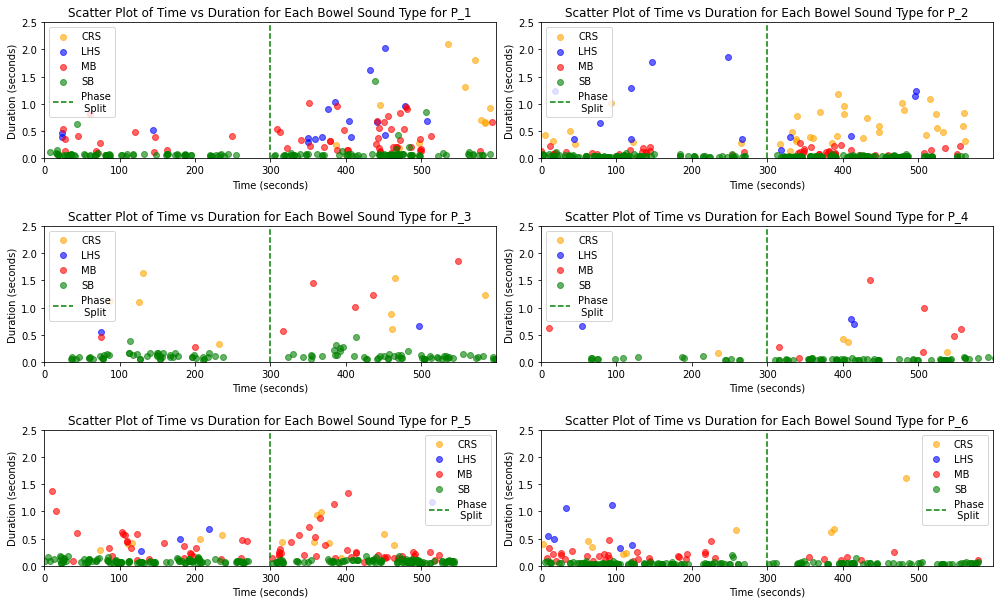
The stimuli come from real recordings. The team taped audio from 7 people during a Water Load Test using an electronic stethoscope on the lower left abdominal quadrant, then labeled the clips into four established categories: Single Burst (SB), Multiple Bursts (MB), Continuous Random Sound (CRS), and Long Harmonic Sound (LHS). After filtering, they kept 3 patterns per category as the stimulus pool.
Three studies, 55 participants
Using those recordings, the researchers ran three studies covering (A) the effects of gut-based audio-haptic feedback on users' feelings, (B) how the patterns influence perceived hunger and satiety, and (C) their effects on drinking behavior.
- Study 1 (N=18, think-aloud): participants reported feelings every minute across 4 stimuli of 5 minutes each. Nine themes emerged; 48.3% of responses were gastric. Hunger dominated (94 codes), followed by fullness (34), stomach upset (25), gassy/burp (12), thirst (4). Longer sounds (LHS, CRS) tended to induce hunger; short bursty patterns (SB, MB) leaned toward fullness or discomfort.
- Study 2 (N=16, rating scale): participants rated hunger/satiety on a -7 to 7 scale every minute. CRS produced the biggest hunger increase (mean change 2.75) and SB the smallest (1.59), a statistically significant gap (p=0.015).
- Study 3 (N=21, within-subjects WLT-II): the behavioral test. Participants completed three sessions on separate days under baseline, SB, and CRS conditions, drinking water through 1m straws from opaque 2L bottles.

The counterintuitive result
In Study 3, SB, the pattern participants had rated as least hunger-inducing in Studies 1 and 2, was the one that significantly increased water intake in the satiation phase (p=0.049) compared to baseline. CRS, the strongest subjective hunger-inducer, did not shift behavior. Participants in the SB condition drank about 295 ml before feeling satiated versus 249 ml at baseline, without reporting different fullness levels afterward.
Interviews suggested why. CRS sounds occurred so frequently that they made participants hyper-aware of their stomach, which triggered caution rather than compliance. Several participants said the vibration pushed them to pay more attention to whether they were actually hungry or full. Subtle, infrequent cues (SB) slipped past that conscious check.
What actually broke ground
The headline is behavioral influence, but the deeper contribution is a working, non-invasive lever on visceral perception. The paper offers the first evidence that audio-haptic stimulation can alter gastric interoceptive behavior, opening the door to noninvasive methods for influencing users' feelings and actions. The authors interpret the effect through predictive coding: because gut sounds are naturally perceived through both auditory and tactile channels, replaying them externally slots cleanly into the brain's existing model of what the stomach is doing, and gets treated as an internal signal.
Where it could go, and where it breaks
The obvious applications live in health and behavioral nudging:
- Appetite support for patients recovering from procedures that suppress hunger
- Weight-management or mindful-eating apps that dial hunger cues up or down
- Intervention research for eating disorders, where impaired gastric interoception is a known factor
- Empathy and affective communication tools, letting one person feel another's visceral state
- Immersive dining, VR, and games that use gut sensations as a new feedback modality
The limits are also clear. The stimulus pool is small (3 per category, drawn from 7 recordings), only 18 people went through Study 1, and the drinking effect faded in the second phase once participants' real satiation signals grew loud enough to drown out the device. As one participant put it, the feedback could trick them into feeling hungry early on, but not once the stomach was actually full. There is no code or model release: this is an empirical HCI paper with an apparatus built from off-the-shelf transducers, a belt, and a chair. The recipe is reproducible from the paper, but there is no repo to clone.