
NUS's ToMPC Lets Robot Arms Dodge Obstacles and Push 10x Faster
A new model predictive control framework lets a Franka Panda arm dodge obstacles and apply force in real time using a redundancy-aware ADMM solver.
 Pro
Takeaways
- NUS researchers propose ToMPC, a unified MPC framework for safe, force-aware robotic manipulation.
- ADMM splits the problem into a DDP task solver and a QP safety solver running in parallel.
- Task-oriented avoidance uses kinematic redundancy so the arm dodges obstacles without dropping the target.
- On a Franka Panda, ADMM runs about 10x faster than FDDP while strictly holding hard distance constraints.
- In a whiteboard-wiping test, position error dropped from 0.030 m to 0.020 m versus baseline avoidance.
- Published in IEEE Robotics and Automation Letters; no public code release.
Robot arms in shared workspaces have to juggle two demands that usually get treated separately: not crashing into anything, and actually doing useful physical work like pressing, wiping, or pushing on the environment. A team from the National University of Singapore has proposed ToMPC, a model predictive control framework that folds collision-free motion and force interaction into a single optimization problem, then uses a distributed solver to keep it running in real time on a Franka Panda.
The work was accepted to IEEE Robotics and Automation Letters. Its core trick is decomposing a hard nonlinear optimization into two cooperating solvers that each do what they are best at.
Why one-solver-fits-all MPC breaks down
Model predictive control is attractive for manipulators because it replans on the fly, but it has a well-known weakness. Pure kinematic MPC handles position and velocity constraints comfortably, yet struggles when the task actually involves contact forces. Prior approaches either bolted on an admittance controller to track a desired wrench, or moved to full dynamics-based formulations that get expensive fast.
A second gap sits alongside that one. Most obstacle-avoidance MPCs treat avoidance as pure safety, and manipulation quality degrades whenever the workspace gets crowded. ToMPC unifies collision-free motion and robot-environment interaction, then introduces task-oriented avoidance that exploits kinematic redundancy to preserve manipulation efficiency in obstructed environments. In plain terms, a 7-joint arm has more degrees of freedom than it needs to place a gripper, so ToMPC uses that slack to twist the elbow away from obstacles while the fingertip keeps hitting its target.
Splitting the problem in two with ADMM
The heart of the paper is how the optimization gets solved. Cramming nonlinear dynamics, contact forces, joint limits, and non-convex distance constraints into one solver is why these problems normally run slowly. ToMPC uses the alternating direction method of multipliers (ADMM), which splits a joint optimization into pieces that get solved independently and reconciled through a shared Lagrange multiplier.
The decomposition assigns the problem to differential dynamic programming (DDP) and quadratic programming (QP), and the split maps cleanly onto the physics:
- DDP subproblem (task execution): handles the nonlinear robot dynamics, motion tracking, and force tracking. DDP is efficient because its backward pass only approximates a linear-quadratic problem over the horizon.
- QP subproblem (safety guarantee): enforces joint limits, torque limits, and the linearized obstacle-distance inequality as hard constraints. This one is convex and splits across time steps in parallel.
- Dual update: Lagrange multipliers keep the two subproblems consistent, iteratively squeezing out any disagreement.

A neat consequence is that safety constraints are strict rather than soft. Standard DDP variants can only encode obstacle avoidance as a quadratic barrier in the cost, which means the arm can still clip into something if the task cost pulls hard enough.
Task-oriented avoidance, explained
The second contribution is the avoidance strategy itself. Around every obstacle, ToMPC defines two thresholds: an inner uninvadable region enforced by a hard constraint, and an outer repulsive zone where a virtual velocity nudges nearby links away. Critically, that repulsive velocity is projected into the null space of the task Jacobian, meaning it moves the arm's redundant joints without disturbing the end-effector goal.
A goal-relaxation factor also fades in as the arm approaches an obstacle, briefly de-prioritizing exact target tracking so the robot can pick a better body configuration before returning to full task focus.
Numbers from the Franka Panda
The team validated ToMPC across four scenarios on a Franka Emika Panda, with the algorithm implemented in C++17 running on an Intel Core i9-9900K at a 1 kHz control frequency, using the Pinocchio library for dynamics.
Compared to a standard FDDP solver with quadratic barriers, ADMM was both faster and safer:
| Method | Horizon T | Min distance (m) | Avg time (s) |
|---|---|---|---|
| FDDP (barrier, weight 10) | 10 | 0.0151 | 0.0108 |
| ADMM (ToMPC) | 10 | 0.0229 | 0.0009 |
| ADMM (ToMPC) | 30 | 0.0205 | 0.0025 |
| ADMM (ToMPC) | 50 | 0.0205 | 0.0043 |
All FDDP runs violated the 0.02 m safety threshold; ADMM never did. Roughly a 10x speedup at equal horizon comes from moving the inequality constraints out of DDP and into a specialized QP solver, plus the linear approximation of the distance function.
In the whiteboard-wiping scenario, where the arm has to trace a circle while pressing 8 N against the board and dodging a ball obstacle, ToMPC cut position error from 0.030 m (mean) down to 0.020 m compared to a plain obstacle-avoiding MPC baseline. Force tracking error grew slightly (2.03 N vs 1.05 N mean), which the authors call an acceptable trade-off given the increased reach.
Where this fits, and where it doesn't
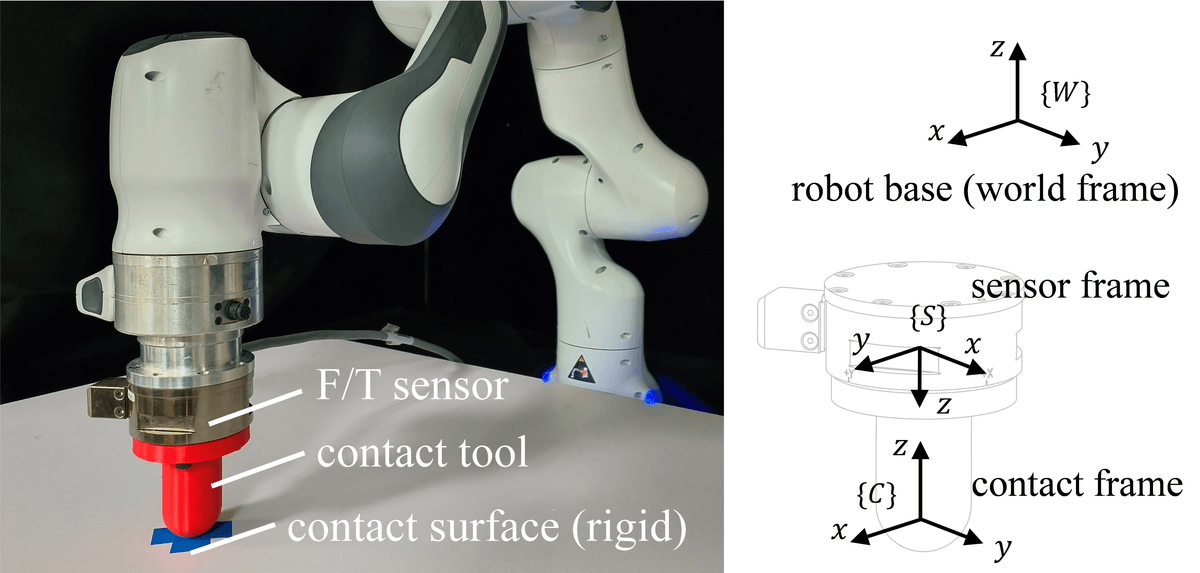
ToMPC targets a specific slice of manipulation problems: torque-controlled arms with kinematic redundancy that need to combine contact tasks with obstacle avoidance. Wiping, polishing, assembly against fixtures, and any bimanual or human-adjacent task where the arm has to press on something while avoiding a person or clutter all fit the mold. Because contact force is planned from full-body dynamics rather than measured, no F/T sensor is required in the control loop.
Limitations the authors acknowledge:
- Performance is sensitive to the quality of the initial trajectory guess, a known ADMM weakness for non-convex problems.
- Cost weights still need hand-tuning per scenario.
- Obstacle geometry is approximated as primitive collision bodies with linearized distances, which may struggle with intricate shapes or fast-moving obstacles beyond the tested cases.
- No code release is mentioned in the paper.
The authors point to learning-based initial-guess generation and automatic weight tuning as their next targets. For anyone working on manipulation stacks that currently juggle a motion planner and a separate impedance controller, the appeal of ToMPC lies in the demonstration that a properly decomposed ADMM formulation can carry standard components together at kilohertz rates on real hardware.