
NUS's TennisExpert 8B Beats GPT-5 and Gemini 3 Pro at Expert Rally Analysis
An 8B tennis-tuned model built on Qwen3-VL beats GPT-5, Gemini 3 Pro, and Claude at expert-level rally commentary, running under two seconds.
 Pro
Takeaways
- TennisExpert beats GPT-5, Gemini 3 Pro, and Claude 4.5 Sonnet on tennis commentary using just 8B parameters.
- TennisVL dataset: 202 Grand Slam matches, 471.9 hours, 40,523 rally clips with expert analytical captions.
- Architecture combines a real-time video semantic parser with FIFO short-term and symbolic long-term memory.
- LLM-judge score of 88.05 versus 59.89 for Gemini 3 Pro; CIDEr more than 4x higher than any baseline.
- Runs under 2 seconds per rally on roughly 20 GB VRAM, making live broadcast use feasible.
- Code and dataset annotations are open source; raw videos referenced by YouTube URL.
Tennis broadcasts are strange beasts for a video model. Balls fly past at 200 km/h, rallies last a few seconds, and the commentary that matters happens in the pause afterward, when analysts explain why a player picked a cross-court backhand instead of going down the line. A team from the National University of Singapore, Nanyang Technological University, and Griffith University just released a dataset and a small model that tackle exactly this analytical layer, and their 8B system outscores every frontier proprietary model they tested.
The project comes in two parts: TennisVL, a benchmark of expert-level rally commentary, and TennisExpert, a framework that combines a lightweight vision pipeline with a memory-augmented Qwen3-VL-8B backbone. Both are open source.
Why sparse frames and dense pixels both fail
Tennis analysis requires fine-grained temporal perception to capture fast-moving balls and rapid shot exchanges, and long-range contextual reasoning over match dynamics that can span hours. That combination is brutal for standard multimodal LLMs. Sparse frame sampling misses the actual shots. Dense sampling blows through context windows and GPU memory. And on top of that, tennis commentary is delivered after each rally during brief intervals between points, requiring higher-level analysis beyond surface-level narration, not the running play-by-play typical of soccer datasets.
Existing tennis datasets weren't much help either. Most contain short clips from a small number of matches and provide only coarse annotations such as shot types or scores. They lack diverse match scenarios, fine-grained temporal annotations, and expert-level narration. The largest prior tennis captioning set had a few hundred clips.
Inside TennisVL
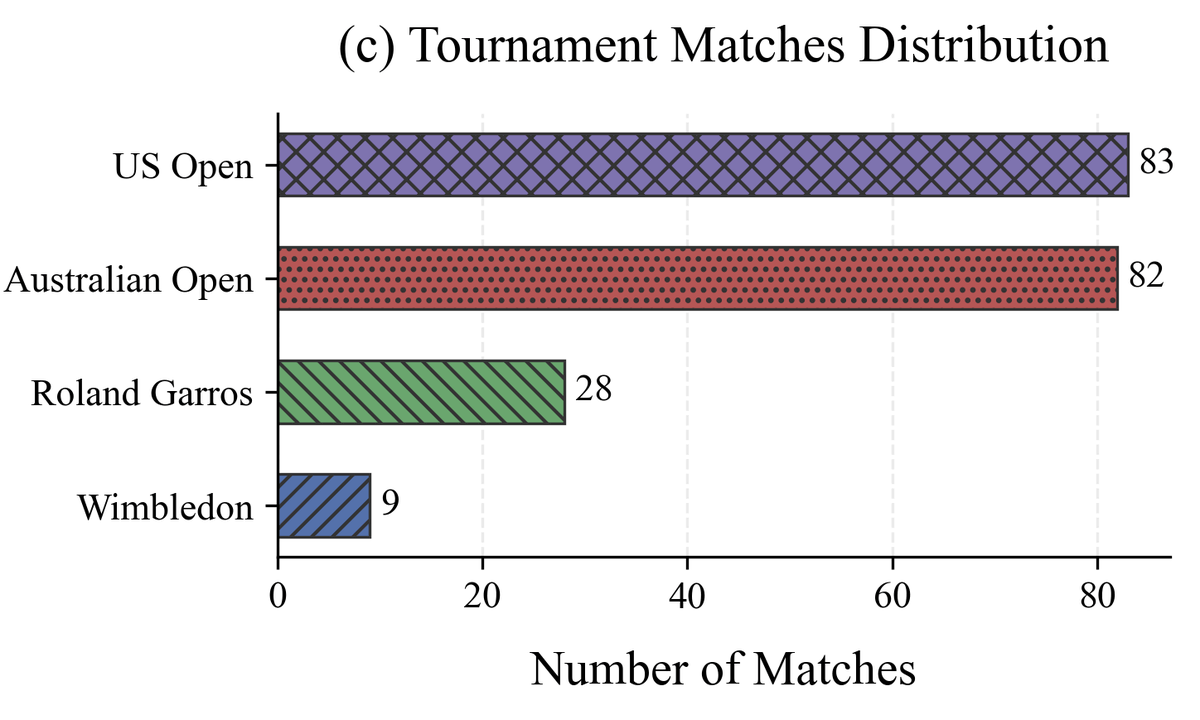
The team assembled 202 publicly available singles matches at 1280x720 and 25 to 30 FPS from YouTube, spanning 2019 to 2025 across all four Grand Slams, both ATP and WTA, and right- and left-handed players. The full dataset covers 471.9 hours of video segmented into 40,523 rally-level clips with an average duration of 7.68 seconds, associated commentaries averaging 31.42 words, 94 unique players, and 162,503 total shots.

Rally segmentation is done automatically. A lightweight audio neural network detects the distinctive acoustic signatures of racquet-ball impacts. Temporally localized, high-confidence impact events are clustered to segment full matches into candidate rally clips, then filtered to keep only standard top-down broadcast views with visible scoreboards.
For the commentary itself, raw broadcast audio was too noisy to use as ground truth. Instead, the pipeline transcribes audio with WhisperX, pulls structured shot-by-shot descriptions from TennisAbstract, and asks Gemini 3 Pro to synthesize everything into refined analytical commentary. A two-stage verification protocol enforces factual alignment (player names, scores, shot types must match reference metadata) and includes human expert review of 2,000 pairs, where the human acceptance rate exceeded 95%.
The architecture: parse, remember, comment
TennisExpert has three parts working together, and the key move is that the MLLM never sees a long raw video.

The video semantic parser extracts a compact structured metadata object for each rally, containing:
- Scoreboard state: set, game, and point scores plus server, extracted by a prompt-guided MLLM using tournament-specific templates (Wimbledon, for instance, drops the points column between games).
- Event sequence: shot types, techniques, directions, outcomes, and ball bounces with timestamps, produced by an end-to-end temporal event detector that hits an Edit Score of 81.2.
- Object tracks: player and ball positions from a tennis-fine-tuned RF-DETR, projected into real-world court coordinates via homography from 14 court keypoints.
On top of that sits a hierarchical memory. Short-term memory is a FIFO queue storing the semantic and visual states of the most recent K rallies (K=4 in the paper), capturing immediate match momentum like a player winning three consecutive points. Long-term memory is different: instead of storing raw clips, it maintains a symbolic per-player state that gets updated as rallies exit the FIFO queue, tracking broadcast metrics including service statistics like aces, double faults, and first-serve percentage, return statistics, and overall point statistics like winners and unforced errors.
The Qwen3-VL-8B backbone then receives the current rally video, the structured metadata, and the memory context as a unified prompt. Fine-tuning updates the language model while freezing the vision encoder and multimodal projector, running 3 epochs at a learning rate of 1e-5 with cosine scheduling on 4 NVIDIA H200 GPUs under BF16 precision.
Results: 88 versus 60
The evaluation combines classic captioning metrics (BLEU-4, METEOR, ROUGE-L, CIDEr) with an LLM-judge score across five 20-point axes: Accuracy, Coherence, Excitement, Professionalism, and Pacing. On the total 100-point LLM score:
| Model | CIDEr | LLM Total |
|---|---|---|
| InternVL3.5-8B | 0.08 | 19.02 |
| Qwen3-VL-8B (base) | 3.89 | 37.68 |
| Claude-4.5-Sonnet | 2.09 | 50.75 |
| GPT-5.2 | 7.52 | 56.59 |
| Gemini-3-Pro | 10.11 | 59.89 |
| TennisExpert (8B) | 43.71 | 88.05 |
The CIDEr gap is the interesting one. TennisExpert scores four times higher than Gemini 3 Pro on a metric that specifically penalizes generic phrasing and rewards content overlap with expert references. Ablations show why: adding structured metadata alone lifts the base fine-tuned model from a 42.7 total to 73.7, short-term memory pushes it to 86.0, and long-term memory nudges it to 88.1 with gains concentrated in Professionalism and Coherence.
Real-time deployment
The efficiency numbers make this practically deployable. The video semantic parser runs in real time on a single GPU at up to 40 FPS, exceeding standard broadcast rates. Because the MLLM consumes structured tokens instead of raw video history, context stays constant around 14k tokens regardless of match length, requiring roughly 20 GB VRAM and achieving under 2 second latency. A baseline feeding raw video up to time t simply runs out of memory.
What it is and is not good for
The system is narrow. It is trained on singles Grand Slam broadcasts with fixed top-down camera views and visible scoreboards, and it depends on tournament-specific scoreboard prompts for the four Slams. Doubles matches, mid-tour events with different broadcast conventions, or amateur footage without a scoreboard will break parts of the pipeline. It is also a commentary generator, not a rules engine or a coaching agent, though the paper points out that the annotated shot sequences and score states are directly usable ground truth for automated coaching and action prediction work.
Where it is genuinely useful is broadcast augmentation, second-screen analysis, and any project that needs cheap access to structured rally-level tennis data at scale. The code and dataset annotations are released on GitHub, with the raw videos available as YouTube URLs to respect broadcaster copyright. If you were about to burn weeks pointing GPT-5 at tennis clips and wondering why it kept hallucinating scorelines, this paper is worth reading before you start.